While Schindlers Are Threatened With Contempt of Court,
Michael Schiavo's Lawyer Gets Set To Clean Up Financially
On the eve of the Supreme Court arguments over Terri's Law, Deborah Bushnell, one of Michael Schiavo's attorneys, sent Pat Anderson, attorney for the Schindlers, two letters in as many days, threatening legal action against Bob and Mary Schindler if videos of Terri are not removed from the family’s web site.
Citing a July 2002 court order, attorney Bushnell, states that videos of Terri may not be disseminated by her family and promises that she will pursue a contempt of court action against the family if videos are not immediately removed.
It is important to note that these videos of Terri were never sealed by the court and, therefore, are public record.
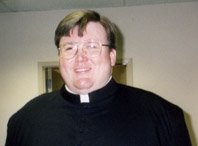
In the meantime, Attorney George Felos has been picked upo as a speaker by Eagles Talent Connection, Inc., a Speakers and Entertainers Bureau in New Jersey. In their online booking site, Eagles Talent offers the speaking services of Mr. Felos for fees ranging from $10,000 to $15,000. Felos joins the Eagles Talent roster with such celebrities as Catherine Crier and Star Jones. Among the topics listed as presented material, Mr. Felos includes “The Terri Schiavo Saga – From Family Fight to Constitutional Crisis”.
I guess it's not enough that Felos has collected more than $500,000 in legal fees from Terri's malpractice settlement fund. Those funds, by the way, were awarded to Terri as a means to provide health care and rehabilitation services. Instead, Michael Schiavo, with the ongoing connivance of Judge Greer, used this money to pay Felos’s legal fees in the ongoing case to end her life.
Tuesday, August 31, 2004

Day Nine Of The Novena For Terri
Holy Mary, Mother of God, and our Mother, hear our prayers on behalf of Terri Schiavo, and all whose lives are in danger from the Culture of Death. By your gracious intercession, may the Florida Supreme Court be guided by the Spirit of Justice, Counsel, and Fear of the Lord. May the people of Pinellas and Pasco Counties choose judges who will respect life, and use their power for the vindication of the innocent. Amen.
Monday, August 30, 2004
C-SPAN To Broadcast Terri's Law Oral Arguments
According to the C-SPAN website, C-SPAN 2 will broadcast the Oral Arguments in the "Terri's Law" case LIVE, tomorrow morning at 9:00 AM EDT.
Attorney George Felos will represent Michael Schiavo in arguing that Terri's Law is unconstitutional. Ken Connor will represent Florida Governor Jeb Bush, arguing that Terri's Law provides necessary protection for the disabled who are unable to speak for themselves, and that crucial issues and facts were never heard in the original court case which ruled, among other things, that Terri is in a Persistent Vegetative State. He will also argue that Circuit Judge Douglas Baird should not have ruled against Terri's Law without a trial.
I'll be tuning in and praying. I hope you do too.
In Spite Of His Advantage, Judge Greer Can Be Defeated
As I mentioned last week, Judge Greer has the advantage over challenger Jan Govan in organization and money. But good voter turnout in this election is almost certain to help Govan far more than Greer.
A reader writes to tell me:
Judge Greer has never been opposed in an election before. While the media and a portion of the legal community are behind him, by no means could he be called a popular jurist. There is no groundswell of "pro-Greer" sentiment out there. And, as a recent article on LifeNews.com reports, " pro-life advocates and disability rights activists...have rallied around Terri and are supporting Govan. They've distributed thousands of brochures and fliers on his behalf."
The bottom line is this: judicial elections traditionally have pretty low voter turnout. So mobilizing pro-lifers to get to the polls tomorrow can put Govan over the top. If you live in Pinellas or Pasco County, get out to vote tomorrow! If you know someone who does, get them out to vote! And if you don't, then pray that tomorrow is a day of victory for Govan, and the cause of the dignity of human life.
As I mentioned last week, Judge Greer has the advantage over challenger Jan Govan in organization and money. But good voter turnout in this election is almost certain to help Govan far more than Greer.
A reader writes to tell me:
The election on the 31st is a primary. Florida judicial elections are non-partisan. If no one wins a clear majority in the primary, then the general election in November is essentially a run-off. If someone gets a clear majority in the primary, then they're automatically elected.
Judge Greer has never been opposed in an election before. While the media and a portion of the legal community are behind him, by no means could he be called a popular jurist. There is no groundswell of "pro-Greer" sentiment out there. And, as a recent article on LifeNews.com reports, " pro-life advocates and disability rights activists...have rallied around Terri and are supporting Govan. They've distributed thousands of brochures and fliers on his behalf."
The bottom line is this: judicial elections traditionally have pretty low voter turnout. So mobilizing pro-lifers to get to the polls tomorrow can put Govan over the top. If you live in Pinellas or Pasco County, get out to vote tomorrow! If you know someone who does, get them out to vote! And if you don't, then pray that tomorrow is a day of victory for Govan, and the cause of the dignity of human life.
Day Eight Of the Novena For Terri
Tomorrow, of course, is the decisive day. The Terri's Law case will be heard by the Florida Supreme Court. Judge Greer's fate will rest in the hands of Pinellas County's voters. Let us pray for the triumph of Mercy and Justice!
Tomorrow, of course, is the decisive day. The Terri's Law case will be heard by the Florida Supreme Court. Judge Greer's fate will rest in the hands of Pinellas County's voters. Let us pray for the triumph of Mercy and Justice!
Holy Mary, we beg you intercede for Terri Schiavo, and all those whose lives are in danger due either to their disability or the fact that their lives are considered meaningless or burdensome. By your prayers, and those of all the faithful united with you, may the Florida Supreme Court see the justice of Terri's Law, and see it as the protection of the weak and innocent it truly is. May Judge Greer be defeated in tomorrow's election, and the courts again become a place where the voiceless and defenseless can be vindicated. Amen.
Friday, August 27, 2004
Day Five Of The Novena For Terri Schiavo
Let us pray today for Terri and her family:
I probably won't be able to post again 'til Sunday or Monday. But keep praying!
Let us pray today for Terri and her family:
Holy Mary, you are the refuge and comfort of all who seek relief in distress and solace in the midst of hardship. We beg your intercession for Terri Schiavo. Make your loving presence known to her. May she also gain strength from the support of the many people praying for her. Look with favor on Terri's parents, and her whole family, who have steadfastly fought to save her life. Help them to persevere in hope, and to trust in the Mercy and Providence of God. Amen.
I probably won't be able to post again 'til Sunday or Monday. But keep praying!
Thursday, August 26, 2004
Partial-Birth Abortion Ban Found Unconstitutional
In a decision which really surprised no one, a New York District Federal Judge handed down a ruling declaring unconstitutional the ban on Partial-Birth Abortion, which President Bush signed into law last year.
In his opinion, Judge Richard Casey stated that the Supreme Court has made it clear that a law that prohibits the performance of a particular abortion procedure must include an exception to preserve a woman's life and health.
However, the law already has language in it granting an exception for the life of the mother:
Judge Casey's ruling is pure legal legerdemain. Firstly, this grisly procedure, which involves delivering the unborn child into the birth canal, thrusting a scissors into its skull, using a suction cannula to suck out its brain, and then crushing its skull, has been repeatedly declared, by the American Medical Association and other medical bodies, to be completely unneccesary, whether to save the mother or for any other reason whatsoever. So providing a "life exception" for the mother in this instance is utterly superfluous.
But the real reasoning for this ruling is contained in the phrase "women's health". The pro-abortion forces have always sought and used a definition of "women's health" that is so broad that practically anything can be used to justify abortion. Particularly slippery are the justifications based on a woman's emotional or mental health. Under this specious reasoning, many of the common inconveniences and burdens of pregnancy can be used to justify abortion. For example, the hormonally-induced depression that many women experience at different points of a pregnancy has been used to justify abortion based on the negative impact it will have on a woman's "emotional health".
The lack of a health exception deprives the pro-abortion movement an end run which would reduce the law to meaninglessness. They cannot allow any abortion, no matter how gratuitous or barbarically accomplished, to be challenged, because that would expose the lies, distortions, and base motives which undergird the abortion license.
Ultimately, this case is about two things: judges preserving their power to legislate from the bench, and their power over life and death. And they will, if necessary, defend those powers at the expense of innocent lives.
This case is also about defending the sexual license which has become the defining and core value of our society. We will have sex with who we want, when we want, and however we want. And we will pretend not to notice, and shout down any who point out, that the bed of our lusts is built on the mangled and disfigured bodies of innocent children.
Thanks to Amy Welborn for the link.
In a decision which really surprised no one, a New York District Federal Judge handed down a ruling declaring unconstitutional the ban on Partial-Birth Abortion, which President Bush signed into law last year.
In his opinion, Judge Richard Casey stated that the Supreme Court has made it clear that a law that prohibits the performance of a particular abortion procedure must include an exception to preserve a woman's life and health.
However, the law already has language in it granting an exception for the life of the mother:
According to the text of the law, the form of abortion is not banned if it is "necessary to save the life of a mother whose life is endangered by a physical disorder, physical illness, or physical injury, including a life-endangering physical condition caused by or arising from the pregnancy itself."
Judge Casey's ruling is pure legal legerdemain. Firstly, this grisly procedure, which involves delivering the unborn child into the birth canal, thrusting a scissors into its skull, using a suction cannula to suck out its brain, and then crushing its skull, has been repeatedly declared, by the American Medical Association and other medical bodies, to be completely unneccesary, whether to save the mother or for any other reason whatsoever. So providing a "life exception" for the mother in this instance is utterly superfluous.
But the real reasoning for this ruling is contained in the phrase "women's health". The pro-abortion forces have always sought and used a definition of "women's health" that is so broad that practically anything can be used to justify abortion. Particularly slippery are the justifications based on a woman's emotional or mental health. Under this specious reasoning, many of the common inconveniences and burdens of pregnancy can be used to justify abortion. For example, the hormonally-induced depression that many women experience at different points of a pregnancy has been used to justify abortion based on the negative impact it will have on a woman's "emotional health".
The lack of a health exception deprives the pro-abortion movement an end run which would reduce the law to meaninglessness. They cannot allow any abortion, no matter how gratuitous or barbarically accomplished, to be challenged, because that would expose the lies, distortions, and base motives which undergird the abortion license.
Ultimately, this case is about two things: judges preserving their power to legislate from the bench, and their power over life and death. And they will, if necessary, defend those powers at the expense of innocent lives.
This case is also about defending the sexual license which has become the defining and core value of our society. We will have sex with who we want, when we want, and however we want. And we will pretend not to notice, and shout down any who point out, that the bed of our lusts is built on the mangled and disfigured bodies of innocent children.
Thanks to Amy Welborn for the link.
Day Four Of The Novena for Terri
Please join with me in praying for our nation, that we may always recognize the dignity of life in everyone, even those who seem "useless":
Please join with me in praying for our nation, that we may always recognize the dignity of life in everyone, even those who seem "useless":
Holy Mary, Patroness of America, we beg you to intercede for our country. So many of our citizens have been misled by those who would judge which lives are no longer "worth" living. Lead our country back to a reverence for life. Help us to see that death is never a solution to problems, and that true compassion lies in protecting and cherishing life. Amen.
Wednesday, August 25, 2004
A Couple of Blugs
Firstly, I am overdue in acknowledging the dedication and yeoman work of Earl E. Appleby, contributor to the Catholic Kerry Watch blog, and author of Times Against Humanity. Earl is seemingly inexhaustible in his efforts on behalf of the innocent and defenseless, whether they be unborn, disabled, or in the final stages of life. Earl is also the motive force behind CURE, Citizens United Resisting Euthanasia, which also maintains a blog, Life Matters.
Earl is a passionate advocate for Catholic teaching on the dignity and inviolability of human life. He should be on your list of regular blogs. He is on mine.
I also want to direct your attention to Oswald Sobrino's always excellent blog, Catholic Analysis, and in particular this post, Pharaoh's Egypt or a New Israel?. He reflects on the thought of Jewish philosopher Leon Kass, in his book The Beginning of Wisdom [Free Press, 2003], and an article, "L'Chaim and Its Limits: Why Not Immortality?" from the May 2001 issue of First Things. In it he expands on Kass's parallel between modern American culture and that of ancient Egypt:
Like the Egyptian Pharaohs of old, we seek to extend our pleasures and extend our lives, even if we do so at the cost of thousands or millions of innocent lives. And like the Pharaohs, our efforts will ultimately be futile. Their tombs are empty and dead, covered in desert sands.
What will cover the evidence of our self-indulgence and folly?
Firstly, I am overdue in acknowledging the dedication and yeoman work of Earl E. Appleby, contributor to the Catholic Kerry Watch blog, and author of Times Against Humanity. Earl is seemingly inexhaustible in his efforts on behalf of the innocent and defenseless, whether they be unborn, disabled, or in the final stages of life. Earl is also the motive force behind CURE, Citizens United Resisting Euthanasia, which also maintains a blog, Life Matters.
Earl is a passionate advocate for Catholic teaching on the dignity and inviolability of human life. He should be on your list of regular blogs. He is on mine.
I also want to direct your attention to Oswald Sobrino's always excellent blog, Catholic Analysis, and in particular this post, Pharaoh's Egypt or a New Israel?. He reflects on the thought of Jewish philosopher Leon Kass, in his book The Beginning of Wisdom [Free Press, 2003], and an article, "L'Chaim and Its Limits: Why Not Immortality?" from the May 2001 issue of First Things. In it he expands on Kass's parallel between modern American culture and that of ancient Egypt:
...We are certainly obsessed with avoiding any dangers. We allow the unborn to be killed at will, but mount severe campaigns against smoking. We are willing to create and kill human embryos--human life-- at will in the hope of defeating the natural process of human aging marked by chronic health problems and disease. People who have no problem with casual and promiscuous sexual intimacy assiduously shop at organic food stores. (So do very chaste and honorable people!)
Behind all of this concern with preserving our own lives lies the desire to freeze time...
Like the Egyptian Pharaohs of old, we seek to extend our pleasures and extend our lives, even if we do so at the cost of thousands or millions of innocent lives. And like the Pharaohs, our efforts will ultimately be futile. Their tombs are empty and dead, covered in desert sands.
What will cover the evidence of our self-indulgence and folly?
Day 3 of the Novena For Terri Schiavo
Sorry I didn't get to post anything yesterday. I hope all of you were able to offer a prayer for Terri, and all those whose lives are in danger because they are considered burdensome.
Please join me in a prayer for Terri, that the forces arrayed to end her life might be thwarted, and her human dignity recognized and respected.
Holy Mary, protectress of all the weak and defenseless, we beg your gracious intercession for Terri Schiavo, and all those, sick and disabled, who are neglected or pushed aside. By your prayers, may God reach the hearts of the judges, attorneys, and Terri's husband, that they may embrace true mercy and compassion for Terri and all like her. Amen.
Monday, August 23, 2004
What We Can Do For Terri
As I explain below, August 31st is going to be a momentous day in the fight to save Terri Schiavo's life, for two reasons:
Firstly, the Florida State Supreme Court will hear oral arguments on the constitutionality of Terri's Law.
Secondly, Judge George Greer, the "unjust judge" who has, seemingly, worked less hard to bring about Terri's death than only George Felos himself, is up for re-election that day. Thank God, he is being opposed by attorney Jan Govan.
As it happens, from today until August 31 is 9 days. Thus, we have a perfect spiritual opportunity.
I urge all of you to commit yourselves to making a Novena to Our Lady, Health of the Sick, as patroness of Terri and all those who are afflicted with disease or debility, and suffer the further indignity of neglect or maltreatment. The Feast of Our Lady, Health of the Sick, falls on the Saturday before the last Sunday in August. Thus it will fall this coming Saturday, August 28.
I would suggest the following intentions:
That the Florida Supreme Court would rule in favor of protecting the weak, innocent, and disabled from those who seek to end their lives.
That Jan Govan would prevail over Judge Greer in the upcoming election.
That Terri herself would be granted some degree of healing and recovery, and that she know of the love and support of all those praying for her.
That Judge Greer, George Felos, and Michael Schiavo would have their hearts softened, and that they embrace true mercy and compassion for Terri and all like her.
That our nation would turn from its infatuation with death as a solution to human problems.
Of course, if you have suitable additional intentions to add, please do so.
You might offer up a rosary every day for this novena, or even just a Hail Mary each day. You might attend daily Mass and offer your communion for these intentions. The important thing is to pray, pray, pray!
I will offer a Novena of Masses for these intentions starting today till the 31st, and a rosary daily.
Please join me in this spiritual offering. In Christ we can do all things and achieve all things!
Terri Schiavo's Case Nears Critical Point
As many of you will recall, the Florida Supreme Court will be hearing oral arguments on the case of Terri's Law on August 31. Terri's husband Michael Schiavo, through his attorney George Felos, has challenged the constitutionality of the law, passed by the Florida legislature and signed into law by Governor Jeb Bush last October.
The nominal grounds for Felos' challenge is that it violates the separation of powers between the executive, legislative and judicial branches, by granting the governor the authority to usurp what is normally considered the prerogative of the courts. I've written at some length about the legal issues here and here. But what is really at stake, as I have also argued before, is the god-like power of judges, such as Pinellas County Judge Greer and Appellate Court Judge Baird, to decide who may live and who may die.
Michael has failed to comply with a 1996 court order compelling him to disclose changes in Terri’s medical condition to her parents and to notify the staff that they may do just that. On a visit to Terri on July 30, the Schindlers noticed a wrist band on Terri from a local hospital and inquired as to when and why their daughter had been hospitalized. The staff refused to provide the information. A phone call was placed to Michael to ask permission to disclose details to Terri’s parents. He denied permission. Michael's defiance to this court order is ongoing. So far, he continues to deny the Schindlers information about their daughter’s medical condition.
The Schindlers are still contesting Michael's guardianship of Terri. Michael has demonstrably failed to meet the standard for guardians specified under Florida law, and so the Schindlers filed their petition challenging Michael's guardianship on November 15, 2002. But Judge Greer has yet to rule on it. As I reported in March, Michael has so allowed Terri's care to deteriorate that she had developed bedsores, and had five teeth decay to such an extent that they had to be extracted. Also, Michael failed to submit the annual care plans for Terri required under Florida statute for the years 2001, 2002, and 2003. Failure to file the care plans is a clear breach of Florida law, and should be sufficient cause to remove Michael as guardian. Michael's failure to comply with the law, and the growing evidence of Terri's neglect, led the Schindlers to file a "Writ of Quo Warranto", demanding that Michael show cause why he should not be removed as guardian. Judge Greer dismissed the Writ, stating that the Schindlers had ample legal remedy in their 2002 Petition (which he has not ruled on), and that "extraordinary relief will not be granted in cases where the granting of it will result in confusion and disorder." In a further display of judicial toadyism, Judge Greer actually allowed Michael to "back file" the aforementioned care plans for 2001, 2002, and 2003, while the Writ of Quo Warranto (not to mention the original 2002 Petition) was before him for consideration. We could all wish that the courts, and other government agencies, were so accommodating to the rest of us when we fail to comply with legal mandates in a timely fashion.
In a related note, on August 2nd Michael Schiavo failed to show up for a scheduled Deposition in the 2002 Guardianship matter. This is not the first time that Michael has resorted to "no show" tactics in order to delay progress in Terri's case. Judge Greer himself ordered that both Michael and Jodi Centonze, his live-in girlfriend and mother of his two children, be deposed. But Judge Greer has in no way sanctioned Schiavo or his attorney, George Felos, for failing to comply with his own order. A new date for the deposition is scheduled for today, August 23rd. We'll see if Michael can be troubled to show up for this one.
It seems that Judge Greer and Michael are engaging in similar stalling tactics. Why? Well, the obvious answer is that the Supreme Court arguments are looming on the horizon. Most legal experts expect the Court to uphold the ruling that Terri's Law is unconstitutional. Furthermore, the Schindlers' legal team expects that, if the Supreme Court rules as expected, it will do so relatively quickly. Michael, George Felos, and Judge Greer are, in all likelihood, hoping that a quick Supreme Court ruling will render the whole guardianship matter moot. Once Terri's Law is ruled unconstitutional, Felos will, almost certainly, immediately apply for a new order to remove Terri's feeding tube and a new death date. As I have written before, "once Terri's Law is declared unconstitutional, that puts an end to the inconvenient questions and demands of Gov. Bush and the Schindlers. Against the fact of Terri's death, none of those problematic issues will have much actuality. Felos and his comrades at the Hemlock Society and 'Death-with-Dignity' will have their test case, and the legal means to continue apace their offerings to Death The All-Embracing. "
August 31st Could Be A Day Of Victory!
In addition to the Supreme Court arguments on Terri's Law being heard on that day, August 31st is also the day of Judicial Elections in Florida. And, as I mentioned in June, Judge George Greer is being opposed in this year's election! Local attorney Jan Govan is courageously opposing Judge Greer, and promises to stand up for the innocent and powerless.
Govan is fighting an uphill battle, and now it's crunch time. Contributions to Govan's campaign, with only 9 days till the election, total only $20,896.
Judge Greer, on the other hand, has a well funded campaign, with $153,589 in his war chest. He has plenty of support from local attorneys, who apparently are either equally allied with the Culture of Death, or cowed by his reputation for vindictiveness from the bench.
According to Florida Division of Elections records, even the legal firm representing the Catholic Diocese of St. Petersburg, DiVito & Higham, has contributed to Judge Greer's re-election campaign. In addition to representing the Diocese, firm principal Joseph DiVito is also St. Petersburg Bishop Robert Lynch's personal attorney and close friend.
Show your support for Jan Govan! If you haven't made a contribution, please do so TODAY!
And say a prayer for Govan's victory. For his victory will be a victory for Life!
Friday, August 13, 2004
A Bishop Weighs In On The Questionnaire
Bishop Rene Gracida has also studied the USCCB Presidential Candidate Questionnaire, and found it wanting:
STATEMENT OF BISHOP RENE HENRY GRACIDA
ON THE 2004 PRESIDENTIAL QUESTIONNAIRE
I have had an opportunity to review a copy of the 2004 Presidential Questionnaire submitted by the United States Conference of Catholic Bishops to President George Bush and Senator John Kerry. I am disappointed that the Questionnaire is so broad and covers so many issues that are before the American public today that its value in helping to show the differences between the positions of the two candidates on the really important issues will be minimal.
While certainly there could be and should be a "Catholic" position on most, if not all, of the issues covered by the Questionnaire, from the perspective of the Church's teaching some issues far outweigh others in importance. For instance, there is no moral equivalence between the issue of abortion-on-demand and farm subsidies. The Questionnaire should have been much shorter and should have been limited to questions on those issues on which there is a clear unequivocal teaching of the Church, e.g., abortion, cloning, assisted suicide, embryonic stem-cell research and marriage.
There is no clear unequivocal position of the Church on such issues as the minimum wage, immigration, farm subsidies, etc. The inclusion of questions in the Questionnaire can only result in confusion in the minds of Catholic voters who do not understand that there is no moral equivalence between these two groups of issues. I can only hope that both presidential candidates will refuse to reply to the Questionnaire, or, if they do reply, that the leadership of the United States Conference of Catholic Bishops will recognize the danger to Catholic voters and will publish those replies with a clear teaching on the greater importance which should be attached to the replies to the first group of questions I have listed above that have far greater moral implications for the Nation.
+Rene Henry Gracida
Bishop Emeritus of Corpus Christi
10 August 2004
From Deal Hudson's Crisis E-Letter
Thursday, August 12, 2004
Christ Makes Us Worthy
My friend, Fr. Brian Stanley, reacted about as strongly to some comments on women's ordination and "modern priestly formstion" over at Amy Welborn's blog as I did Tuesday. Fr. Stanley sent me the following note, with his observations on the matter:
As a priest, I take, too, take offense at the question of worthiness that has been raised, however "unintentionally". Am I to understand that the comments were intended to criticize the institution, but not the individuals who have given their lives over in service to God through that institution? I'm not buying it. That's a little too neatly compartmentalized. And it would seem that since the question of personal worthiness is an internal one, but evidently fair game for blogger commentary, wouldn't the question of intentionality be similarly fair game? Bottom line, how many priests have to blog and say that they were insulted before a comment is acknowledged as an insult? I think that the effects of a statement have as much weight as the intention behind it.
I have a brother, less than a year younger than I, who absented himself from the Mass for my ordination, because he and his wife considered me "unworthy" for ordination. To be fair, he also absented himself from my sister's wedding, my brother's wedding, and my mother's funeral, all because those people were “unworthy.” I tend to have a purely personal reaction when I hear the question of "worthiness" brought up, mainly because I think such question reveals more about the person asking the question than it does the actual object of the question.
Now to the actual object of the question, from my own story. I spent seven years in priestly formation with the Holy Cross Fathers in South Bend, from age 18 to 25. At no time did I ever hear that I was worthy of breakfast, lunch or dinner, let alone ordination to the priesthood. When I left the community of my own volition, my self esteem was pretty low. Who is worthy? No one. Fortunately, Christ makes us worthy. And like it or not, the Church is the instrument of grace for ordination.
Then I went to teach with the Jesuits in Wilmette, IL, for five years. I had a good experience teaching and coaching there. I also had a department chairman who liked to remind me that I was easily replaced, and frequently quoted General DeGaulle: The cemeteries are filled with indispensible men. Who is needed? No one. Fortunately, Christ calls us, not the department chairman. And like it or not, the Church is the instrument of that calling to ordination.
At Sacred Heart Major Seminary in Detroit, I had further priestly formation that emphasized service, humility, self-sacrificing love, self examination, frequent confession, peer evaluation. I was grilled, questioned, prodded, examined, stretched, gutted, stuffed, and then we went through the process again... for five years. That anyone gets through that without becoming a complete cynic is the real miracle of formation. I know my flaws and failings better than most know their own, if there is indeed even the slightest inkling of self examination in the modern world. The bald fact of the world today is that, as the blog commentary shows all too clearly, we're far more comfortable challenging others' worthiness than questioning our own worthiness. In a world that has promoted ultimate rebellion in questioning authority (and yes, Joan Chittister does exactly that, and not as logically as has been asserted, either), there are some who are seeking to authorize the questions first. I applaud Fr. Johansen’s responses, which promote the historical record, the hardest thing for liberals to overcome (they generally prefer to ignore that record). For the record, I am with the Centurion: Lord, I am not worthy that you should come under my roof. But only say the word and my servant will be healed. Only say the word, Lord, and I will be healed.
Has recent seminary formation somehow failed to address the issue of worthiness? I suppose if one confuses confidence in the Church’s teachings with personal pride, one might come away thinking that many newly ordained priests are full of themselves. I assure you, they are not. They are filled with the Good News, and proclaim it confidently, boldly. Some hearers take exception to that, because they want their gospel meek and mild. They do not want to hear of authority or objective truth or historical record. Such things do not fit into their preconceived notions, their ideas of ministry which come to resemble themselves rather than resemble Christ.
I think something has to be acknowledged here, a difficult matter of fact -- those who promote women’s ordination will not accept any argument against women’s ordination based on the Tradition of the Church. I have read so many specious arguments for women’s ordination which blithely sweep away Tradition, because they claim the Tradition on this subject is unreasonable, irrational, illogical. They do not substantiate the claim – they merely state it, as if saying it is irrational makes it so. No argument by Fr. Johansen or Cardinal Ratzinger or Pope John Paul II will sway these people, regardless of the soundness of their logic, the accuracy of their history, or the passion and sincerity of their presentation. It is a shame that the defense of male ordination is deemed insufficient, and that according to its critics, no worthy effort has been made in two thousand years.
One gets the sense that Our Lord Himself could return and proclaim the Church’s teaching on television clearly and plainly, and the feminists would respond with, “But that’s not logical,” and would ask Our Lord to defend His statement. The other difficult matter of fact is that Our Lord Himself has indeed spoken clearly and plainly on this topic, in the magisterial teaching of the Church. And it is just as clear and plain that the critics do not acknowledge that Holy Presence in the Church hierarchy, and that they are taking advantage of the incompetent administration in the midst of the Scandal as rationale for their rejection of Tradition.
And they fail to address the problem of precedent: if the Church changes this substantial discipline and doctrine, which discipline or doctrine will be next? This is the program that Fr. Johansen describes, this is the program that the Joan Chittisters of the world promote. And it is a program that is most destructive to the Church.
Fr. Brian Stanley is Pastor of St. Charles Borromeo Catholic Church in Coldwater, Michigan. He can be reached at frstanley at cbpu dot com.
The Eternal Banquet of The Lamb
Fr. Jim Tucker over at Dappled Things has an outstanding post on the Eucharist, based on a talk he gave to a monastery of the Poor Clares.
The issue for him, and for all of us, is how do we come into "real contact" with Christ's saving act on Calvary? The answer is: through the Eternal Sacrifice of the Mass. He explains:
Read the whole thing. Fr. Jim is one of the best.
Fr. Jim Tucker over at Dappled Things has an outstanding post on the Eucharist, based on a talk he gave to a monastery of the Poor Clares.
The issue for him, and for all of us, is how do we come into "real contact" with Christ's saving act on Calvary? The answer is: through the Eternal Sacrifice of the Mass. He explains:
In some way that cannot be explained, the Christian who takes part in the Mass finds the walls of the church dissolving and the hands of the clock stopping and the familiar faces around him being lost amid a multitude of faces of people who have lived the Faith throughout the centuries. He finds himself beneath a Cross as bread and wine lose their reality, and crucified Flesh is held aloft, and sacrificed Blood comes streaming out of a Heart that was pierced 2,000 years ago. With the eyes of his Faith, he sees, as John saw in the Apocalypse, a slaughtered Lamb that lives again. And he is offered a chance to be a part of that Sacrifice, to eat and drink the Death of Jesus, which is the only way to win the promise of a share in His Resurrection. "Blessed are those who are called to the wedding feast of the Lamb."
Read the whole thing. Fr. Jim is one of the best.
Tuesday, August 10, 2004
"My Grace Is Sufficient For Thee"
I would have preferred to narrate the following experience according to the promptings of a spirit of peaceful reflection or the like. But recent events have induced me to relate it in almost a spirit of self-defense, or perhaps more importantly, in a spirit of defense of the priesthood, as it is and has been understood by the Church, and lived out by some of the best men I know: the priests whom I attended seminary with and are products of "modern" priestly formation.
I have been reticent about sharing the following, except with a few close friends, because intense spiritual experiences, experiences which hindsight reveals to be turning points in one's life, are initimate matters. To reveal them too widely risks a sort of spiritual nakedness, which can perhaps render one more vulnerable than the physical variety. I am also reluctant to share this because I do not want to be seen as "tooting my own horn".
I am prompted to share this now as a result of some comments made by another commentor over on Amy Welborn's blog (You'll have to scroll fairly far down to find the relevant comments). He and I were carrying on a running debate on various issues relating to feminism and women's ordination, and at one point he wrote:
This remark that the awareness of unworthiness is "hardly the model of modern priestly formation...", carries with it the implication that I and other recently ordained priests somehow think of ourselves as worthy or deserving of the privilege of the Priesthood, as though we see ourselves as some sort of elevated Brahmin caste. Nothing could be further from the truth, and I found the remark and the implication deeply offensive. Knowing the years of trial, purification, and sheer hell that many of my confreres went through to be ordained makes the remark all the more offensive. While the author didn't intend it this way, it seems to impugn the priesthood of all of those good men with whom I am privileged to serve as brother priests.
No doubt, there are some men who enter the seminary with some twisted idea that they are "worthy" of the priesthood, or that they are doing God some sort of favor by offering themselves for ordination. I met a few along the way during my formation. But those guys usually didn't last long, and I'm glad to be able to say that not one of those losers I encountered made it to ordination. The fact is that the difficulties and trials of seminary life simply won't permit that sort of nonsense to survive long. Furthermore, a man's classmates are usually the best bullshit detector in the seminary. I recall once, during my time at St. Charles Borromeo Seminary in Philadelphia, I heard a classmate complaining over dinner about being made to do work at his Apostolate assignment which he felt was "beneath" him. He said "these hands were meant for chalices, not callouses." I felt sickened upon hearing his remark, and at that moment lost any respect I had for him. I seriously considered "reporting" his comment to the seminary Formation Team, and believe me, that was the sort of thought I rarely entertained. But I felt that a man who harbored such an attitude was simply unfit for ordination. I was dissuaded from reporting this seminarian by my spiritual director, who advised me to hold off, and assured me that the Formation Team was "onto him". When, later that year, that seminarian was dismissed, his departure came as no surprise to, and was greeted with a sense of relief by, his classmates.
Now, after that long preface (I'm sure that purgatory for me will consist mainly of having to endure the ramblings of people as long-winded as myself), on to the narrative of an experience I had in the seminary which I think is relevant to the above-mentioned comment:
Because I transferred both dioceses and seminaries, my reception of the ministries of Lector and Acolyte (two "stepping stones" on the way to ordination) was delayed. This meant also that my admission to Candidacy for Holy Orders was also delayed. Candidacy is the formal recognition by the Church's authority that a man is in fact considered a candidate for Orders. It is, in a sense, the Church's "seal of approval", that in due course of time, when a man completes his studies, he will be ordained. Normally, at Sacred Heart Major Seminary, where I completed my formation, Candidacy is received in a man's third year of Theology. Because of my transfer, I did not receive Candidacy until the fall of my fourth year.
I received Candidacy at a regular Sunday Mass at the seminary, from the then-Rector of Sacred Heart, Bishop Allen Vigneron (now bishop of Oakland, California). I was the only man to receive Candidacy then, so I felt particularly "on the spot". I was also both touched and challenged by the fact that, as it seemed to me at the time, Bishop Vigneron's homily was directed to me personally. His admonitions and exhortations seemed to be tailored specifically to my shortcomings, strengths, and weaknesses. I did not feel threatened or oppressed by this, so much as I felt a growing sense that this was serious business.
The ritual for Candidacy includes a prescribed Instruction, with which Bp. Vigneron concluded his homily. These words seemed to leap up and challenge me:
I began thinking, "OK, I've got the zeal, but that's about all that I have. My Faith is weak, my Hope struggles, and I can think of a dozen people who are much better than me at exhibiting the Love of Christ. Why me, Lord?"
Then, a little later in the ceremony, the bishop asks the candidate two questions:
At this point, my mind started whirling. I asked myself, am I really prepared? Am I really ready to give myself to Christ and His Church?
The enormity of what I was doing struck me. I realized at that moment that I was standing before the Church - the whole Church, the Church in Heaven and the Church here on earth, and saying "Ordain me. I will serve." And it seemed to me at that moment that I was no longer standing in just that seminary chapel. I felt as though the space had opened up, and I was in the midst of some vast space, surrounded by a multitude. I looked up at Bishop Vigneron, and realized that I had addressed my words, those two simple "I am's" not to Bishop Vigneron, not even to my assembled brothers, but to Christ Himself.
And the thought came to my mind "Who do you think you are? Who are you to be standing here? You're not worthy of this great calling. You're a fraud, a poseur."
And my heart sank, as I began to feel that I was committing some great effrontery.
Then, as if welling up from some great depth, I heard in my heart a voice. That voice was not my own mind, my own thought. It had a different quality than my questions and self-reproach. The voice seemed to be both from the very center of my self, and yet from somewhere else.
And the voice said "My grace is sufficient for thee. (2 Cor. 12:9) My grace, my life, my body and blood, are sufficient for thee, Rob."
And the weight, the reproach, vanished. I knew once again that this wasn't about me. It wasn't about me, my strengths or my weakness. It was about Christ. He had called, and I would say "yes." Christ was the one who would remedy my unworthiness. He was the one who would supply the sufficiency for my lack.
After the Mass, I went back to my room and looked up Second Corinthians. The full verse is this:
This verse has been a constant part of my prayer ever since.
I would have preferred to narrate the following experience according to the promptings of a spirit of peaceful reflection or the like. But recent events have induced me to relate it in almost a spirit of self-defense, or perhaps more importantly, in a spirit of defense of the priesthood, as it is and has been understood by the Church, and lived out by some of the best men I know: the priests whom I attended seminary with and are products of "modern" priestly formation.
I have been reticent about sharing the following, except with a few close friends, because intense spiritual experiences, experiences which hindsight reveals to be turning points in one's life, are initimate matters. To reveal them too widely risks a sort of spiritual nakedness, which can perhaps render one more vulnerable than the physical variety. I am also reluctant to share this because I do not want to be seen as "tooting my own horn".
I am prompted to share this now as a result of some comments made by another commentor over on Amy Welborn's blog (You'll have to scroll fairly far down to find the relevant comments). He and I were carrying on a running debate on various issues relating to feminism and women's ordination, and at one point he wrote:
We have too many instances of people following the way of the reluctant Biblical figure or Christian saint: aware of unworthiness, they respond anyway. (Hardly the model of modern priestly formation, I might add.) [emphasis mine]
This remark that the awareness of unworthiness is "hardly the model of modern priestly formation...", carries with it the implication that I and other recently ordained priests somehow think of ourselves as worthy or deserving of the privilege of the Priesthood, as though we see ourselves as some sort of elevated Brahmin caste. Nothing could be further from the truth, and I found the remark and the implication deeply offensive. Knowing the years of trial, purification, and sheer hell that many of my confreres went through to be ordained makes the remark all the more offensive. While the author didn't intend it this way, it seems to impugn the priesthood of all of those good men with whom I am privileged to serve as brother priests.
No doubt, there are some men who enter the seminary with some twisted idea that they are "worthy" of the priesthood, or that they are doing God some sort of favor by offering themselves for ordination. I met a few along the way during my formation. But those guys usually didn't last long, and I'm glad to be able to say that not one of those losers I encountered made it to ordination. The fact is that the difficulties and trials of seminary life simply won't permit that sort of nonsense to survive long. Furthermore, a man's classmates are usually the best bullshit detector in the seminary. I recall once, during my time at St. Charles Borromeo Seminary in Philadelphia, I heard a classmate complaining over dinner about being made to do work at his Apostolate assignment which he felt was "beneath" him. He said "these hands were meant for chalices, not callouses." I felt sickened upon hearing his remark, and at that moment lost any respect I had for him. I seriously considered "reporting" his comment to the seminary Formation Team, and believe me, that was the sort of thought I rarely entertained. But I felt that a man who harbored such an attitude was simply unfit for ordination. I was dissuaded from reporting this seminarian by my spiritual director, who advised me to hold off, and assured me that the Formation Team was "onto him". When, later that year, that seminarian was dismissed, his departure came as no surprise to, and was greeted with a sense of relief by, his classmates.
Now, after that long preface (I'm sure that purgatory for me will consist mainly of having to endure the ramblings of people as long-winded as myself), on to the narrative of an experience I had in the seminary which I think is relevant to the above-mentioned comment:
Because I transferred both dioceses and seminaries, my reception of the ministries of Lector and Acolyte (two "stepping stones" on the way to ordination) was delayed. This meant also that my admission to Candidacy for Holy Orders was also delayed. Candidacy is the formal recognition by the Church's authority that a man is in fact considered a candidate for Orders. It is, in a sense, the Church's "seal of approval", that in due course of time, when a man completes his studies, he will be ordained. Normally, at Sacred Heart Major Seminary, where I completed my formation, Candidacy is received in a man's third year of Theology. Because of my transfer, I did not receive Candidacy until the fall of my fourth year.
I received Candidacy at a regular Sunday Mass at the seminary, from the then-Rector of Sacred Heart, Bishop Allen Vigneron (now bishop of Oakland, California). I was the only man to receive Candidacy then, so I felt particularly "on the spot". I was also both touched and challenged by the fact that, as it seemed to me at the time, Bishop Vigneron's homily was directed to me personally. His admonitions and exhortations seemed to be tailored specifically to my shortcomings, strengths, and weaknesses. I did not feel threatened or oppressed by this, so much as I felt a growing sense that this was serious business.
The ritual for Candidacy includes a prescribed Instruction, with which Bp. Vigneron concluded his homily. These words seemed to leap up and challenge me:
Day by day you [the candidate] will learn to live the life of the Gospel and deepen your life of Faith, Hope, and Love. In the practice of these virtues you will gain the spirit of prayer and grow in zeal to win the world to Christ.
I began thinking, "OK, I've got the zeal, but that's about all that I have. My Faith is weak, my Hope struggles, and I can think of a dozen people who are much better than me at exhibiting the Love of Christ. Why me, Lord?"
Then, a little later in the ceremony, the bishop asks the candidate two questions:
Bishop: In response to the Lord's call are you resolved to complete your preparation so that in due time you will be ready to be ordained for the ministry of the Church?
Candidate: I am.
Bishop: Are you resolved to prepare yourself in mind and spirit to give faithful service to Christ the Lord and his body, the Church?
Candidate: I am.
At this point, my mind started whirling. I asked myself, am I really prepared? Am I really ready to give myself to Christ and His Church?
The enormity of what I was doing struck me. I realized at that moment that I was standing before the Church - the whole Church, the Church in Heaven and the Church here on earth, and saying "Ordain me. I will serve." And it seemed to me at that moment that I was no longer standing in just that seminary chapel. I felt as though the space had opened up, and I was in the midst of some vast space, surrounded by a multitude. I looked up at Bishop Vigneron, and realized that I had addressed my words, those two simple "I am's" not to Bishop Vigneron, not even to my assembled brothers, but to Christ Himself.
And the thought came to my mind "Who do you think you are? Who are you to be standing here? You're not worthy of this great calling. You're a fraud, a poseur."
And my heart sank, as I began to feel that I was committing some great effrontery.
Then, as if welling up from some great depth, I heard in my heart a voice. That voice was not my own mind, my own thought. It had a different quality than my questions and self-reproach. The voice seemed to be both from the very center of my self, and yet from somewhere else.
And the voice said "My grace is sufficient for thee. (2 Cor. 12:9) My grace, my life, my body and blood, are sufficient for thee, Rob."
And the weight, the reproach, vanished. I knew once again that this wasn't about me. It wasn't about me, my strengths or my weakness. It was about Christ. He had called, and I would say "yes." Christ was the one who would remedy my unworthiness. He was the one who would supply the sufficiency for my lack.
After the Mass, I went back to my room and looked up Second Corinthians. The full verse is this:
"My grace is sufficient for you, for power is made perfect in weakness." I will rather boast most gladly of my weaknesses, in order that the power of Christ may dwell with me.
This verse has been a constant part of my prayer ever since.
Monday, July 26, 2004
The Pope As Ignorant Schoolboy
I Respond To Fr. Tuohey's Commonweal Article
Amy Welborn linked to an article by Fr. John Tuohey published in last week's Commonweal magazine titled "The Pope On PVS", in which he critiques the Holy Father's teaching regarding care of PVS patients as expressed in his Address to the Participants of the International Congress on Life Sustaining Treatments and the Vegetative State. Fr. Tuohey's article begins in this vein:
As this is an issue of great moment today, and Fr. Tuohey's article is so problematic in certain respects, I felt obliged to reply.
To the Editor:
Fr. Tuohey's article "The Pope on PVS" is problematic on several levels, and requires rebuttal. Firstly, though this is perhaps a concern of style rather than substance, I cannot pass over the condescending tone in which the article is written. Had I received a similar letter from my advisor or thesis committee during my own graduate work, I would have immediately sought new ones, who demonstrated the ability to offer criticism without being patronizing and insulting. The Holy Father has demonstrated more than adequate knowledge of the Church's moral tradition in several encyclicals. It is quite certain, for example, that the Holy Father is familiar with the distinction between probabilism and tutiorism. It is especially offensive that a priest should address the Vicar of Christ as though he were an ignorant schoolboy.
Apart from the tone, however there are even more serious difficulties with Fr. Tuohey's article. The first is his statement that the "1980 Declaration on Euthanasia" and the "1995 Pontifical Council’s Charter of Health-Care Workers" represent the most recent authoritative teaching regarding the care of PVS patients. But, of course, he ignores the teaching authority of the Holy Father's address, which certainly constitutes the most recent pronouncement of Church authority on the issue. While the Holy Father's address does not rise to the level of an encyclical, it nonetheless represents the Holy Father articulating and explicating what has previously been said by the Church. I would compare it to the pronouncement of another pope on another moral issue, Pius XII's address to the Italian Catholic Union of Midwives in 1951. Pius XII's address was an elaboration and reinforcement of Catholic teaching on conjugal morality, built on the work of his predecessors. It is now considered part of authoritative papal teaching, and is standard reading for any student of Church teaching on the theology of marriage and sexuality. So here John Paul II is enlarging upon previous pronouncements on life issues. This is the exercise of the Ordinary Magisterium, and as such must be considered authoritative. The Holy Father's pronouncement last March must be taken as part of the data from which moralists reason, and not merely another theological opinion.
Fr. Tuohey takes issue with the Pope's evaluation of "the clinical reality of PVS", in which he stated "that PVS is not a diagnosis, but 'only a conventional prognostic judgment.'" Fr. Tuohey then opines that "PVS refers to a medical condition, defined by specific clinical indications..." But, in fact, as I wrote in last January's Crisis Magazine, the diagnosis of PVS is notoriously difficult and unreliable. Indeed, a 1996 study, "Misdiagnosis of the Vegetative State", published in the British Medical Journal discovered that the diagnosis of PVS was inaccurate 43% of the time. They found that the misdiagnosed patients had severe communication problems as a result of their disabilities, but, with the proper clinical measures, "nearly all were able to communicate...some to a high level." They concluded that:
The difficulty in diagnosing PVS, and the widespread errors in making the diagnosis, has led many leading hospitals, such as the Northwestern University Rehabilitation Institute, to routinely re-assess patients referred to them as PVS.
Furthermore, the criteria themselves for a diagnosis of PVS are highly problematic. Cindy Province, MSN, of the Bioethics Center of St. Louis, has criticized the reliance for a diagnosis of PVS on judgments regarding a patient's "thought" or "awareness", things which are not medically measurable. One speaker at the Rome conference, Dr. D. Alan Shewmon, observed that "the PVS literature suffers from an oversimplified notion of 'consciousness' and from conflating consciousness with responsiveness." Province also observes that doctors are realizing that "consciousness is a continuum, not an all-or nothing phenomenon. In general terms, human brains aren't light bulbs with an 'on' and 'off' switch, but instead are more like irons, with 'warm' settings all the way up to 'hot'."
Fr. Tuohey also criticizes the Pope's understanding of prognosis in evaluating artificial nutrition/hydration for PVS patients. He seems to take for granted a moral certitude that PVS patients will almost certainly never recover. However, the difficulty and inaccuracy of diagnosis makes reliable prognosis all the more problematic. There is ample empirical evidence that people supposedly diagnosed as PVS recover with an unsettling frequency: the cases of Rus Cooper-Dowda and Sgt. Richard Mack are recent examples. Perhaps the most chilling recent example of a supposed PVS patient recovering is Kate Adamson, who, once diagnosed as PVS, had her feeding tube removed. But she was in fact fully conscious, aware of what was going on around her:
The tenuousness of the PVS diagnosis, the consequent uncertainty regarding the prognosis of PVS patients, and the fact that a disturbing number of supposed PVS patients seem to "recover", has led some doctors, especially those who regularly treat brain-injured patients, to describe PVS as a "meaningless diagnosis". Given these difficulties, it strikes me as almost absurd for Fr. Tuohey to speak of "moral certainty" in this regard. If there is uncertainty surrounding whether or not a patient is PVS, and uncertainty surrounding whether or not such a patient can recover, it makes no sense to assert "moral certainty" in making a decision to withdraw treatment. Under these circumstances, and given the overriding nature of the dignity of human life, the only responsible position to take is the tutioristic ["more cautious"] approach Fr. Tuohey so readily dismisses.
In asserting Gerald Kelly's conclusion regarding the withdrawal of nutrition and hydration from patients in "terminal coma". Fr. Tuohey either is using sloppy language or is engaging in semantic sleight of hand. The PVS condition (when it has actually been accurately diagnosed), is not what would ordinarily be called "terminal", that is, approaching death within a reasonably foreseeable amount of time. The PVS condition is not a disease process which in se causes death. PVS patients can and frequently do live for years in that condition, if they are given proper care. The proper care required of PVS patients is normally quite minimal, and does not require hospitalization: ensuring sufficient food and water, regular turning to prevent bedsores, and basic hygiene. This basic level of care can be provided by any nursing home. When PVS patients do die, it is usually as a result of some secondary disease or trauma. To apply the diagnosis "terminal" to PVS patients is simply unwarranted.
Hence the sleight of hand employed by Tuohey in defining terminal as "a condition from which he or she was unlikely to recover." Surely Fr. Tuohey does not mean this? For there are many conditions from which a person will not recover, but no reasonable person would call "terminal". For example, Down's Syndrome is congenital, and no one "recovers" from it. Is Down's thereby a "terminal" condition, which could justify the withdrawal of food and water from those afflicted with it? Congestive Heart Failure is a degenerative condition from which patients do not recover. Indeed, it can even be called "terminal", because eventually it will lead to death, and the only cure is a heart transplant Would Fr. Tuohey argue that a diagnosis of CHF would justify the withdrawal of food and water from its sufferers? Fr. Tuohey's definition of the "terminal" condition provides easy justification to end the lives of all manner of patients.
Fr. Tuohey also implies that the use of a feeding tube to supply nutrition and hydration to PVS patients may be unduly burdensome, and therefore licitly denied. He even quotes Pope John Paul's use of phrases like “therapeutic tyranny,” and "artificially prolonged agony". But if Fr. Tuohey is referring to the Holy Father's remarks in his 1992 "Address to An International Congress on the Care of the Dying", it would seem that Fr. Tuohey is taking the Pope's remarks out of context, for they in fact do not signify what Tuohey implies. The Pope did in fact refer to "'aggressive therapeutic care' which refers to the use of treatments which are particularly wearing and burdensome for the sick person, condemning him or her in fact to an artificially prolonged agony." [emphasis is mine] But he prefaced this remark by reiterating the CDF's 1980 Declaration On Euthanasia:
Furthermore, he followed his remark about "artificially prolonged agony" with this statement, also from the CDF's Declaration:
John Paul's statement, then, was made in the context of patients who are imminently dying, for whom medical treatment will no longer avail. As I have stated above, PVS patients cannot be considered "terminal" or in danger of imminent death. Furthermore, the Pope clearly has in mind what most people would regard as "treatment": surgery, medications, etc. There is nothing in the Pope's statement which could be construed as applying to the withdrawal of nutrition and hydration from PVS patients. Indeed, I would argue that the Pope's 1992 address, elaborating on the CDF Declaration, when taken in conjunction with his remarks last March, strongly indicate that authentic Catholic teaching cannot be interpreted as permitting the withdrawal of nutrition and hydration from PVS patients.
And the fact is that use of feeding tubes for PVS patients cannot reasonably be considered "unduly burdensome". The percutaneous gastrostomy tube (PEG) is most commonly used in PVS patients. It consists of a plastic tube inserted directly into the stomach through the abdominal wall and sutured into place. Once surgical wound has healed, it is a stable and low-risk device. This method has been in use for nearly a century, and cannot by any reasonable stretch be called "high-tech", and is considered a minimally invasive measure. As long as proper hygiene is maintained (a basic nursing task), it presents very minimal risk of complication. Furthermore, it normally occasions little to no discomfort in the patient. Many people are misled by the general fear of "tubes" to think that the use of the PEG is more burdensome than it really is. Indeed, in the treatment of the various forms of dysphagia, procedures even more invasive than the PEG tube are routinely tolerated. Why would a low-tech intervention such as the PEG tube be considered "unduly burdensome" in PVS patients, but even more aggressive treatments be accepted in otherwise "normal" cases? It would seem that for some, the PVS patients are considered somehow less worthy or deserving than others.
Finally, Fr. Tuohey's discussion of such things as "basic" or "normal" care reflects a shift in the thinking and language about the place of food and water in the overall care of a patient. Twenty to thirty years ago, no clinician would have classified food and water as "treatment". They were considered part of the routine care which were given to all patients. But as Cindy Province points out in her essay "Hungering and Thirsting After Righteousness: Providing Nutrition and Hydration to Patients in the Persistent Vegetative State", there has been a redefinition of food and water as "treatment" by a growing number of clinicians and ethicists. But, Province points out, the actual arguments in favor of this redefinition are "relatively weak." Fr. Tuohey appears to have adopted this redefinition, saying that whether intervention is justified or not depends not on whether it achieves its purpose, but on "its ability to offer what McFadden called 'the sound hope of providing benefit'". Of course, the question Tuohey begs is "what benefit does one expect food and water to provide?' The answer is that no reasonable person would expect that food and water would have some kind of "benefit", in terms of producing a cure. They are simply the fundamental prerequisites of maintaining life. If we are going to label food and water as treatment, we may as well define providing sick people with shelter from the elements as such. But no one, at least as of today, is advocating exposing PVS or terminally ill patients, because we implicitly understand that shelter, too, is one of the basic prerequisites of maintaining life.
Indeed, underlying Fr. Tuohey's position, and that of many who advocate removing food and water from PVS patients, is a further redefinition of what constitutes "futile" treatment. It is a commonplace of medical ethics, as well as Catholic teaching, that one is under no obligation to continue, and may indeed be obliged to withdraw, treatment that is "futile." A treatment has typically been considered "futile" if it has no benefit or desired effect whatsoever. Thus food has not been considered treatment because no one expects food to have any "direct curative effect". Furthermore, Province explains, in PVS patients tube feeding can be considered effective because it "clearly achieves the objective of maintaining a good nutritional state." But this kind of common-sense thinking has been rejected by much of the medical community:
Now, since food and water, redefined as treatment, do not help the patient to recover from his underlying condition, it can be labeled as "futile." Having deemed feeding the patient, by this sleight-of-hand, as "futile", it is a short step to justifying its withdrawal. By means of these redefinitions, Fr. Tuohey and others have provided those want to help the sub-functional to depart this life a little more quickly with an infinitely fungible, increasingly meaningless and arbitrary set of boundaries within which to do so.
The Holy Father, in his address last March, demonstrated that he has a very sound grasp of the current clinical realities in dealing with PVS patients. Furthermore, when taken in context, his remarks are quite clearly emerging from the magisterial teaching on caring for the sick and dying that the Church has articulated both recently and historically . Finally, analysis of Fr. Tuohey's remarks, as well as its implicit assumptions, reveals that they rely on a misreading of the authoritative pronouncements of the Church, as well as on certain dubious trends in contemporary bioethics. Perhaps it is he who needs to exercise "greater care" in his "use of sources".
I Respond To Fr. Tuohey's Commonweal Article
Amy Welborn linked to an article by Fr. John Tuohey published in last week's Commonweal magazine titled "The Pope On PVS", in which he critiques the Holy Father's teaching regarding care of PVS patients as expressed in his Address to the Participants of the International Congress on Life Sustaining Treatments and the Vegetative State. Fr. Tuohey's article begins in this vein:
In brief, you propose to show there is a moral obligation to maintain nutrition and hydration, “even artificially administered,” for the PVS patient, saying that doing so is “necessarily ordinary and proportionate.” You affirm that this is “not a medical act,” but a “natural means of preserving life.” In short, you say it is required whenever it works to maintain life.
While we are pleased to accept your proposal, we would like to bring up some issues to which you will want to pay particular attention as you continue your work. Our brief comments below will refer only to the 1980 Declaration on Euthanasia, the most authoritative statement by the church to date on the topic; the 1995 Pontifical Council’s Charter of Health-Care Workers; and some older traditional references that represent the long-held moral tradition on this subject. Other sources will, of course, also need to be explored as you continue your work.
As this is an issue of great moment today, and Fr. Tuohey's article is so problematic in certain respects, I felt obliged to reply.
To the Editor:
Fr. Tuohey's article "The Pope on PVS" is problematic on several levels, and requires rebuttal. Firstly, though this is perhaps a concern of style rather than substance, I cannot pass over the condescending tone in which the article is written. Had I received a similar letter from my advisor or thesis committee during my own graduate work, I would have immediately sought new ones, who demonstrated the ability to offer criticism without being patronizing and insulting. The Holy Father has demonstrated more than adequate knowledge of the Church's moral tradition in several encyclicals. It is quite certain, for example, that the Holy Father is familiar with the distinction between probabilism and tutiorism. It is especially offensive that a priest should address the Vicar of Christ as though he were an ignorant schoolboy.
Apart from the tone, however there are even more serious difficulties with Fr. Tuohey's article. The first is his statement that the "1980 Declaration on Euthanasia" and the "1995 Pontifical Council’s Charter of Health-Care Workers" represent the most recent authoritative teaching regarding the care of PVS patients. But, of course, he ignores the teaching authority of the Holy Father's address, which certainly constitutes the most recent pronouncement of Church authority on the issue. While the Holy Father's address does not rise to the level of an encyclical, it nonetheless represents the Holy Father articulating and explicating what has previously been said by the Church. I would compare it to the pronouncement of another pope on another moral issue, Pius XII's address to the Italian Catholic Union of Midwives in 1951. Pius XII's address was an elaboration and reinforcement of Catholic teaching on conjugal morality, built on the work of his predecessors. It is now considered part of authoritative papal teaching, and is standard reading for any student of Church teaching on the theology of marriage and sexuality. So here John Paul II is enlarging upon previous pronouncements on life issues. This is the exercise of the Ordinary Magisterium, and as such must be considered authoritative. The Holy Father's pronouncement last March must be taken as part of the data from which moralists reason, and not merely another theological opinion.
Fr. Tuohey takes issue with the Pope's evaluation of "the clinical reality of PVS", in which he stated "that PVS is not a diagnosis, but 'only a conventional prognostic judgment.'" Fr. Tuohey then opines that "PVS refers to a medical condition, defined by specific clinical indications..." But, in fact, as I wrote in last January's Crisis Magazine, the diagnosis of PVS is notoriously difficult and unreliable. Indeed, a 1996 study, "Misdiagnosis of the Vegetative State", published in the British Medical Journal discovered that the diagnosis of PVS was inaccurate 43% of the time. They found that the misdiagnosed patients had severe communication problems as a result of their disabilities, but, with the proper clinical measures, "nearly all were able to communicate...some to a high level." They concluded that:
The vegetative state needs considerable skill to diagnose, requiring assessment over a period of time; diagnosis cannot be made, even by the most experienced clinician, from a bedside assessment [emphasis is mine]... Recognition of awareness is essential...to avoid inappropriate approaches to the courts for a declaration for withdrawal of tube feeding.
The difficulty in diagnosing PVS, and the widespread errors in making the diagnosis, has led many leading hospitals, such as the Northwestern University Rehabilitation Institute, to routinely re-assess patients referred to them as PVS.
Furthermore, the criteria themselves for a diagnosis of PVS are highly problematic. Cindy Province, MSN, of the Bioethics Center of St. Louis, has criticized the reliance for a diagnosis of PVS on judgments regarding a patient's "thought" or "awareness", things which are not medically measurable. One speaker at the Rome conference, Dr. D. Alan Shewmon, observed that "the PVS literature suffers from an oversimplified notion of 'consciousness' and from conflating consciousness with responsiveness." Province also observes that doctors are realizing that "consciousness is a continuum, not an all-or nothing phenomenon. In general terms, human brains aren't light bulbs with an 'on' and 'off' switch, but instead are more like irons, with 'warm' settings all the way up to 'hot'."
Fr. Tuohey also criticizes the Pope's understanding of prognosis in evaluating artificial nutrition/hydration for PVS patients. He seems to take for granted a moral certitude that PVS patients will almost certainly never recover. However, the difficulty and inaccuracy of diagnosis makes reliable prognosis all the more problematic. There is ample empirical evidence that people supposedly diagnosed as PVS recover with an unsettling frequency: the cases of Rus Cooper-Dowda and Sgt. Richard Mack are recent examples. Perhaps the most chilling recent example of a supposed PVS patient recovering is Kate Adamson, who, once diagnosed as PVS, had her feeding tube removed. But she was in fact fully conscious, aware of what was going on around her:
I could see and hear everything going on around me, and I had no way... of communicating with anyone. I knew what I wanted to say. I had -- I was completely paralyzed. I had no way of communicating at all. When the feeding tube was turned off for eight days, I was -- thought I was going insane. I was screaming out [in her mind] "don't you know I need to eat." ... Michael [Schiavo] on national TV [the infamous Larry King interview last October] had mentioned last week that it's a pretty painless thing to have the feeding tube removed. It is the exact opposite. It was sheer torture...
The tenuousness of the PVS diagnosis, the consequent uncertainty regarding the prognosis of PVS patients, and the fact that a disturbing number of supposed PVS patients seem to "recover", has led some doctors, especially those who regularly treat brain-injured patients, to describe PVS as a "meaningless diagnosis". Given these difficulties, it strikes me as almost absurd for Fr. Tuohey to speak of "moral certainty" in this regard. If there is uncertainty surrounding whether or not a patient is PVS, and uncertainty surrounding whether or not such a patient can recover, it makes no sense to assert "moral certainty" in making a decision to withdraw treatment. Under these circumstances, and given the overriding nature of the dignity of human life, the only responsible position to take is the tutioristic ["more cautious"] approach Fr. Tuohey so readily dismisses.
In asserting Gerald Kelly's conclusion regarding the withdrawal of nutrition and hydration from patients in "terminal coma". Fr. Tuohey either is using sloppy language or is engaging in semantic sleight of hand. The PVS condition (when it has actually been accurately diagnosed), is not what would ordinarily be called "terminal", that is, approaching death within a reasonably foreseeable amount of time. The PVS condition is not a disease process which in se causes death. PVS patients can and frequently do live for years in that condition, if they are given proper care. The proper care required of PVS patients is normally quite minimal, and does not require hospitalization: ensuring sufficient food and water, regular turning to prevent bedsores, and basic hygiene. This basic level of care can be provided by any nursing home. When PVS patients do die, it is usually as a result of some secondary disease or trauma. To apply the diagnosis "terminal" to PVS patients is simply unwarranted.
Hence the sleight of hand employed by Tuohey in defining terminal as "a condition from which he or she was unlikely to recover." Surely Fr. Tuohey does not mean this? For there are many conditions from which a person will not recover, but no reasonable person would call "terminal". For example, Down's Syndrome is congenital, and no one "recovers" from it. Is Down's thereby a "terminal" condition, which could justify the withdrawal of food and water from those afflicted with it? Congestive Heart Failure is a degenerative condition from which patients do not recover. Indeed, it can even be called "terminal", because eventually it will lead to death, and the only cure is a heart transplant Would Fr. Tuohey argue that a diagnosis of CHF would justify the withdrawal of food and water from its sufferers? Fr. Tuohey's definition of the "terminal" condition provides easy justification to end the lives of all manner of patients.
Fr. Tuohey also implies that the use of a feeding tube to supply nutrition and hydration to PVS patients may be unduly burdensome, and therefore licitly denied. He even quotes Pope John Paul's use of phrases like “therapeutic tyranny,” and "artificially prolonged agony". But if Fr. Tuohey is referring to the Holy Father's remarks in his 1992 "Address to An International Congress on the Care of the Dying", it would seem that Fr. Tuohey is taking the Pope's remarks out of context, for they in fact do not signify what Tuohey implies. The Pope did in fact refer to "'aggressive therapeutic care' which refers to the use of treatments which are particularly wearing and burdensome for the sick person, condemning him or her in fact to an artificially prolonged agony." [emphasis is mine] But he prefaced this remark by reiterating the CDF's 1980 Declaration On Euthanasia:
Nothing and no one can in any way permit the killing of an innocent human being, whether a foetus or an embryo, an infant or an adult, an old person, or one suffering from an incurable disease, or a person who is dying. Furthermore, no one is permitted to ask for this act of killing, either for himself or herself or for another person entrusted to his or her care, nor can he or she consent to it, either explicitly or implicitly. Nor can any authority legitimately recommend or permit such an action. [emphases mine]
Furthermore, he followed his remark about "artificially prolonged agony" with this statement, also from the CDF's Declaration:
When inevitable death is imminent in spite of the means used, it is permitted in conscience to take the decision to refuse forms of treatment that would only secure a precarious and burdensome prolongation of life, so long as the normal care due to the sick person in similar cases is not interrupted."
John Paul's statement, then, was made in the context of patients who are imminently dying, for whom medical treatment will no longer avail. As I have stated above, PVS patients cannot be considered "terminal" or in danger of imminent death. Furthermore, the Pope clearly has in mind what most people would regard as "treatment": surgery, medications, etc. There is nothing in the Pope's statement which could be construed as applying to the withdrawal of nutrition and hydration from PVS patients. Indeed, I would argue that the Pope's 1992 address, elaborating on the CDF Declaration, when taken in conjunction with his remarks last March, strongly indicate that authentic Catholic teaching cannot be interpreted as permitting the withdrawal of nutrition and hydration from PVS patients.
And the fact is that use of feeding tubes for PVS patients cannot reasonably be considered "unduly burdensome". The percutaneous gastrostomy tube (PEG) is most commonly used in PVS patients. It consists of a plastic tube inserted directly into the stomach through the abdominal wall and sutured into place. Once surgical wound has healed, it is a stable and low-risk device. This method has been in use for nearly a century, and cannot by any reasonable stretch be called "high-tech", and is considered a minimally invasive measure. As long as proper hygiene is maintained (a basic nursing task), it presents very minimal risk of complication. Furthermore, it normally occasions little to no discomfort in the patient. Many people are misled by the general fear of "tubes" to think that the use of the PEG is more burdensome than it really is. Indeed, in the treatment of the various forms of dysphagia, procedures even more invasive than the PEG tube are routinely tolerated. Why would a low-tech intervention such as the PEG tube be considered "unduly burdensome" in PVS patients, but even more aggressive treatments be accepted in otherwise "normal" cases? It would seem that for some, the PVS patients are considered somehow less worthy or deserving than others.
Finally, Fr. Tuohey's discussion of such things as "basic" or "normal" care reflects a shift in the thinking and language about the place of food and water in the overall care of a patient. Twenty to thirty years ago, no clinician would have classified food and water as "treatment". They were considered part of the routine care which were given to all patients. But as Cindy Province points out in her essay "Hungering and Thirsting After Righteousness: Providing Nutrition and Hydration to Patients in the Persistent Vegetative State", there has been a redefinition of food and water as "treatment" by a growing number of clinicians and ethicists. But, Province points out, the actual arguments in favor of this redefinition are "relatively weak." Fr. Tuohey appears to have adopted this redefinition, saying that whether intervention is justified or not depends not on whether it achieves its purpose, but on "its ability to offer what McFadden called 'the sound hope of providing benefit'". Of course, the question Tuohey begs is "what benefit does one expect food and water to provide?' The answer is that no reasonable person would expect that food and water would have some kind of "benefit", in terms of producing a cure. They are simply the fundamental prerequisites of maintaining life. If we are going to label food and water as treatment, we may as well define providing sick people with shelter from the elements as such. But no one, at least as of today, is advocating exposing PVS or terminally ill patients, because we implicitly understand that shelter, too, is one of the basic prerequisites of maintaining life.
Indeed, underlying Fr. Tuohey's position, and that of many who advocate removing food and water from PVS patients, is a further redefinition of what constitutes "futile" treatment. It is a commonplace of medical ethics, as well as Catholic teaching, that one is under no obligation to continue, and may indeed be obliged to withdraw, treatment that is "futile." A treatment has typically been considered "futile" if it has no benefit or desired effect whatsoever. Thus food has not been considered treatment because no one expects food to have any "direct curative effect". Furthermore, Province explains, in PVS patients tube feeding can be considered effective because it "clearly achieves the objective of maintaining a good nutritional state." But this kind of common-sense thinking has been rejected by much of the medical community:
...This view has been largely replaced by a more general view of the nature of nutrition as treatment... in that it has not enabled the patient to recover from his underlying condition.
Now, since food and water, redefined as treatment, do not help the patient to recover from his underlying condition, it can be labeled as "futile." Having deemed feeding the patient, by this sleight-of-hand, as "futile", it is a short step to justifying its withdrawal. By means of these redefinitions, Fr. Tuohey and others have provided those want to help the sub-functional to depart this life a little more quickly with an infinitely fungible, increasingly meaningless and arbitrary set of boundaries within which to do so.
The Holy Father, in his address last March, demonstrated that he has a very sound grasp of the current clinical realities in dealing with PVS patients. Furthermore, when taken in context, his remarks are quite clearly emerging from the magisterial teaching on caring for the sick and dying that the Church has articulated both recently and historically . Finally, analysis of Fr. Tuohey's remarks, as well as its implicit assumptions, reveals that they rely on a misreading of the authoritative pronouncements of the Church, as well as on certain dubious trends in contemporary bioethics. Perhaps it is he who needs to exercise "greater care" in his "use of sources".
Wednesday, July 21, 2004
Why Is Mary Crying?
Probably because ignoramuses like Jack Chick and those who hand out his tracts so ridiculously misrepresent what the Church her Son founded actually teaches about her.
Just a couple of examples of the errors in this tract: Firstly, the confusion of an offering to cleanse one of ritual impurity (Leviticus 12:6-8) with an offering to atone for personal sin. Also, the misunderstanding of the phrase "Mother of God", the doctrine concerning which, is, in actuality, about safeguarding the doctrine of the divinity and humanity of Christ.
And let's not even get into all of the well-trodden nonsense linking Mary with Semiramis...
To paraphrase Archbishop Sheen, there aren't 1 in a 100 people who actually hate the Catholic Church, but hate the slanders and distortions circulated about her by the ignorant and dishonest.
Evangelical Catholicism
Fr. Jay Scott Newman is the pastor of St. Mary's Catholic Church in Greenville, South Carolina. He's a convert from the Episcopal church, in the line of John Henry Newman and Ronald Knox. He's also a passionate advocate of "Evangelical Catholicism", about which he says:
Fr. Newman (great name to have...) has outlined Seven Principles of Evangelical Catholicism, such as number four:
Fr. Newman has some great ideas, a great parish, and a great website. While I've never met him, I'm sure he's the kind of priest I'd love to meet.
Thanks to Pontifications for the link!
Fr. Jay Scott Newman is the pastor of St. Mary's Catholic Church in Greenville, South Carolina. He's a convert from the Episcopal church, in the line of John Henry Newman and Ronald Knox. He's also a passionate advocate of "Evangelical Catholicism", about which he says:
Responding to our Holy Father's call to the New Evangelization means that we must become Evangelical Catholics. By our Baptism, we are called to be men and women of the Gospel who are Christian disciples by conviction rather than Church members by convention. Being Evangelical Catholics requires that we know the Gospel, believe the Gospel, live the Gospel, and share the Gospel with others. Becoming Evangelical Catholics is a lifelong adventure of letting go of cafeteria, casual, and cultural Catholicism by accepting the liberating truth of the Word of God and living by grace through faith in the Son of God.
Fr. Newman (great name to have...) has outlined Seven Principles of Evangelical Catholicism, such as number four:
Through Word and Sacrament we are drawn by grace into a transforming union with the Lord Jesus, and having been justified by faith we are called to sanctification and equipped by the Holy Spirit for the good works of the new creation. We must, therefore, learn to live as faithful disciples and to reject whatever is contrary to the Gospel, which is the Good News of the Father's mercy and love revealed in the life, death, and Resurrection of Jesus Christ.
Fr. Newman has some great ideas, a great parish, and a great website. While I've never met him, I'm sure he's the kind of priest I'd love to meet.
Thanks to Pontifications for the link!
Subscribe to:
Comment Feed (RSS)