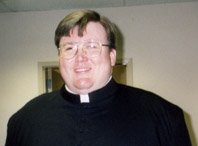
Motor City, Here I Come
I'm in Detroit today, visiting my alma mater, Sacred Heart Major Seminary.
Later today, at 4:00 PM EDT, I'll be on the Al Kresta Live show to talk about my review of Goodbye! Good Men.
Tune in if you can!

Wednesday, August 07, 2002
From the Shameless Self-Promotion Department
Tomorrow, that is Thursday, August 8, I will be interviewed on the Al Kresta Live radio show. The interview is scheduled for 4:00 PM EDT.
The subject of the interview will be my recent review of Goodbye! Good Men, the book by Michael Rose which is being touted as an expose' of the problems in American seminaries. The review was published in the May issue of Culture Wars. I have been quite critical, in my review and here on my blog, of Mr. Rose's book, and of some of his actions subsequent to the publication of my review.
Al Kresta Live is a daily national Catholic radio talk show, which addresses a wide variety of topics and contemporary issues from an orthodox Catholic perspective. The show is syndicated nationally by the Ave Maria Radio network. If you have a Catholic radio station in your area, chances are they carry Al Kresta already, so tune in! If they don't, then ask them to start carrying Al's show.
Tomorrow, that is Thursday, August 8, I will be interviewed on the Al Kresta Live radio show. The interview is scheduled for 4:00 PM EDT.
The subject of the interview will be my recent review of Goodbye! Good Men, the book by Michael Rose which is being touted as an expose' of the problems in American seminaries. The review was published in the May issue of Culture Wars. I have been quite critical, in my review and here on my blog, of Mr. Rose's book, and of some of his actions subsequent to the publication of my review.
Al Kresta Live is a daily national Catholic radio talk show, which addresses a wide variety of topics and contemporary issues from an orthodox Catholic perspective. The show is syndicated nationally by the Ave Maria Radio network. If you have a Catholic radio station in your area, chances are they carry Al Kresta already, so tune in! If they don't, then ask them to start carrying Al's show.
Monday, August 05, 2002
Today is the Feast of the Dedication of St. Mary Major Basilica

This is the oldest church dedicated to Our Lady in Rome, having been built by Pope Liberius in about 352 AD. Our Lady appeared to a Christian Roman nobleman on the night of August 4, and she asked that a church be built in her honor on the Esquiline hill. She told him there would be a sign to accompany this dream: that the exact location of the Church would be marked out in snow. Pope Liberius was granted a similar vision that same night, so that he would know of Our Lady's request.
Upon awakening, John and Pope Liberius rushed to the Esquiline and saw the miraculous snowfall which had traced the form of the basilica on the hill. Many other people were there to see the snow which had miraculously fallen in the August heat (anyone who has ever experienced the sauna that is Rome in August will know just how miraculous such a thing would be).
The basilica was completed on that spot within two years and consecrated by Pope Liberius. When the Council of Ephesus defined Mary as Theotokos, the God-bearer, in 431 A.D., Pope Sixtus III (432-440) rebuilt and embellished the basilica. From the seventh century onward, it was referred to as St. Mary the Great or Major. Because of the miraculous snowfall, it is also sometimes referred to as Our Lady of the Snows.
Today's Feast is marked at the basilica by a special procession in which white flower petals are droppd from the ceiling of the church to commemorate the miraculous snowfall. On this day, traditionally, the Pope is presented at the basilica with his flock of Papal sheep, which he gives a special blessing. These are the sheep from whose wool the pallia (singular= pallium) are made. The pallium is the white woolen cloth, decorated with black crosses, worn by Metropolitan Archbishops around their neck over their vestments when they celebrate Mass. The pallium is a sign of the Archbishop's communion with the See of Peter and is presented to new Archbishops on the Feast of SS. Peter and Paul, June 29. Bet you didn't know the Pope had his own special flock of sheep! The sheep are raised at Castel Gondolfo, the Pope's summer residence.
On a note of pure diversion, at Castel Gondolfo is also the Papal herd of cows. I have seen the Papal cows myself and taken part in the unusual tradition of serenading the Pope's cows. The song which one sings to the Pope's cows is, of course, in Latin, though the text is not ready to hand. I took part in this curious custom when I was studying Latin in Rome in 1997 with Fr. Reginald Foster, OCD, who is known as "the Pope's Latinist". Reggie regularly takes his students out to Castel Gondolfo to take part in this pilgrimage of Papal animal-lore.
Getting back to Saint Mary Major, also there is the Praesepium, the relic of the manger in which Christ rested:

The chapel of the Praesepium is granted a singular privilege: In that chapel any priest may, on any day of the year save Good Friday and Easter Sunday, celebrate any of the Masses of Christmas. It's Christmas everyday there! I intend on my next visit to Rome, which will be the first since my ordination, to visit that Chapel and celebrate Midnight Mass there. Being Catholic is great, isn't it?
As one might gather from my enthusiasm, this feast is special to me. It was in this Basilica, as a seminarian, that I put away some doubts and difficulties I was having in persevering, and rededicated myself to seeing through my vocation to the priesthood. Also, by God's providence, this day is the day I was privileged to be able to offer my First Mass at the Cathedral of St. Augustine in Kalamazoo. That day, the oldest known prayer to Our Lady became a special and personal prayer for me. The music director at Sacred Heart Major Seminary, Mr. Calvert Shenk, has written a sublimely beautiful motet on this text, which I hope he has published:
Sub tuum praesidium confugimus,xxxxxxxxxxWe fly to thy patronage,
sancta Dei Genitrix: nostras deprecationesxxxxO holy Mother of God. Depise not
ne despicias in neccestitatibus:xxxxxxxxxxxxxour petitions in our neccessities,
sed a periculis cunctis libera nos semper,xxxxbut deliver us always from all dangers,
Virgo gloriosa et benedicta.xxxxxxxxxxxxxxxO glorious and blessed Virgin.
This is the oldest church dedicated to Our Lady in Rome, having been built by Pope Liberius in about 352 AD. Our Lady appeared to a Christian Roman nobleman on the night of August 4, and she asked that a church be built in her honor on the Esquiline hill. She told him there would be a sign to accompany this dream: that the exact location of the Church would be marked out in snow. Pope Liberius was granted a similar vision that same night, so that he would know of Our Lady's request.
Upon awakening, John and Pope Liberius rushed to the Esquiline and saw the miraculous snowfall which had traced the form of the basilica on the hill. Many other people were there to see the snow which had miraculously fallen in the August heat (anyone who has ever experienced the sauna that is Rome in August will know just how miraculous such a thing would be).
The basilica was completed on that spot within two years and consecrated by Pope Liberius. When the Council of Ephesus defined Mary as Theotokos, the God-bearer, in 431 A.D., Pope Sixtus III (432-440) rebuilt and embellished the basilica. From the seventh century onward, it was referred to as St. Mary the Great or Major. Because of the miraculous snowfall, it is also sometimes referred to as Our Lady of the Snows.
Today's Feast is marked at the basilica by a special procession in which white flower petals are droppd from the ceiling of the church to commemorate the miraculous snowfall. On this day, traditionally, the Pope is presented at the basilica with his flock of Papal sheep, which he gives a special blessing. These are the sheep from whose wool the pallia (singular= pallium) are made. The pallium is the white woolen cloth, decorated with black crosses, worn by Metropolitan Archbishops around their neck over their vestments when they celebrate Mass. The pallium is a sign of the Archbishop's communion with the See of Peter and is presented to new Archbishops on the Feast of SS. Peter and Paul, June 29. Bet you didn't know the Pope had his own special flock of sheep! The sheep are raised at Castel Gondolfo, the Pope's summer residence.
On a note of pure diversion, at Castel Gondolfo is also the Papal herd of cows. I have seen the Papal cows myself and taken part in the unusual tradition of serenading the Pope's cows. The song which one sings to the Pope's cows is, of course, in Latin, though the text is not ready to hand. I took part in this curious custom when I was studying Latin in Rome in 1997 with Fr. Reginald Foster, OCD, who is known as "the Pope's Latinist". Reggie regularly takes his students out to Castel Gondolfo to take part in this pilgrimage of Papal animal-lore.
Getting back to Saint Mary Major, also there is the Praesepium, the relic of the manger in which Christ rested:
The chapel of the Praesepium is granted a singular privilege: In that chapel any priest may, on any day of the year save Good Friday and Easter Sunday, celebrate any of the Masses of Christmas. It's Christmas everyday there! I intend on my next visit to Rome, which will be the first since my ordination, to visit that Chapel and celebrate Midnight Mass there. Being Catholic is great, isn't it?
As one might gather from my enthusiasm, this feast is special to me. It was in this Basilica, as a seminarian, that I put away some doubts and difficulties I was having in persevering, and rededicated myself to seeing through my vocation to the priesthood. Also, by God's providence, this day is the day I was privileged to be able to offer my First Mass at the Cathedral of St. Augustine in Kalamazoo. That day, the oldest known prayer to Our Lady became a special and personal prayer for me. The music director at Sacred Heart Major Seminary, Mr. Calvert Shenk, has written a sublimely beautiful motet on this text, which I hope he has published:
Sub tuum praesidium confugimus,xxxxxxxxxxWe fly to thy patronage,
sancta Dei Genitrix: nostras deprecationesxxxxO holy Mother of God. Depise not
ne despicias in neccestitatibus:xxxxxxxxxxxxxour petitions in our neccessities,
sed a periculis cunctis libera nos semper,xxxxbut deliver us always from all dangers,
Virgo gloriosa et benedicta.xxxxxxxxxxxxxxxO glorious and blessed Virgin.
Comments, Anyone?
Well, I've gone and done it! I've added a comment feature to my blog. It seems to be pretty much de rigeuranymore. So please, comment away! Debate about what I or other bloggers have written. Argue about things (always with charity). Tell me if I said something really stupid.
Of course, I still love to get e-mail. So talk back!
Well, I've gone and done it! I've added a comment feature to my blog. It seems to be pretty much de rigeuranymore. So please, comment away! Debate about what I or other bloggers have written. Argue about things (always with charity). Tell me if I said something really stupid.
Of course, I still love to get e-mail. So talk back!
The Priesthood: Fraternity or Club?
At the ordination of Fr. Fleckenstein Saturday I saw in a new way what the fraternity of the priesthood is really supposed to be about, and, at its best moments, truly is. For those of you who have never attended and ordination, you should know that after the bishop lays hands on the ordinand to impart the gift of the Holy Spirit, all of the other priests present lay hands on him to express the unity of the priesthood and our sharing in the one high priesthood of Christ. As I laid hands on John in turn with the other priests, I realized that I gained a new brother. For all of us who share in the high priesthood of Christ are brothers.
I have seen this brotherhood at work in different ways since my ordination. A few months ago I was having a difficult time with a situation in my parish and I was really discouraged by it. I called one of my priest friends to talk about it, and he dropped everything the next afternoon to drive almost 2 hours to have lunch with me and spend most of the afternoon talking with me and giving me encouragement. That is brotherhood. And conversely, if I or another priest says or does something out of line, or is headed down the wrong path, we are usually the first to call one another to account.
Some bloggers and readers have voiced their concerns that I, by trying to set the record straight about Fr. DeVita, have given the impression that the priesthood is a sort of club whose members rally around one another no matter what. I imagine that the priesthood, like any other human organization, can devolve into a sort of "in-group" interested primarily in its own prerogatives. I have seen parishes that function that way, and it is very disordered. A presbyterate that decayed into an "in-group" or club would be very disordered indeed. And perhaps that is what happened in places where priest-abusers got shuffled around and no one seemed to pay attention or care.
I have not experienced the priesthood as a club, but as a brotherhood. And when I speak of the priesthood as a brotherhood, I am not thinking of some sort of metaphorical or symbolic brotherhood. If anything, the spritual brotherhood of the priesthood may be more real than natural brotherhood, because it is a participation in the Person of Christ. When my brother priests are honored or advanced (such as my friend Bishop-elect Earl Boyea), I rejoice with them. And when one of them experiences sorrow or grief, I grieve with him. When one of them is discouraged, I try to encourage him. And if one of my brother priests should fall, I am filled with sorrow and pity for him. And, as we now know has happened far too often, if one of them should go so far as to abuse his office in order to vicitmize those under his care, I am moved to anger and a sense of personal betrayal, because the priesthood he has betrayed is my priesthood as well.
If anyone has been led to believe by my remarks concerning Fr. DeVita that I am somehow defending abuse or abusers, then I am truly sorry, for that is the last thing I intended to convey. I would never defend anyone's wrongdoing, be he priest or layman. Anyone who has read my previous ruminations (for example, here or here) regarding The Situation knows that I am no defender of abusers or those who protected or enabled them. But just as I would never defend wrongdoing perpetrated by anyone, so too will I always demand that wrongdoers, be they priests or anyone else, be treated with justice: no more, and no less than justice. And I will always plead that any wrongdoer, be he a priest or anyone else, be shown mercy.
If anyone of you had a brother who committed a grievous crime, would you cease to love him? Would you cease to desire his redemption and restoration? I would hope not. I feel precisely this way about a brother priest, such as Fr. DeVita, who has sinned and sullied the sacred trust he was given. In his particular case I (and my bishop) believed him to be redeemed and reclaimed. So I ask "what does 'restorative' mercy look like for someone like Fr. DeVita?" It is my concern for living out this value of "restorative" mercy that prompts me to think that some form of active priestly ministry may still be possible for him.
It may be the case that restorative mercy for priests like Fr. DeVita doesn't include continuing in some form of active ministry. The bonds of trust may be too badly shatttered by his crime. But what does restorative mercy look like, then? Is restorative mercy something we should expect to see in this life, in this world? I would hope so, especially within the Church. Is a restorative mercy that includes the possibility of continued active ministry is a false mercy?
I am aware of the danger, as Fr. Greeley warned, of priests showing false compassion towards their offending brothers. But it does not demean the victims or make light of their pain, as some have implied, to demand justice and plead for mercy for offenders. Justice and mercy are not some kind of zero-sum game where to give them to the offenders is to take them away from victims. Ultimately it is for the victims' good that offenders are given no more and no less than justice. And restorative mercy, which brings healing and restoration, is all of a piece. Why? because it is a quality of God, who is one. There isn't one sort of divine mercy for victims and another sort for offenders. There is one divine mercy which is generously given to all. So the question for us is "How do we show restorative mercy that is in some way unitary for victims and offenders? How do we show mercy that restores communion?" When we find the answer to that question, we will be doing the greatest good for victims, offenders, and the whole Church.
At the ordination of Fr. Fleckenstein Saturday I saw in a new way what the fraternity of the priesthood is really supposed to be about, and, at its best moments, truly is. For those of you who have never attended and ordination, you should know that after the bishop lays hands on the ordinand to impart the gift of the Holy Spirit, all of the other priests present lay hands on him to express the unity of the priesthood and our sharing in the one high priesthood of Christ. As I laid hands on John in turn with the other priests, I realized that I gained a new brother. For all of us who share in the high priesthood of Christ are brothers.
I have seen this brotherhood at work in different ways since my ordination. A few months ago I was having a difficult time with a situation in my parish and I was really discouraged by it. I called one of my priest friends to talk about it, and he dropped everything the next afternoon to drive almost 2 hours to have lunch with me and spend most of the afternoon talking with me and giving me encouragement. That is brotherhood. And conversely, if I or another priest says or does something out of line, or is headed down the wrong path, we are usually the first to call one another to account.
Some bloggers and readers have voiced their concerns that I, by trying to set the record straight about Fr. DeVita, have given the impression that the priesthood is a sort of club whose members rally around one another no matter what. I imagine that the priesthood, like any other human organization, can devolve into a sort of "in-group" interested primarily in its own prerogatives. I have seen parishes that function that way, and it is very disordered. A presbyterate that decayed into an "in-group" or club would be very disordered indeed. And perhaps that is what happened in places where priest-abusers got shuffled around and no one seemed to pay attention or care.
I have not experienced the priesthood as a club, but as a brotherhood. And when I speak of the priesthood as a brotherhood, I am not thinking of some sort of metaphorical or symbolic brotherhood. If anything, the spritual brotherhood of the priesthood may be more real than natural brotherhood, because it is a participation in the Person of Christ. When my brother priests are honored or advanced (such as my friend Bishop-elect Earl Boyea), I rejoice with them. And when one of them experiences sorrow or grief, I grieve with him. When one of them is discouraged, I try to encourage him. And if one of my brother priests should fall, I am filled with sorrow and pity for him. And, as we now know has happened far too often, if one of them should go so far as to abuse his office in order to vicitmize those under his care, I am moved to anger and a sense of personal betrayal, because the priesthood he has betrayed is my priesthood as well.
If anyone has been led to believe by my remarks concerning Fr. DeVita that I am somehow defending abuse or abusers, then I am truly sorry, for that is the last thing I intended to convey. I would never defend anyone's wrongdoing, be he priest or layman. Anyone who has read my previous ruminations (for example, here or here) regarding The Situation knows that I am no defender of abusers or those who protected or enabled them. But just as I would never defend wrongdoing perpetrated by anyone, so too will I always demand that wrongdoers, be they priests or anyone else, be treated with justice: no more, and no less than justice. And I will always plead that any wrongdoer, be he a priest or anyone else, be shown mercy.
If anyone of you had a brother who committed a grievous crime, would you cease to love him? Would you cease to desire his redemption and restoration? I would hope not. I feel precisely this way about a brother priest, such as Fr. DeVita, who has sinned and sullied the sacred trust he was given. In his particular case I (and my bishop) believed him to be redeemed and reclaimed. So I ask "what does 'restorative' mercy look like for someone like Fr. DeVita?" It is my concern for living out this value of "restorative" mercy that prompts me to think that some form of active priestly ministry may still be possible for him.
It may be the case that restorative mercy for priests like Fr. DeVita doesn't include continuing in some form of active ministry. The bonds of trust may be too badly shatttered by his crime. But what does restorative mercy look like, then? Is restorative mercy something we should expect to see in this life, in this world? I would hope so, especially within the Church. Is a restorative mercy that includes the possibility of continued active ministry is a false mercy?
I am aware of the danger, as Fr. Greeley warned, of priests showing false compassion towards their offending brothers. But it does not demean the victims or make light of their pain, as some have implied, to demand justice and plead for mercy for offenders. Justice and mercy are not some kind of zero-sum game where to give them to the offenders is to take them away from victims. Ultimately it is for the victims' good that offenders are given no more and no less than justice. And restorative mercy, which brings healing and restoration, is all of a piece. Why? because it is a quality of God, who is one. There isn't one sort of divine mercy for victims and another sort for offenders. There is one divine mercy which is generously given to all. So the question for us is "How do we show restorative mercy that is in some way unitary for victims and offenders? How do we show mercy that restores communion?" When we find the answer to that question, we will be doing the greatest good for victims, offenders, and the whole Church.
Subscribe to:
Comment Feed (RSS)