Penguins in Bethlehem...?
After the 10:00 AM Mass yesterday, a cute thing happened. There is a family in my parish that has two young boys. The younger one is about 2-3 years old. After Mass, his mother was showing him our creche, which is hand made by parishioners, and fairly large. The boy was looking at and naming all of the animals. Well, he took out of his coat pocket a little toy penguin (his mom explained to me later that he had received a play zoo as a Christmas present), looked at it, and then looked at the animals in the creche, and then proceeded to put his penguin in the creche, facing the baby Jesus. I almost said something to correct him, like "I don't think there were any penguins there in Bethlehem." But fortunately, I stopped myself. I told myself, "well, if Jesus had been born in Antartica, I'm sure there would have been penguins gathered around the manger!"
Mom also told me that a couple of weeks earlier, they had been driving somewhere when, spontaneously, the older boy (about 5) started signing in Latin! We've been chanting the Kyrie and the Agnus Dei during Advent, and I had the choir do a couple of other Latin chants. I'm glad to hear that it's making an impact!
Monday, December 26, 2005

A Belated, But Nonetheless Merry, Christmas to You!

Byzantine Icon of the Nativity
I hope your Christmas was a happy, merry, and blessed one, and I hope it will continue to be so! Remember that Christmas isn't just one day, but lasts through the Octave, that is, until the eighth day afterward. So Christmas isn't over, it's just begun!
My Christmas was a good, but busy one. This is my first Christmas as pastor of my own parish, so there were a number of things I had to learn about preparing for the festival. I had several moments during the past week or so when I realized, "Oh, yeah, if I don't do that, it won't get done. I didn't get much sleep over the past few days. But my tiredness was of a good kind. And I rewarded myself with a nap yesterday afternoon, and by sleeping in today.
The Christmas Masses all went fairly well: there were minor glitches here and there. Several of those glitches were of my own doing. For example, I forgot to instruct the congregation to kneel during the creed at the words "and became man", and to do so myself, at Midnight Mass. I remembered at the 6:00 PM Mass, and the 9:00 PM Mass, but forgot at Midnight. Oh well... But on the whole the liturgies proceeded smoothly. For the most part good liturgy isn't about creativity, it's about fidelity: doing things as the books tell us and according to the mind of the Church.
My parish churches are both decorated beautifully: I was very gratified that so many people came out to help set up the decorations and make the churches truly splendid settings for the celebration of this most stupendous mystery of God becoming one of us.
And we had some nice music as well. I had gentlemen chant the Christmas Proclamation at the Midnight and 10:00 AM Masses, and I had the choir chant the "Puer Natus Est" as well. They also did a nice job on a two-part setting of "Es Ist Ein Ros Entsprungen" ("Lo, How a Rose E'er Blooming"). The people of my mission parish also put some nice music together: they sang a lovely 4-part setting of "Lo, how A Rose" and a song called "In Old Judaea", which I had never heard before.
It was a lovely first Christmas as pastor. I'm taking today and tomorrow off, enjoying a little "holy leisure". I hope you get some of that, too.
Byzantine Icon of the Nativity
I hope your Christmas was a happy, merry, and blessed one, and I hope it will continue to be so! Remember that Christmas isn't just one day, but lasts through the Octave, that is, until the eighth day afterward. So Christmas isn't over, it's just begun!
My Christmas was a good, but busy one. This is my first Christmas as pastor of my own parish, so there were a number of things I had to learn about preparing for the festival. I had several moments during the past week or so when I realized, "Oh, yeah, if I don't do that, it won't get done. I didn't get much sleep over the past few days. But my tiredness was of a good kind. And I rewarded myself with a nap yesterday afternoon, and by sleeping in today.
The Christmas Masses all went fairly well: there were minor glitches here and there. Several of those glitches were of my own doing. For example, I forgot to instruct the congregation to kneel during the creed at the words "and became man", and to do so myself, at Midnight Mass. I remembered at the 6:00 PM Mass, and the 9:00 PM Mass, but forgot at Midnight. Oh well... But on the whole the liturgies proceeded smoothly. For the most part good liturgy isn't about creativity, it's about fidelity: doing things as the books tell us and according to the mind of the Church.
My parish churches are both decorated beautifully: I was very gratified that so many people came out to help set up the decorations and make the churches truly splendid settings for the celebration of this most stupendous mystery of God becoming one of us.
And we had some nice music as well. I had gentlemen chant the Christmas Proclamation at the Midnight and 10:00 AM Masses, and I had the choir chant the "Puer Natus Est" as well. They also did a nice job on a two-part setting of "Es Ist Ein Ros Entsprungen" ("Lo, How a Rose E'er Blooming"). The people of my mission parish also put some nice music together: they sang a lovely 4-part setting of "Lo, how A Rose" and a song called "In Old Judaea", which I had never heard before.
It was a lovely first Christmas as pastor. I'm taking today and tomorrow off, enjoying a little "holy leisure". I hope you get some of that, too.
Monday, December 12, 2005
Homily For the Third Sunday of Advent
Isaiah 61: 1-2a, 10-11
1 Thess. 5: 16-24
John 1: 6-8, 19-28

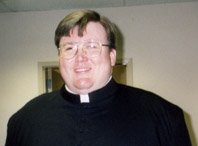
Me in my Rose Vestments (sorry for the poor image quality)
"Where Is the Joy?"
I want to begin this morning with a question. This is a question for the kids here today; grownups, you're not allowed to answer. So, kids, if you know the answer, raise your hands. The question is this [steps out from behind ambo]: What color am I wearing?
[A child answers:] "Pink!"
Well, that's close, but not quite right. No, the color I am wearing isn't pink, it's rose. It may look like pink, but it really isn't, it's rose.
Now, the reason I'm wearing such an unusual color is that today is a day of special rejoicing for the Church. Rose is the color of joy, the color of rejoicing. And it's so special that the priest may wear rose vestments on only two days of the year.
So why are we rejoicing today? Why is today a day of joy? Because the light is coming! The light of the world is coming, and will soon be here. John the Baptist testified to the light, and told us "prepare the way of the Lord make straight his paths!". We can rejoice today because we know that God's salvation is coming soon. We can rejoice today because we know that Christ has already come, and will come again.
To live a Catholic life is to live in a world of "both... and". Jesus has both come already, and will come again. God's salvation has both been given to us now and is yet to be made complete. Creation has both been redeemed, and that redemption has yet to be consummated and fulfilled.
And so today we rejoice. We rejoice because Christ has come - he came as an infant in Bethlehem about 2,000 years ago, and we will celebrate that coming in just two short weeks - and because he is yet to come, he is to come again!
That is why, as we heard in our second reading, St. Paul tells us to "rejoice always". Indeed, this day gets it's very name from rejoicing. Traditionally, this day has always been known as Gaudete Sunday. Gaudete is the Latin word for "Rejoice". And the old Latin chant that was always sung on this day also tells us of rejoicing. It began with the words "Rejoice in the Lord always", and it went like this:
[Sings beginning of chant] "Gaudete in Domino semper! Iterum, dico, Gaudete!".
[If you want to hear it, you can listen to it here. ]
Rejoice in the Lord always! I say again, rejoice!
We are called to live as people of joy, because God's salvation has been made known to us. God has given us the light of his Son, has given us, through Him, a share in his very own life.
You know, I have to wonder sometimes. Every Sunday, I come down in front here to distribute Holy Communion. And when I hold up the Host and say "The Body of Christ", I usually look right at your faces. And I wonder... I don't wonder about your faith, or devotion: I have no doubts about that. But what I wonder is "Where is the joy?" Because, as you come up to receive communion, many of you look like this: [I put on a downcast, gloomy frown.] It's as though you were coming up to receive a dose of medicine: something you know is good for you, but not necessarily pleasant at the time.
So I wonder, where is the joy? Where is the sheer wonder and amazement that God has so privileged us to come down to be with us? Where is the joy and awe that God should give us his very Self as food? Where is the elation that Christ has once again fulfilled his promise that He "will be with us always, even until the end"? Every Sunday is Christmas, every Sunday is Easter. So I say to you, Rejoice!
If you study the Saints, their lives and writings, you discover that they led lives full of joy. They were continually rejoicing. And that's not because everything always went well for them. It's not because they never had trials or difficulties. Indeed, they often bore tremendous burdens. They frequently met with opposition and frustration. It often seemed to them as though everything was going badly.
But they were able to look beyond the difficulties and trials. They were able to see through the setbacks and frustrations, to see that there were tremendous possibilities and wonders on the other side. They knew that the God who would see them through was the same God who came to earth on Christmas night. They knew that the God who raised His own Son from the dead would give them victory over their challenges. They knew that the God who was guiding and leading them was the God who was "with us always" in the Sacrament of the Altar.
The same possibilities that were given to the Saints are given to us. Our Lord longs, yearns, to make those possibilities real for us. The possibility of redemption, the possibility of transformation, the possibility of wonders and glories of which we can scarcely dream. Christ came to earth and died for us to give us all those things, and He will, if we but give him half a chance. All these things: possibilities of beauty and wonder and glory greater than the universe itself, lie in store for us. He wants to give them to us. He will, if we but let Him.
Rejoice in the Lord always! I say again, rejoice! The One who calls you is faithful, and He will accomplish it.
Isaiah 61: 1-2a, 10-11
1 Thess. 5: 16-24
John 1: 6-8, 19-28
Me in my Rose Vestments (sorry for the poor image quality)
"Where Is the Joy?"
I want to begin this morning with a question. This is a question for the kids here today; grownups, you're not allowed to answer. So, kids, if you know the answer, raise your hands. The question is this [steps out from behind ambo]: What color am I wearing?
[A child answers:] "Pink!"
Well, that's close, but not quite right. No, the color I am wearing isn't pink, it's rose. It may look like pink, but it really isn't, it's rose.
Now, the reason I'm wearing such an unusual color is that today is a day of special rejoicing for the Church. Rose is the color of joy, the color of rejoicing. And it's so special that the priest may wear rose vestments on only two days of the year.
So why are we rejoicing today? Why is today a day of joy? Because the light is coming! The light of the world is coming, and will soon be here. John the Baptist testified to the light, and told us "prepare the way of the Lord make straight his paths!". We can rejoice today because we know that God's salvation is coming soon. We can rejoice today because we know that Christ has already come, and will come again.
To live a Catholic life is to live in a world of "both... and". Jesus has both come already, and will come again. God's salvation has both been given to us now and is yet to be made complete. Creation has both been redeemed, and that redemption has yet to be consummated and fulfilled.
And so today we rejoice. We rejoice because Christ has come - he came as an infant in Bethlehem about 2,000 years ago, and we will celebrate that coming in just two short weeks - and because he is yet to come, he is to come again!
That is why, as we heard in our second reading, St. Paul tells us to "rejoice always". Indeed, this day gets it's very name from rejoicing. Traditionally, this day has always been known as Gaudete Sunday. Gaudete is the Latin word for "Rejoice". And the old Latin chant that was always sung on this day also tells us of rejoicing. It began with the words "Rejoice in the Lord always", and it went like this:
[Sings beginning of chant] "Gaudete in Domino semper! Iterum, dico, Gaudete!".
[If you want to hear it, you can listen to it here. ]
Rejoice in the Lord always! I say again, rejoice!
We are called to live as people of joy, because God's salvation has been made known to us. God has given us the light of his Son, has given us, through Him, a share in his very own life.
You know, I have to wonder sometimes. Every Sunday, I come down in front here to distribute Holy Communion. And when I hold up the Host and say "The Body of Christ", I usually look right at your faces. And I wonder... I don't wonder about your faith, or devotion: I have no doubts about that. But what I wonder is "Where is the joy?" Because, as you come up to receive communion, many of you look like this: [I put on a downcast, gloomy frown.] It's as though you were coming up to receive a dose of medicine: something you know is good for you, but not necessarily pleasant at the time.
So I wonder, where is the joy? Where is the sheer wonder and amazement that God has so privileged us to come down to be with us? Where is the joy and awe that God should give us his very Self as food? Where is the elation that Christ has once again fulfilled his promise that He "will be with us always, even until the end"? Every Sunday is Christmas, every Sunday is Easter. So I say to you, Rejoice!
If you study the Saints, their lives and writings, you discover that they led lives full of joy. They were continually rejoicing. And that's not because everything always went well for them. It's not because they never had trials or difficulties. Indeed, they often bore tremendous burdens. They frequently met with opposition and frustration. It often seemed to them as though everything was going badly.
But they were able to look beyond the difficulties and trials. They were able to see through the setbacks and frustrations, to see that there were tremendous possibilities and wonders on the other side. They knew that the God who would see them through was the same God who came to earth on Christmas night. They knew that the God who raised His own Son from the dead would give them victory over their challenges. They knew that the God who was guiding and leading them was the God who was "with us always" in the Sacrament of the Altar.
The same possibilities that were given to the Saints are given to us. Our Lord longs, yearns, to make those possibilities real for us. The possibility of redemption, the possibility of transformation, the possibility of wonders and glories of which we can scarcely dream. Christ came to earth and died for us to give us all those things, and He will, if we but give him half a chance. All these things: possibilities of beauty and wonder and glory greater than the universe itself, lie in store for us. He wants to give them to us. He will, if we but let Him.
Rejoice in the Lord always! I say again, rejoice! The One who calls you is faithful, and He will accomplish it.
Tuesday, November 22, 2005
God on the Internet
Jonathan Last has a very good article on the Catholic blogosphere over at First Things. Of course, one of the things that makes it so good is that he quotes your humble scribe several times and links to this blog.
But seriously, even if he hadn't done those things, it would be well worth reading. It's a good overview of St. Blog's, and the opportunities and limitations presented by blogdom. But the fact that he quotes me does make it better...
Jonathan Last has a very good article on the Catholic blogosphere over at First Things. Of course, one of the things that makes it so good is that he quotes your humble scribe several times and links to this blog.
But seriously, even if he hadn't done those things, it would be well worth reading. It's a good overview of St. Blog's, and the opportunities and limitations presented by blogdom. But the fact that he quotes me does make it better...
Wednesday, November 16, 2005
It's Good To Be The Pastor, Part II
One of the things that has been keeping me busy over the last few weeks is trying to address some of the needs I have identified in the parish, and making preparations for the Solemnity of Christ the King and the season of Advent.
I've been re-training my altar servers. In so many parishes, the servers are really not properly trained, and consequently just sort of shuffle and bumble their way through the liturgy (not the case here, BTW). I resolved a long time ago that in any parish I pastored, I would personally devote time and attention to training my servers. Not only so that they will make the bella figura in the liturgy, but so they can really take pride in what they are doing, and see the true importance of their ministry. A good friend of mine remarked that the priest needs to see himself not just as teaching the servers what to do, but as forming them in God's service. So I've been trying to do just that. I think that here, as in any other ministry to young people, we need to challenge them with a high standard, with something they have to invest themselves in, and help them rise to the challenge.
I've also been re-training the Lectors and Extraordinary Ministers of Holy Communion. In this case, for the most part they didn't need to be taught what to do. But there were a few aspects in which those ministries had not been carried out in complete harmony with either the GIRM or the "Instruction on the Collaboration of the Non-Ordained Faithful in the Sacred Ministry of Priest". So my goal is to bring our practice into conformity with the Universal Church.
In addition to those things, I have been spending a lot of time planning for the big solemnity, Advent, and Christmas. I've been thinking about music, decorations, etc. I'm starting to introduce some chant in the liturgy, so I've begun working with the choir on that. In my previous assignment as associate in a big parish, the director of liturgy and pastor took care of such things, and I didn't really have to worry about them. Here, we have me. It's a lot of work, but this is really the fun part of the job for me. I want our Christmas liturgies in particular to be as solemn and beautiful as they can be.
I'm also going to be shopping for new vestments and altar hangings for my two churches in the near future. We're really in need of these things - most of what we have is of '70's and '80's vintage, and are overdue to be replaced. That's fun stuff for a priest as well!
Next Sunday night I'm going to be visiting with our 8th and 9th grade CCD kids, and fielding their questions. I'm deliberately making it a sort of free-for-all. So say a prayer that I can answer their questions well, and help invite them to get to know Jesus and the Church He founded a little better!
One of the things that has been keeping me busy over the last few weeks is trying to address some of the needs I have identified in the parish, and making preparations for the Solemnity of Christ the King and the season of Advent.
I've been re-training my altar servers. In so many parishes, the servers are really not properly trained, and consequently just sort of shuffle and bumble their way through the liturgy (not the case here, BTW). I resolved a long time ago that in any parish I pastored, I would personally devote time and attention to training my servers. Not only so that they will make the bella figura in the liturgy, but so they can really take pride in what they are doing, and see the true importance of their ministry. A good friend of mine remarked that the priest needs to see himself not just as teaching the servers what to do, but as forming them in God's service. So I've been trying to do just that. I think that here, as in any other ministry to young people, we need to challenge them with a high standard, with something they have to invest themselves in, and help them rise to the challenge.
I've also been re-training the Lectors and Extraordinary Ministers of Holy Communion. In this case, for the most part they didn't need to be taught what to do. But there were a few aspects in which those ministries had not been carried out in complete harmony with either the GIRM or the "Instruction on the Collaboration of the Non-Ordained Faithful in the Sacred Ministry of Priest". So my goal is to bring our practice into conformity with the Universal Church.
In addition to those things, I have been spending a lot of time planning for the big solemnity, Advent, and Christmas. I've been thinking about music, decorations, etc. I'm starting to introduce some chant in the liturgy, so I've begun working with the choir on that. In my previous assignment as associate in a big parish, the director of liturgy and pastor took care of such things, and I didn't really have to worry about them. Here, we have me. It's a lot of work, but this is really the fun part of the job for me. I want our Christmas liturgies in particular to be as solemn and beautiful as they can be.
I'm also going to be shopping for new vestments and altar hangings for my two churches in the near future. We're really in need of these things - most of what we have is of '70's and '80's vintage, and are overdue to be replaced. That's fun stuff for a priest as well!
Next Sunday night I'm going to be visiting with our 8th and 9th grade CCD kids, and fielding their questions. I'm deliberately making it a sort of free-for-all. So say a prayer that I can answer their questions well, and help invite them to get to know Jesus and the Church He founded a little better!
Tuesday, November 15, 2005
By The Way, A Belated Thank You
One of my readers sent me a much appreciated gift about a month ago. He's a regular reader and knows my likes and foibles all too well. He sent me a bottle of 15 year-old Laphroaig (the really good stuff) and a couple of good cigars.
Thanks very much, D.C.! I'll be raising a glass in your honor very soon!
One of my readers sent me a much appreciated gift about a month ago. He's a regular reader and knows my likes and foibles all too well. He sent me a bottle of 15 year-old Laphroaig (the really good stuff) and a couple of good cigars.
Thanks very much, D.C.! I'll be raising a glass in your honor very soon!
Monday, November 14, 2005
So Where Have I Been This Time?...
Well, I haven't really been, anywhere, except busy - if that's a place. In a sense it is a place. At these times I feel "removed" from the wider world in the activity of my parish and my priestly ministry, and while I listen to the news and read some of the other bloggers, I don't really pay more than cursory attention. Then I emerge, as I'm doing now, with a few observations and things to say.
But I've been having some fun as well. Last Thursday I went out for a few hours and did some pheasont hunting with one of my parishioners. He owns some property a few miles outside of town, and we walked the fields, following the trained nose of his chocolate Lab, Buck. A couple of times the dog got too far ahead of us and flushed a bird out of range, but otherwise he did his job well. I, on the other hand, did not hold up my end very well. Buck flushed 3 or 4 birds in my field of fire, and while I had good shots at them all, I must confess I failed to hit any of them. I do have the excuse of not having been out hunting for two years, and therefore being a rather rusty shot. After the third missed bird, the dog came back to me, and I'll swear he was giving me a quizzical look, as though he were saying "what's your problem?" I felt embarrassed enough to apologize to the dog, saying "Sorry, Buck. You did a good job, I just couldn't hit the broadside of a barn today." I'm going to have to go out and shoot some clay pigeons so as not to let the dog down again.
But my host did shoot a couple of pheasants, and, much like fishing, even a bad day hunting (or a day hunting badly) is a good day. And the following evening I joined him and his wife for a lovely dinner, featuring the pheasants he had shot, with some rice and a nice bottle of Italian wine.
This week the deer season opens here in Michigan, so half of the male population of my parish is off to various cabins and camps in hope of bagging that big buck. I've never been much interested in deer hunting myself. I like the getting out and walking around that pheasant and quail hunting entail. The idea of sitting in a blind or stand waiting for a deer just doesn't do much for me. But I wish the guys well.
Well, I haven't really been, anywhere, except busy - if that's a place. In a sense it is a place. At these times I feel "removed" from the wider world in the activity of my parish and my priestly ministry, and while I listen to the news and read some of the other bloggers, I don't really pay more than cursory attention. Then I emerge, as I'm doing now, with a few observations and things to say.
But I've been having some fun as well. Last Thursday I went out for a few hours and did some pheasont hunting with one of my parishioners. He owns some property a few miles outside of town, and we walked the fields, following the trained nose of his chocolate Lab, Buck. A couple of times the dog got too far ahead of us and flushed a bird out of range, but otherwise he did his job well. I, on the other hand, did not hold up my end very well. Buck flushed 3 or 4 birds in my field of fire, and while I had good shots at them all, I must confess I failed to hit any of them. I do have the excuse of not having been out hunting for two years, and therefore being a rather rusty shot. After the third missed bird, the dog came back to me, and I'll swear he was giving me a quizzical look, as though he were saying "what's your problem?" I felt embarrassed enough to apologize to the dog, saying "Sorry, Buck. You did a good job, I just couldn't hit the broadside of a barn today." I'm going to have to go out and shoot some clay pigeons so as not to let the dog down again.
But my host did shoot a couple of pheasants, and, much like fishing, even a bad day hunting (or a day hunting badly) is a good day. And the following evening I joined him and his wife for a lovely dinner, featuring the pheasants he had shot, with some rice and a nice bottle of Italian wine.
This week the deer season opens here in Michigan, so half of the male population of my parish is off to various cabins and camps in hope of bagging that big buck. I've never been much interested in deer hunting myself. I like the getting out and walking around that pheasant and quail hunting entail. The idea of sitting in a blind or stand waiting for a deer just doesn't do much for me. But I wish the guys well.
Thursday, October 20, 2005
"Do You Think That I Have Come To Establish Peace...?"
Today's Gospel:
Luke 12:49-53
While I don't think anyone would accuse me of being a Pollyanna regarding the human condition or what we face as Christians in today's world, this gospel is still a sobering reminder to me.
Our Lord's words should not be construed as a statement expressing his wishes, but a no - nonsense appraisal of reality: the reality of what happens when the Truth confronts Sin, when Love confronts Self. You see, we always have the choice of whether to accept and acknowledge the Truth, whether we will live for Love or for Self. And, unfortunately, some people, when confronted with the choice, will choose badly. Some sin one person wants to cling to will lead him to reject the Truth, and the One who brings it. Another person will reject Love so as to go on living with her Self enthroned in her heart.
And such people often react vehemently against the Truth and Love. It is not enough for them to reject it - they will not rest till you reject it as well. They will even go so far as to attempt to banish the Truth from discourse and society: to silence its voice, so as to avoid its continual and implicit accusation.
So Truth and Love, against all reason, bring about conflict. Indeed, the conflict is literally against reason, for Sin and Self are ultimately unreasonable. As a friend has written, "sin makes you stupid."
When the stupidity of Sin and the unreasoning, unrelenting tyranny of Self meet Truth and Love, the result is conflict and division. That conflict came to a head against Our Lord, and its confluence was Calvary. The Cross is where Sin and Self sought once and for all to destroy Truth and Love.
Fortunately, we know how that story ended. Sin and Self succeeded only in destroying themselves. Some, unfortunately, still cling to those defeated spectres. For those, let us pray.
Today's Gospel:
Luke 12:49-53
Jesus said to his disciples:
“I have come to set the earth on fire,
and how I wish it were already blazing!
There is a baptism with which I must be baptized,
and how great is my anguish until it is accomplished!
Do you think that I have come to establish peace
on the earth?
No, I tell you, but rather division.
From now on a household of five will be divided,
three against two and two against three;
a father will be divided against his son
and a son against his father,
a mother against her daughter
and a daughter against her mother,
a mother-in-law against her daughter-in-law
and a daughter-in-law against her mother-in-law.”
While I don't think anyone would accuse me of being a Pollyanna regarding the human condition or what we face as Christians in today's world, this gospel is still a sobering reminder to me.
Our Lord's words should not be construed as a statement expressing his wishes, but a no - nonsense appraisal of reality: the reality of what happens when the Truth confronts Sin, when Love confronts Self. You see, we always have the choice of whether to accept and acknowledge the Truth, whether we will live for Love or for Self. And, unfortunately, some people, when confronted with the choice, will choose badly. Some sin one person wants to cling to will lead him to reject the Truth, and the One who brings it. Another person will reject Love so as to go on living with her Self enthroned in her heart.
And such people often react vehemently against the Truth and Love. It is not enough for them to reject it - they will not rest till you reject it as well. They will even go so far as to attempt to banish the Truth from discourse and society: to silence its voice, so as to avoid its continual and implicit accusation.
So Truth and Love, against all reason, bring about conflict. Indeed, the conflict is literally against reason, for Sin and Self are ultimately unreasonable. As a friend has written, "sin makes you stupid."
When the stupidity of Sin and the unreasoning, unrelenting tyranny of Self meet Truth and Love, the result is conflict and division. That conflict came to a head against Our Lord, and its confluence was Calvary. The Cross is where Sin and Self sought once and for all to destroy Truth and Love.
Fortunately, we know how that story ended. Sin and Self succeeded only in destroying themselves. Some, unfortunately, still cling to those defeated spectres. For those, let us pray.
Okay, Okay, I've finally done it...
A number of people have bugged me over the last few months to enable syndication of my blog. I've never really bothered about it before, because I don't use a syndicator or aggregator (or whatever the heck they are) myself. In fact, I still don't know what blog syndication is.
But I finally went ahead and enabled the Atom feed for my blog. So those of you who use Atom can now get my blog that way. (Whatever the heck it is.)
A number of people have bugged me over the last few months to enable syndication of my blog. I've never really bothered about it before, because I don't use a syndicator or aggregator (or whatever the heck they are) myself. In fact, I still don't know what blog syndication is.
But I finally went ahead and enabled the Atom feed for my blog. So those of you who use Atom can now get my blog that way. (Whatever the heck it is.)
Friday, October 14, 2005
Just What Is a "Faith Community" Anyway?
A reader writes me and asks:
I reply:
You're right in sensing that something's a little hinky about these changes in terminology.
People or institutions change the terms they use in order to try to affect the way people think about things.
The phrase "Faith Community" is meant to place the emphasis on the "horizontal", subjective relationships between parishioners, rather than the "vertical" relationship between the people and God. It is part of the tendency in "progressive" catholicism to see the church as "the actualized community celebrating itself". Using a phrase like "Faith Community" also helps to de-emphasize the fact that we are part of a larger entity, the Church, which is, of course, spread throughout space and time. It helps to disconnect the faithful from their sense of membership in and accountability to the larger Church. Such a term helps people to think of their faith as a merely subjective local, privatistic matter. It helps aging hippies forget about that mean old official "Church" (made up of the Pope, the Vatican, etc.) which so obstinately refuses to enact their adolescent fantasies.
The word "church" has a fairly well-defined meaning, which the Church herself has expressed in her Tradition. The phrase "Faith Community" is a nebulous gassy emission, which is designed to evoke certain emotional responses, but means almost anything the user wants.
That the use of the term "Faith Community" is accompanied by the abandonment of the term "celebrant" and replacement by the term "presider" is not surprising. Strictly speaking, the term is inaccurate, and may betray faulty theology. A chairman or chairwoman of a committee or legislature "presides" over a meeting, that is, ensures the smooth running over business that is largely transacted by others. While not exactly a passive spectator, one who "presides" is generally not the chief actor in the business at hand.
In a liturgical setting, a bishop or other prelate may "preside" at a Mass celebrated by another priest, at which he himself is not a celebrant. In such an instance, the bishop or prelate exercises a largely ceremonial function, and is not the primary liturgical actor.
So to call the priest who celebrates Mass the "presider" is at least erroneous. The word "celebrate" comes from the Latin celebro, which means "to solemnize, to keep a festival", "to honor, praise". The priest gives fitting honor and praise to God by solemnizing the New Festival of Christ, the Mass. The priest is the chief actor in the Mass - it is he, who, acting in persona Christi, makes the sacramental action happen. He is not merely a chairperson who sees to the smooth running of the liturgical proceedings.
So you can see what the term "presider" is intended to bring about: It reduces the priest's role to that of a sort of glorified "master of ceremonies". It conceals his role as the one who actually brings about the sacramental reality of the Eucharist by his action. The use of the term "presider" has its origins in the horizontalizing, levelling tendency of "progressive" catholicism. It is the product of an exaggerated "eucharist as communal meal" theology, which sees the eucharistic action as happening primarily in the "gathered community" rather than in the sacramental action of the priest. It is a desacralizing tendency, and is completely at odds with a truly Catholic understanding of the priesthood and the Eucharist, as expressed in our authentic Tradition.
A reader writes me and asks:
Dear Father Johansen,
Please straighten me out on a few newly adopted phrases I hear lately, first what is the difference between a Church, and a Faith Community?
Our beloved Pastor died this year, and we now refer to the Priest celebrating the Sacrifice of the Mass as the "Presider" rather than the Celebrant ....."Our Presider today will be Fr. (first name).
I reply:
You're right in sensing that something's a little hinky about these changes in terminology.
People or institutions change the terms they use in order to try to affect the way people think about things.
The phrase "Faith Community" is meant to place the emphasis on the "horizontal", subjective relationships between parishioners, rather than the "vertical" relationship between the people and God. It is part of the tendency in "progressive" catholicism to see the church as "the actualized community celebrating itself". Using a phrase like "Faith Community" also helps to de-emphasize the fact that we are part of a larger entity, the Church, which is, of course, spread throughout space and time. It helps to disconnect the faithful from their sense of membership in and accountability to the larger Church. Such a term helps people to think of their faith as a merely subjective local, privatistic matter. It helps aging hippies forget about that mean old official "Church" (made up of the Pope, the Vatican, etc.) which so obstinately refuses to enact their adolescent fantasies.
The word "church" has a fairly well-defined meaning, which the Church herself has expressed in her Tradition. The phrase "Faith Community" is a nebulous gassy emission, which is designed to evoke certain emotional responses, but means almost anything the user wants.
That the use of the term "Faith Community" is accompanied by the abandonment of the term "celebrant" and replacement by the term "presider" is not surprising. Strictly speaking, the term is inaccurate, and may betray faulty theology. A chairman or chairwoman of a committee or legislature "presides" over a meeting, that is, ensures the smooth running over business that is largely transacted by others. While not exactly a passive spectator, one who "presides" is generally not the chief actor in the business at hand.
In a liturgical setting, a bishop or other prelate may "preside" at a Mass celebrated by another priest, at which he himself is not a celebrant. In such an instance, the bishop or prelate exercises a largely ceremonial function, and is not the primary liturgical actor.
So to call the priest who celebrates Mass the "presider" is at least erroneous. The word "celebrate" comes from the Latin celebro, which means "to solemnize, to keep a festival", "to honor, praise". The priest gives fitting honor and praise to God by solemnizing the New Festival of Christ, the Mass. The priest is the chief actor in the Mass - it is he, who, acting in persona Christi, makes the sacramental action happen. He is not merely a chairperson who sees to the smooth running of the liturgical proceedings.
So you can see what the term "presider" is intended to bring about: It reduces the priest's role to that of a sort of glorified "master of ceremonies". It conceals his role as the one who actually brings about the sacramental reality of the Eucharist by his action. The use of the term "presider" has its origins in the horizontalizing, levelling tendency of "progressive" catholicism. It is the product of an exaggerated "eucharist as communal meal" theology, which sees the eucharistic action as happening primarily in the "gathered community" rather than in the sacramental action of the priest. It is a desacralizing tendency, and is completely at odds with a truly Catholic understanding of the priesthood and the Eucharist, as expressed in our authentic Tradition.
It's Good To Be The Pastor, Part I
So, I've been here at St. Stanislaus for almost 4 months, and I'm starting to get a sense of the parish and it's people. The people here, as I've written before, have been wonderful. They've been very welcoming and generous. I've been invited by a number of parishioners to dinner at their homes, and frequently parishioners will drop by with a jar of home-made jam, or some farm-fresh eggs, a cake or some other goodies. So I'm in no danger of going hungry...
My secretary/business manager is Hannah. She and her husband are long-time parishioners, and they've both become invaluable to me. Hannah deals with all of the accounting and paying the bills, etc, which is just as well because that's the kind of stuff that just puts me to sleep. Of course, I oversee things and keep tabs on the finances - it's my responsibility as pastor - but I'm glad to have her to deal with the nuts & bolts of it. Hannah's husband Russell is a big help to me, helping me set up for Mass several times a week, and generally doing countless favors for me.
The nice thing about a parish this size is that most everybody knows everyone else, at least by name, and frequently much more closely. One blessing and/or burden is that, because we're a small rural community, it seems like everyone is, in one way or another, related to everyone else. When I came here several parishioners warned me to be careful if I ever say anything about a parishioner, because there was a good chance someone within earshot was related to him! It will probably take me years to sort out who all is related to whom and how.
I'm blessed by my parish because the parishioners are so active and involved in parish life. Last weekend we had our annual Harvest Festival, which is the parish's Big Event in the fall. People come from all around to eat, buy things at the craft fair, and enjoy a Sunday afternoon in the country. The food was fantastic - there was turkey and beef and mashed potatoes (real - nothing out of a box), and stuffing, 5 or 6 different salads, all kinds of vegetables, and a plethora of desserts. Of course, I had to sample many different desserts, in order to develop a full sense of the diversity of the offerings.
This involvement also translates to a deep sense of "ownership" of the parish. My people care deeply about their parish, and will give quite generously, not only of their money, but of their time and talents, to help out. They want the parish to grow and prosper, and they want to be a part of what goes on. They also have a keen interest in making sure that things are well maintained and taken-care-of. They know that this is their parish, and it represents and reflects their faith.
Which is as it should be.
more later...
So, I've been here at St. Stanislaus for almost 4 months, and I'm starting to get a sense of the parish and it's people. The people here, as I've written before, have been wonderful. They've been very welcoming and generous. I've been invited by a number of parishioners to dinner at their homes, and frequently parishioners will drop by with a jar of home-made jam, or some farm-fresh eggs, a cake or some other goodies. So I'm in no danger of going hungry...
My secretary/business manager is Hannah. She and her husband are long-time parishioners, and they've both become invaluable to me. Hannah deals with all of the accounting and paying the bills, etc, which is just as well because that's the kind of stuff that just puts me to sleep. Of course, I oversee things and keep tabs on the finances - it's my responsibility as pastor - but I'm glad to have her to deal with the nuts & bolts of it. Hannah's husband Russell is a big help to me, helping me set up for Mass several times a week, and generally doing countless favors for me.
The nice thing about a parish this size is that most everybody knows everyone else, at least by name, and frequently much more closely. One blessing and/or burden is that, because we're a small rural community, it seems like everyone is, in one way or another, related to everyone else. When I came here several parishioners warned me to be careful if I ever say anything about a parishioner, because there was a good chance someone within earshot was related to him! It will probably take me years to sort out who all is related to whom and how.
I'm blessed by my parish because the parishioners are so active and involved in parish life. Last weekend we had our annual Harvest Festival, which is the parish's Big Event in the fall. People come from all around to eat, buy things at the craft fair, and enjoy a Sunday afternoon in the country. The food was fantastic - there was turkey and beef and mashed potatoes (real - nothing out of a box), and stuffing, 5 or 6 different salads, all kinds of vegetables, and a plethora of desserts. Of course, I had to sample many different desserts, in order to develop a full sense of the diversity of the offerings.
This involvement also translates to a deep sense of "ownership" of the parish. My people care deeply about their parish, and will give quite generously, not only of their money, but of their time and talents, to help out. They want the parish to grow and prosper, and they want to be a part of what goes on. They also have a keen interest in making sure that things are well maintained and taken-care-of. They know that this is their parish, and it represents and reflects their faith.
Which is as it should be.
more later...
Friday, October 07, 2005
Feast of Our Lady of The Rosary

Today we celebrate the Feast of Our Lady, Queen of the Rosary. This feast is celebrated today to commemorate the great victory of the combined Christian fleet over the invading Moslem Turks at Lepanto on this day in 1571. (You can read more about the battle itself here.)

The Battle of Lepanto
Pope Pius V, who instituted this feast following the victory, had urged all Christians to pray the Rosary to ask Our Lady's intercession and protection, to hold back the Turks and grant the Christian forces victory.
This battle, while it did not completely end the Moslem threat of invasion of Europe, nonetheless was pivotal, as it broke the Turkish power at sea for some time to come, and gave the Christian world renewed hope and unity against the invaders.
This victory also is a lasting reminder of the power of Our Lady's intercession, and the power of the Rosary.
Our Lady, Help of Christians, pray for us!
Today we celebrate the Feast of Our Lady, Queen of the Rosary. This feast is celebrated today to commemorate the great victory of the combined Christian fleet over the invading Moslem Turks at Lepanto on this day in 1571. (You can read more about the battle itself here.)
The Battle of Lepanto
Pope Pius V, who instituted this feast following the victory, had urged all Christians to pray the Rosary to ask Our Lady's intercession and protection, to hold back the Turks and grant the Christian forces victory.
This battle, while it did not completely end the Moslem threat of invasion of Europe, nonetheless was pivotal, as it broke the Turkish power at sea for some time to come, and gave the Christian world renewed hope and unity against the invaders.
This victory also is a lasting reminder of the power of Our Lady's intercession, and the power of the Rosary.
Our Lady, Help of Christians, pray for us!
Wednesday, October 05, 2005
The Miers Nomination, or, Mark Shea Comes Unhinged
Mark Shea is a friend of mine, and I have more or less shared his attitude toward the Republicans and President Bush that they are allies of convenience, giving them support because their policies are much more pro-life than the Democrats. On my part, I also believe in things like limited government and, generally speaking, economic liberty. And, like Mark and many other conservatives, I have grown increasingly frustrated by the President's seeming abandonment of the conservative principles that got him elected.
And, like Mark and many others, I reacted to Harriet Miers's nomination to the Supreme Court with "Harriet who?"
But, unlike Mark and others, I do not think it is yet time to go all chicken little, proclaim that the sky has fallen, and say to the Repubs "the hell with 'em". I also do not think it is the height of insight or analysis to simply dismiss the President's appointment of Miers as "stupid, stupid, stupid."
Now, don't get me wrong: I'm not defending the appointment of Miers. As many others have pointed out, this nomination is utterly deficient. President Bush could have done far better. But I think more can be said than that it is "stupid". To dismiss the President's action as "stupid" is a refusal to think about it. Charity requires more, and, frankly, so does simply trying to understand it.
The President said something in his press conference yesterday morning which seemed quite telling, and that practically no one else seems to have picked up on. The President said of Miers, "I know this woman's character," or something pretty close. This is very much the Bush style, to put character over "paper" qualifications. The president has never been one dazzled by academic distinctions or swollen resumes. Indeed, he ran for president on a "character" platform. He almost granted that Al Gore was the brainy, wonky, intellectual, but argued that he was the better choice on the grounds of character and principles. So it shouldn't surprise when he takes that same tack in a presidential appointment. What Bush is saying is "I know this woman, and I think she has the right stuff." Yes, that does boil down to "trust me". But it's not the same thing as merely "stupid". The real question is, do you think the president is a good judge of character?
Another thing is that many conservatives have been saying that this appointment was a "surprise", that it came from out of the blue. While I too was surprised at the choice of Miers, I wasn't surprised that the president chose a "stealth" candidate. Because the president has shown time and again that he is very reluctant to get into pitched political fights.
Many conservatives, sensing that their hour has come, and their influence has increased, have been spoiling for a fight. They've been itching for the opportunity to have that last open battle, in which they can put the liberals to flight once and for all. Pat Buchanan, interviewed Monday night, said that he thought Senator Harry Reid sounded relieved at the Miers nomination because Reid didn't want a confirmation battle, as Reid knew that the Dems would lose such a battle.
I for one do not share Buchanan's optimism. I do not think it is yet time for such a pitched battle. While conservatism has grown and is growing, liberals are still far too numerous and dominant for anything like assurance of victory. Fighting a premature battle and losing would do great damage and accomplish little. The liberals made their inroads on the culture over the course of 50 years. We will not undo that all in a decade or two, and certainly not in one all-out battle. It seems to me that the President has a similar view: far better to take incremental gains than to risk an all-out fight that you may lose. The president and I may be wrong, but I don't think that's merely "stupid."
Mark Shea is a friend of mine, and I have more or less shared his attitude toward the Republicans and President Bush that they are allies of convenience, giving them support because their policies are much more pro-life than the Democrats. On my part, I also believe in things like limited government and, generally speaking, economic liberty. And, like Mark and many other conservatives, I have grown increasingly frustrated by the President's seeming abandonment of the conservative principles that got him elected.
And, like Mark and many others, I reacted to Harriet Miers's nomination to the Supreme Court with "Harriet who?"
But, unlike Mark and others, I do not think it is yet time to go all chicken little, proclaim that the sky has fallen, and say to the Repubs "the hell with 'em". I also do not think it is the height of insight or analysis to simply dismiss the President's appointment of Miers as "stupid, stupid, stupid."
Now, don't get me wrong: I'm not defending the appointment of Miers. As many others have pointed out, this nomination is utterly deficient. President Bush could have done far better. But I think more can be said than that it is "stupid". To dismiss the President's action as "stupid" is a refusal to think about it. Charity requires more, and, frankly, so does simply trying to understand it.
The President said something in his press conference yesterday morning which seemed quite telling, and that practically no one else seems to have picked up on. The President said of Miers, "I know this woman's character," or something pretty close. This is very much the Bush style, to put character over "paper" qualifications. The president has never been one dazzled by academic distinctions or swollen resumes. Indeed, he ran for president on a "character" platform. He almost granted that Al Gore was the brainy, wonky, intellectual, but argued that he was the better choice on the grounds of character and principles. So it shouldn't surprise when he takes that same tack in a presidential appointment. What Bush is saying is "I know this woman, and I think she has the right stuff." Yes, that does boil down to "trust me". But it's not the same thing as merely "stupid". The real question is, do you think the president is a good judge of character?
Another thing is that many conservatives have been saying that this appointment was a "surprise", that it came from out of the blue. While I too was surprised at the choice of Miers, I wasn't surprised that the president chose a "stealth" candidate. Because the president has shown time and again that he is very reluctant to get into pitched political fights.
Many conservatives, sensing that their hour has come, and their influence has increased, have been spoiling for a fight. They've been itching for the opportunity to have that last open battle, in which they can put the liberals to flight once and for all. Pat Buchanan, interviewed Monday night, said that he thought Senator Harry Reid sounded relieved at the Miers nomination because Reid didn't want a confirmation battle, as Reid knew that the Dems would lose such a battle.
I for one do not share Buchanan's optimism. I do not think it is yet time for such a pitched battle. While conservatism has grown and is growing, liberals are still far too numerous and dominant for anything like assurance of victory. Fighting a premature battle and losing would do great damage and accomplish little. The liberals made their inroads on the culture over the course of 50 years. We will not undo that all in a decade or two, and certainly not in one all-out battle. It seems to me that the President has a similar view: far better to take incremental gains than to risk an all-out fight that you may lose. The president and I may be wrong, but I don't think that's merely "stupid."
Well, I'm Back!
After my 3-month hiatus, I'm returning to blogging. Sorry to have been silent all this time, but I've been pretty busy, getting settled in to my new rectory, getting to know my parish, and generally trying to get a handle on what being a pastor is all about.
I'm still not completely unpacked - I still have some boxes to empty out, and there are a few things I haven't found places for yet. But I'm working on that, a little at a time.
The people of my parish have been wonderful: very welcoming and generous. They've really made me feel "at home" here. I just need to mention that I'd like something or like something done and "bingo", it happens. I've had a number of invitations to parishioners homes for dinner, and consequently enjoyed some good polish cooking!
Being pastor is a whole new ball game for me. While obviously, I'm doing many of the same priestly things that I did while I was an associate, I'm the only one doing them here. And people look to me for answers and decisions in a way that they didn't when I was associate. There have been a few times when I've had to bring myself up short and say "Oh yeah, I'm the one who has to make a decision about that..." I'll have some more thoughts on being a pastor later tonight or tomorrow.
Thank you all for your encouraging e-mails over the last three months, and for checking back on my blog periodically. Thanks for wondering what happened to me. I'm going to try to be here regularly again. Obviously my parish is first and foremost, but I think I have the time to ventilate and bloviate a little!
After my 3-month hiatus, I'm returning to blogging. Sorry to have been silent all this time, but I've been pretty busy, getting settled in to my new rectory, getting to know my parish, and generally trying to get a handle on what being a pastor is all about.
I'm still not completely unpacked - I still have some boxes to empty out, and there are a few things I haven't found places for yet. But I'm working on that, a little at a time.
The people of my parish have been wonderful: very welcoming and generous. They've really made me feel "at home" here. I just need to mention that I'd like something or like something done and "bingo", it happens. I've had a number of invitations to parishioners homes for dinner, and consequently enjoyed some good polish cooking!
Being pastor is a whole new ball game for me. While obviously, I'm doing many of the same priestly things that I did while I was an associate, I'm the only one doing them here. And people look to me for answers and decisions in a way that they didn't when I was associate. There have been a few times when I've had to bring myself up short and say "Oh yeah, I'm the one who has to make a decision about that..." I'll have some more thoughts on being a pastor later tonight or tomorrow.
Thank you all for your encouraging e-mails over the last three months, and for checking back on my blog periodically. Thanks for wondering what happened to me. I'm going to try to be here regularly again. Obviously my parish is first and foremost, but I think I have the time to ventilate and bloviate a little!
Friday, June 24, 2005
"The Death of Terri Schiavo" Now Online
My article "The Death of Terri Schiavo", which appeared in the May issue of Catholic World Report, is now available online.
In this article, I describe and analyze the events and circumstances surrounding Terri's tragic death, and uncover some information you may not have seen before, such as:
I also explained, almost two months before the autopsy results came out, why the contention that "Terri was bulimic" was nonsense.
Terri's death, like much of the information concerning her condition while alive, was the object of spin and outright disinformation. In this Catholic World Report article, I try to unpack the distortions and give you the truth.
My article "The Death of Terri Schiavo", which appeared in the May issue of Catholic World Report, is now available online.
In this article, I describe and analyze the events and circumstances surrounding Terri's tragic death, and uncover some information you may not have seen before, such as:
Judge Greer took it upon himself to decide which tests Terri could or could not have, prompting one attorney to say that the judge "practiced quite a bit of medicine" in Terri's case.
Terri's death did not take place in quite the manner which the mainstream media reported.
I also explained, almost two months before the autopsy results came out, why the contention that "Terri was bulimic" was nonsense.
Terri's death, like much of the information concerning her condition while alive, was the object of spin and outright disinformation. In this Catholic World Report article, I try to unpack the distortions and give you the truth.
Some Pictures of My New Parish
Last week I posted the news that, at the end of the month, I will be leaving St. Joseph parish in St. Joseph, Michigan, where I have been an Associate Pastor since my ordination four years ago. I will be moving to St. Stanislaus parish in Dorr, Michigan, to become Pastor there.
I've made a couple of trips up there, to meet people and get acquainted, and to start moving my stuff up there. On the last trip, I tooks some photos of St. Stanislaus, and its mission, Sacred Heart Catholic Church in Watson, MI. It was an overcast day, so I couldn't get any good exterior shots of the churches, but I got some good interiors.
Here's the interior of St. Stanislaus:

As you can see, it's a lovely little church. It seats about 200 people, I'd guess. It still has all the statues and the high altar. It's all been very well taken care of, too. And, yes, that is a communion rail up there in the sanctuary! This picture was taken while Eucharistic Adoration was going on. It's certainly a good sign that the parish has regular adoration.

A close-up of the Sanctuary
Here's a picture of the mission church, Sacred Heart in Watson, Michigan:

Again, this church is another little gem. The stained-glass windows in Sacred Heart are particularly lovely.

The Sanctuary at Sacred Heart Catholic Church
I've been blessed with two beautiful churches. I'm grateful that no "up-to-date" liturgical consultant ever got his hands on these churches to "renovate" them. I begin as Pastor on June 29 - next Wednesday. Pray for me!
Last week I posted the news that, at the end of the month, I will be leaving St. Joseph parish in St. Joseph, Michigan, where I have been an Associate Pastor since my ordination four years ago. I will be moving to St. Stanislaus parish in Dorr, Michigan, to become Pastor there.
I've made a couple of trips up there, to meet people and get acquainted, and to start moving my stuff up there. On the last trip, I tooks some photos of St. Stanislaus, and its mission, Sacred Heart Catholic Church in Watson, MI. It was an overcast day, so I couldn't get any good exterior shots of the churches, but I got some good interiors.
Here's the interior of St. Stanislaus:
As you can see, it's a lovely little church. It seats about 200 people, I'd guess. It still has all the statues and the high altar. It's all been very well taken care of, too. And, yes, that is a communion rail up there in the sanctuary! This picture was taken while Eucharistic Adoration was going on. It's certainly a good sign that the parish has regular adoration.
A close-up of the Sanctuary
Here's a picture of the mission church, Sacred Heart in Watson, Michigan:
Again, this church is another little gem. The stained-glass windows in Sacred Heart are particularly lovely.
The Sanctuary at Sacred Heart Catholic Church
I've been blessed with two beautiful churches. I'm grateful that no "up-to-date" liturgical consultant ever got his hands on these churches to "renovate" them. I begin as Pastor on June 29 - next Wednesday. Pray for me!
Friday, June 17, 2005
I Was Wrong...
On Wednesday morning, I predicted that the autopsy report for Terri Schiavo would in some way purport to draw the conclusion that Terri was in a PVS.
I was wrong about that. But that's the kind of thing I'm happy to be wrong about.
I was pleasantly surprised to find that Dr. Thogmartin, the Pinellas County Medical Examiner, and Dr. Stephen Nelson, the consulting neuropathologist, were quite measured and reasonable in the conclusions they made concerning Terri's neurological state. They stated clearly in the report, and reiterated several times during Wednesday's press conference, that PVS is a clinical diagnosis and cannot be confirmed by autopsy. They confined themselves to stating that Terri had severe brain damage, and that such damage was "consistent with" a diagnosis of PVS.
A reporter questioned Dr. Nelson about whether Terri's autopsy results meant that Terri's family could not have interacted with her, as they claimed. Dr. Nelson, to his credit, said quite emphatically, "no, not at all". He again reiterated that pathological studies cannot confirm PVS. This conforms with what other neurologists have observed, that there is no correlation between the size of the brain, or the number of neurons present, and a person's cognitive function.
But I Was Right...
Unfortunately, the measured, reasonable conclusions of the autopsy report have not stopped ignorant journalists and pundits from making erroneous and outrageous claims about what the autopsy "proved". In my previous post, I quoted Boston neurologist Dr. Peter Morin, saying that he expected "gross overstatements regarding the implications of the neuropathology." Dr. Morin's pessimistic expectations have been realized: News reports such as this AP story describe the autopsy report as "vindicating" Michael Schiavo in his contention that Terri was a vegetable, when in fact it does no such thing. Joe Scarborough, on his MSNBC program Scarborough Country, asserted that the Medical Examiner said that Terri had "no brain activity". Tampa Tribune columnist Daniel Ruth, in a screed directed mainly at talk-show host Glenn Beck, claimed that the autopsy "confirmed" that Terri was in a PVS. Even more egregiously, he put words in Dr. Nelson's mouth, writing that the doctor stated that Terri had "no cognitive capability, " when he had neither said nor written any such thing.
It seems to me, barring the rage-induced excesses of Ruth and his ilk, that the pundits and reporters have made a fundamental logical error. They have interpreted the pathologists' statements that the condition of Terri's brain is "consistent with" PVS as somehow meaning "indicative of" or "supportive of" the PVS diagnosis. And that's not at all what the words mean. To say that something is "consistent" with something else is merely to say that they can co-exist - that one is not contradictory of the other. "Consistent with" is not synonymous with "indicative of" or "probative". To say that the condition of Terri's brain was "consistent with" PVS does not eliminate or exclude other explanations or conclusions.
And there is evidence to support other conclusions. Dr. Morin, elaborating on the lack of correlation between the amount of brain tissue and consciousness, said "No one knows how many neurons are necessary for consciousness." Indeed, patients with surprisingly little brain tissue are sometimes seen to have remarkably high function. Florida neurologist Dr. Mack Jones said "What is seen grossly doesn't always tell the story." He recalled the case of a patient who suffered from severe hydrocephalus: The patient had "a rim of cerebral cortex" only a few millimeters thick. "And yet", he said, "the young woman by all appearances functioned normally. If her brain were examined at autopsy without a clinical history, one would assume that this individual couldn't have had much useful function at all."
Now, clearly Terri was not going to regain anything like "normal" function. But the above case indicates how little we really know about what goes on in the brain, and how little we can conclude regarding the "awareness" of Terri, or any brain-injured patient. In short, the autopsy "proved" very little regarding Terri's level of consciousness or awareness. The pathologists made sober, reasonable judgments. But those reasonable and sober judgments were lost, apparently, on the opinion-arbiters of the MSM. The distortions and outright misrepresentations continue apace.
It may be just my cynicism again, but perhaps it was too much to expect otherwise.
Cross-posted at Blogs For Terri
On Wednesday morning, I predicted that the autopsy report for Terri Schiavo would in some way purport to draw the conclusion that Terri was in a PVS.
I was wrong about that. But that's the kind of thing I'm happy to be wrong about.
I was pleasantly surprised to find that Dr. Thogmartin, the Pinellas County Medical Examiner, and Dr. Stephen Nelson, the consulting neuropathologist, were quite measured and reasonable in the conclusions they made concerning Terri's neurological state. They stated clearly in the report, and reiterated several times during Wednesday's press conference, that PVS is a clinical diagnosis and cannot be confirmed by autopsy. They confined themselves to stating that Terri had severe brain damage, and that such damage was "consistent with" a diagnosis of PVS.
A reporter questioned Dr. Nelson about whether Terri's autopsy results meant that Terri's family could not have interacted with her, as they claimed. Dr. Nelson, to his credit, said quite emphatically, "no, not at all". He again reiterated that pathological studies cannot confirm PVS. This conforms with what other neurologists have observed, that there is no correlation between the size of the brain, or the number of neurons present, and a person's cognitive function.
But I Was Right...
Unfortunately, the measured, reasonable conclusions of the autopsy report have not stopped ignorant journalists and pundits from making erroneous and outrageous claims about what the autopsy "proved". In my previous post, I quoted Boston neurologist Dr. Peter Morin, saying that he expected "gross overstatements regarding the implications of the neuropathology." Dr. Morin's pessimistic expectations have been realized: News reports such as this AP story describe the autopsy report as "vindicating" Michael Schiavo in his contention that Terri was a vegetable, when in fact it does no such thing. Joe Scarborough, on his MSNBC program Scarborough Country, asserted that the Medical Examiner said that Terri had "no brain activity". Tampa Tribune columnist Daniel Ruth, in a screed directed mainly at talk-show host Glenn Beck, claimed that the autopsy "confirmed" that Terri was in a PVS. Even more egregiously, he put words in Dr. Nelson's mouth, writing that the doctor stated that Terri had "no cognitive capability, " when he had neither said nor written any such thing.
It seems to me, barring the rage-induced excesses of Ruth and his ilk, that the pundits and reporters have made a fundamental logical error. They have interpreted the pathologists' statements that the condition of Terri's brain is "consistent with" PVS as somehow meaning "indicative of" or "supportive of" the PVS diagnosis. And that's not at all what the words mean. To say that something is "consistent" with something else is merely to say that they can co-exist - that one is not contradictory of the other. "Consistent with" is not synonymous with "indicative of" or "probative". To say that the condition of Terri's brain was "consistent with" PVS does not eliminate or exclude other explanations or conclusions.
And there is evidence to support other conclusions. Dr. Morin, elaborating on the lack of correlation between the amount of brain tissue and consciousness, said "No one knows how many neurons are necessary for consciousness." Indeed, patients with surprisingly little brain tissue are sometimes seen to have remarkably high function. Florida neurologist Dr. Mack Jones said "What is seen grossly doesn't always tell the story." He recalled the case of a patient who suffered from severe hydrocephalus: The patient had "a rim of cerebral cortex" only a few millimeters thick. "And yet", he said, "the young woman by all appearances functioned normally. If her brain were examined at autopsy without a clinical history, one would assume that this individual couldn't have had much useful function at all."
Now, clearly Terri was not going to regain anything like "normal" function. But the above case indicates how little we really know about what goes on in the brain, and how little we can conclude regarding the "awareness" of Terri, or any brain-injured patient. In short, the autopsy "proved" very little regarding Terri's level of consciousness or awareness. The pathologists made sober, reasonable judgments. But those reasonable and sober judgments were lost, apparently, on the opinion-arbiters of the MSM. The distortions and outright misrepresentations continue apace.
It may be just my cynicism again, but perhaps it was too much to expect otherwise.
Cross-posted at Blogs For Terri
Who Has Something To Say?
In a comment over at The Curt Jester, someone opined:
"Everybody has something to say, period."
I would concede the literal probability of that statement: I'm pretty sure that most of humanity has "something" to say.
However, I would add that a great many people have nothing to say that's actually worth listening to.
Hat tip to Kathy.
In a comment over at The Curt Jester, someone opined:
"Everybody has something to say, period."
I would concede the literal probability of that statement: I'm pretty sure that most of humanity has "something" to say.
However, I would add that a great many people have nothing to say that's actually worth listening to.
Hat tip to Kathy.
To Be Or Not To Be A Priest
While the bishops are meeting in Chicago, yesterday's Chicago Tribune had this quite detailed, and very well-done, feature on the young men discerning their vocation to the priesthood at St. Joseph College Seminary in Chicago.
I especially appreciated the generally symmpathetic presentation of the seminarians' faith.
More, please!
While the bishops are meeting in Chicago, yesterday's Chicago Tribune had this quite detailed, and very well-done, feature on the young men discerning their vocation to the priesthood at St. Joseph College Seminary in Chicago.
I especially appreciated the generally symmpathetic presentation of the seminarians' faith.
More, please!
Looking for Another Great Blog To Read?
Then you'd do well to take a look at Gathering Goat Eggs. Blogmistress Kathy is a hoot - I especially appreciated her no-nonsense advice in "Safe Sex For the Star-Struck".
Perhaps another reason I have a certain fellow-feeling for her is that, like her, I too am a genius:
Great minds think alike!
Then you'd do well to take a look at Gathering Goat Eggs. Blogmistress Kathy is a hoot - I especially appreciated her no-nonsense advice in "Safe Sex For the Star-Struck".
Perhaps another reason I have a certain fellow-feeling for her is that, like her, I too am a genius:
| Your IQ Is 140 |
 Your Logical Intelligence is Genius Your Verbal Intelligence is Genius Your Mathematical Intelligence is Genius Your General Knowledge is Genius |
Great minds think alike!
Wednesday, June 15, 2005
Terri Schiavo's Autopsy Results To Be Released:
Will Report Make "Outlandish" Claims?
The long-awaited autopsy report of Terri Schiavo will be released later today, according to reports in the Washington Post and elsewhere.
Pinellas County Medical Examiner Jon R. Thogmartin will hold a press conference on the autopsy report at 11:00 AM Wednesday.
What the report will conclude is not yet known, but the Schindler family and many supporters of Terri's right to live hope the autopsy will provide clues regarding the cause of the cardiac arrest which led to her anoxic brain injury in 1990. They also hope that the autopsy will provide evidence of the abuse of which they have accused Michael Schiavo.
I am not terribly optimistic that the autopsy will provide evidence of either the cause of Terri's cardiac arrest or any abuse. I think there was simply too much time between Terri's injury(ies) and her death for any such evidence to still be detectable.
What I am most interested to see is whether or not, as Michael Schiavo and his attorney George Felos hope, the M.E. purports to draw any conclusions regarding whether Terri was in a PVS (Persistent Vegetative State).
As many readers will recall, when George Felos announced that Michael would "permit" an autopsy (the matter was later shown to be completely out of his hands), he said that Michael wanted "definitive proof showing the extent of her brain damage".
Of course, as I pointed out back then, an autopsy cannot possibly "prove" whether Terri was PVS or not. Indeed, Dr. Bernardine Healy, a former Director of the National Institutes of Health and medical columnist for U.S. News & World Report, responded to Felos' announcement, in an appearance on MSNBC, by pointing out that an autopsy can tell us nothing about Terri's neurological function. She lamented the surreal reasoning by which Michael would permit an autopsy when Terri was dead, but refused the medical tests that could assess Terri's brain function while she was still alive.
The inability of an autopsy to retrospectively diagnose PVS did not stop some "talking heads" on cable news shows from offering ill-informed speculation. One pathologist, appearing on Greta Van Sustern's "On The Record" (partial transcript), said that though a determination that Terri was PVS could not be made with 100% certainty, nonetheless an autopsy could confirm the extent of Terri's brain damage - her "loss of neurons" - and whether she was in fact in a PVS.
Neurologists react to statements such as the above with incredulity. Dr. Mack Jones, a Florida neurologist I interviewed for my National Review Online article "Starving For a Fair Diagnosis", characterized such claims as among "the most outlandish statement[s] that I have ever heard". He continued, saying:
In a March 31 article at MedPage Today, Dr. Michael De Georgia, head of the neurology/neurosurgery intensive care unit at the Cleveland Clinic Foundation, said that the PVS diagnosis "cannot be confirmed by autopsy." Dr. Mouhammed Kabbani, a neurologist at the University of Missouri, concurred with this evaluation, and added that an "autopsy can show the degree of brain damage and how much brain tissue survived the injury", but that "it cannot by any means tell about the patient's clinical status."
In the MedPage Today article, Harvard neuropathologist E. Tessa Hedley Whyte said that "the [pathologic examination of the] brain can't tell if there is a persistent vegetative state or not". But, unfortunately, that won't necessarily prevent excessive claims from being made. Dr. K.J. Oommen, Vice Director of Clinical Neuroscience at the Oklahoma University Medical Center, summed up the problem best, saying that "a pathologist can make such statements, because you cannot disprove them. The patient is already dead!"
While I don't know what the autopsy report will say, I'm going to go out on a limb here: I predict that the autopsy report will, in at least a tentative way, offer a conclusion that Terri was in a PVS. I say this for three reasons: Firstly (and perhaps this is just my cynicism coming out), it would fit the generally unfortunate and dishonest way that the rest of the Terri Schiavo saga has played out. Secondly, doctors with whom I have discussed the Schiavo case share my pessimistic outlook. Dr. Peter Morin, a Boston neurologist interviewed for my March 16 NRO article, said that he anticipated "gross overstatements regarding the implications of the neuropathology." Thirdly, this Philadelphia Inquirer article provides a hint of what is to come:
There would be no point in mentioning the intent to "address" the issue of PVS if the report was not going to draw a conclusion on the matter. Furthermore, the autopsy cannot prove that Terri was not PVS. Thus it seems likely to me that the report will in some way be presented as "confirming" the diagnosis.
Such a conclusion would be in keeping with the way that various "memes" have governed the debate surrounding Terri Schiavo's fate. I discussed some of these memes in my article "The Death of Terri Schiavo", which appeared in the May 2005 issue (available online soon) of Catholic World Report. These memes, such as "9 (or 12 or 16) judges have all reviewed the case and found for Michael", and "all the doctors who examined Terri diagnosed her as PVS", were readily regurgitated by most of the MSM, as part of what Nat Hentoff described as the "disgracefully ignorant" coverage of Terri's case. If, as I predict, the Medical Examiner's report offers anything approaching a "conclusion" that Terri was PVS, then George Felos, the "right-to-die" advocates, and their accomplices in the media elite will have the final meme, with which they can tie up the Terri Schiavo case in a nice, neat bow. The Culture of Death will advance a little further, abetted by self-assured and willing acolytes.
Cross-posted at Blogs For Terri
Will Report Make "Outlandish" Claims?
The long-awaited autopsy report of Terri Schiavo will be released later today, according to reports in the Washington Post and elsewhere.
Pinellas County Medical Examiner Jon R. Thogmartin will hold a press conference on the autopsy report at 11:00 AM Wednesday.
What the report will conclude is not yet known, but the Schindler family and many supporters of Terri's right to live hope the autopsy will provide clues regarding the cause of the cardiac arrest which led to her anoxic brain injury in 1990. They also hope that the autopsy will provide evidence of the abuse of which they have accused Michael Schiavo.
I am not terribly optimistic that the autopsy will provide evidence of either the cause of Terri's cardiac arrest or any abuse. I think there was simply too much time between Terri's injury(ies) and her death for any such evidence to still be detectable.
What I am most interested to see is whether or not, as Michael Schiavo and his attorney George Felos hope, the M.E. purports to draw any conclusions regarding whether Terri was in a PVS (Persistent Vegetative State).
As many readers will recall, when George Felos announced that Michael would "permit" an autopsy (the matter was later shown to be completely out of his hands), he said that Michael wanted "definitive proof showing the extent of her brain damage".
Of course, as I pointed out back then, an autopsy cannot possibly "prove" whether Terri was PVS or not. Indeed, Dr. Bernardine Healy, a former Director of the National Institutes of Health and medical columnist for U.S. News & World Report, responded to Felos' announcement, in an appearance on MSNBC, by pointing out that an autopsy can tell us nothing about Terri's neurological function. She lamented the surreal reasoning by which Michael would permit an autopsy when Terri was dead, but refused the medical tests that could assess Terri's brain function while she was still alive.
The inability of an autopsy to retrospectively diagnose PVS did not stop some "talking heads" on cable news shows from offering ill-informed speculation. One pathologist, appearing on Greta Van Sustern's "On The Record" (partial transcript), said that though a determination that Terri was PVS could not be made with 100% certainty, nonetheless an autopsy could confirm the extent of Terri's brain damage - her "loss of neurons" - and whether she was in fact in a PVS.
Neurologists react to statements such as the above with incredulity. Dr. Mack Jones, a Florida neurologist I interviewed for my National Review Online article "Starving For a Fair Diagnosis", characterized such claims as among "the most outlandish statement[s] that I have ever heard". He continued, saying:
Autopsy findings cannot diagnose PVS. I expect evidence of severe brain damage consistent with hypoxic - ischemic injury to the cerebrum with subsequent atrophy. These findings nor any other findings have no bearing on the diagnosis of "minimal consciousness" or PVS.
In a March 31 article at MedPage Today, Dr. Michael De Georgia, head of the neurology/neurosurgery intensive care unit at the Cleveland Clinic Foundation, said that the PVS diagnosis "cannot be confirmed by autopsy." Dr. Mouhammed Kabbani, a neurologist at the University of Missouri, concurred with this evaluation, and added that an "autopsy can show the degree of brain damage and how much brain tissue survived the injury", but that "it cannot by any means tell about the patient's clinical status."
In the MedPage Today article, Harvard neuropathologist E. Tessa Hedley Whyte said that "the [pathologic examination of the] brain can't tell if there is a persistent vegetative state or not". But, unfortunately, that won't necessarily prevent excessive claims from being made. Dr. K.J. Oommen, Vice Director of Clinical Neuroscience at the Oklahoma University Medical Center, summed up the problem best, saying that "a pathologist can make such statements, because you cannot disprove them. The patient is already dead!"
While I don't know what the autopsy report will say, I'm going to go out on a limb here: I predict that the autopsy report will, in at least a tentative way, offer a conclusion that Terri was in a PVS. I say this for three reasons: Firstly (and perhaps this is just my cynicism coming out), it would fit the generally unfortunate and dishonest way that the rest of the Terri Schiavo saga has played out. Secondly, doctors with whom I have discussed the Schiavo case share my pessimistic outlook. Dr. Peter Morin, a Boston neurologist interviewed for my March 16 NRO article, said that he anticipated "gross overstatements regarding the implications of the neuropathology." Thirdly, this Philadelphia Inquirer article provides a hint of what is to come:
William A. Pellan, director of forensic investigations for the District Six Medical Examiner's Office in Largo, said the report would address whether Schiavo was in a persistent vegetative state.
There would be no point in mentioning the intent to "address" the issue of PVS if the report was not going to draw a conclusion on the matter. Furthermore, the autopsy cannot prove that Terri was not PVS. Thus it seems likely to me that the report will in some way be presented as "confirming" the diagnosis.
Such a conclusion would be in keeping with the way that various "memes" have governed the debate surrounding Terri Schiavo's fate. I discussed some of these memes in my article "The Death of Terri Schiavo", which appeared in the May 2005 issue (available online soon) of Catholic World Report. These memes, such as "9 (or 12 or 16) judges have all reviewed the case and found for Michael", and "all the doctors who examined Terri diagnosed her as PVS", were readily regurgitated by most of the MSM, as part of what Nat Hentoff described as the "disgracefully ignorant" coverage of Terri's case. If, as I predict, the Medical Examiner's report offers anything approaching a "conclusion" that Terri was PVS, then George Felos, the "right-to-die" advocates, and their accomplices in the media elite will have the final meme, with which they can tie up the Terri Schiavo case in a nice, neat bow. The Culture of Death will advance a little further, abetted by self-assured and willing acolytes.
Cross-posted at Blogs For Terri
I've Added A Link
To my National Review Online article "Starving for A Fair Diagnosis" in the list of my "Published Works" to the right.
To my National Review Online article "Starving for A Fair Diagnosis" in the list of my "Published Works" to the right.
A Big Change Coming For Me!
I have been the Associate Pastor here at St. Joseph Catholic Church in St. Joseph, Michigan for just about four years now. And I have enjoyed my tenure here very much. I have loved the town of St. Joseph, which is a picturesque village on the southeastern shore of Lake Michigan. And I have loved my parish, and the wonderful people here.
But all things must come to an end, this side of heaven. And so, at the end of the month, I will be leaving St. Joseph, and moving on. James A. Murray, Bishop of the Diocese of Kalamazoo, has asked me to become Pastor of St. Stanislaus Parish in Dorr, Michigan. Dorr is a small community about 1/2 hour North of Kalamazoo. The parish is a small, rural one of about 250 families, with its own school. I am particularly happy to have a parish with a school, as I am a staunch supporter of Catholic Education, and it has been my experience that parishes with schools are usually more active and vibrant than those without. St. Stanislaus parish boasts one of the prettiest churches in my diocese: it was built in the early 1900's, and still has its high altar and full complement of statues. The church still even possesses its communion rail! Unlike so many beautiful churches, it managed to pass through the 70's and 80's without being "renovated". I'll post some pictures of my new church in the next few days.
I will also be given the care of St. Stanislaus' mission, Sacred Heart Church in Watson. Sacred Heart has 50 familes, and also boasts a little gem of a church.
For those of you who may wish to get some idea of where Dorr is, here is a map of the region:

Map From MapQuest.com
I take up my new assignment on June 29. I do intend to continue my blog after taking over at St. Stanislaus, but obviously I can't predict yet how much time I'll have to devote to blogging. It should also be obvious that my blogging may be a little spotty for a while, until I get settled in.
I am grateful to Bishop Murray for the confidence he has shown in me by giving me this assignment. I am humbled and grateful to Our Lord for making me His priest. I ask all of you to pray for me, that I serve the people of St. Stanislaus and Sacred Heart well.
I have been the Associate Pastor here at St. Joseph Catholic Church in St. Joseph, Michigan for just about four years now. And I have enjoyed my tenure here very much. I have loved the town of St. Joseph, which is a picturesque village on the southeastern shore of Lake Michigan. And I have loved my parish, and the wonderful people here.
But all things must come to an end, this side of heaven. And so, at the end of the month, I will be leaving St. Joseph, and moving on. James A. Murray, Bishop of the Diocese of Kalamazoo, has asked me to become Pastor of St. Stanislaus Parish in Dorr, Michigan. Dorr is a small community about 1/2 hour North of Kalamazoo. The parish is a small, rural one of about 250 families, with its own school. I am particularly happy to have a parish with a school, as I am a staunch supporter of Catholic Education, and it has been my experience that parishes with schools are usually more active and vibrant than those without. St. Stanislaus parish boasts one of the prettiest churches in my diocese: it was built in the early 1900's, and still has its high altar and full complement of statues. The church still even possesses its communion rail! Unlike so many beautiful churches, it managed to pass through the 70's and 80's without being "renovated". I'll post some pictures of my new church in the next few days.
I will also be given the care of St. Stanislaus' mission, Sacred Heart Church in Watson. Sacred Heart has 50 familes, and also boasts a little gem of a church.
For those of you who may wish to get some idea of where Dorr is, here is a map of the region:
Map From MapQuest.com
I take up my new assignment on June 29. I do intend to continue my blog after taking over at St. Stanislaus, but obviously I can't predict yet how much time I'll have to devote to blogging. It should also be obvious that my blogging may be a little spotty for a while, until I get settled in.
I am grateful to Bishop Murray for the confidence he has shown in me by giving me this assignment. I am humbled and grateful to Our Lord for making me His priest. I ask all of you to pray for me, that I serve the people of St. Stanislaus and Sacred Heart well.
Thursday, June 09, 2005
Feast of St. Ephrem the Syrian

Also known as Ephrem the Deacon (c. 306 - 379)
A Doctor of the Church, Ephrem is one of my favorite saints. I studied his hymns and some of his homilies in graduate school. He wrote over 400 hymns, and I think they're just awesome.
Here's an excerpt from his Second Hymn on The Nativity:
Blessed be that Child, Who gladdened Bethlehem to-day! Blessed be the Babe Who made manhood young again to-day! Blessed be the Fruit, Who lowered Himself to our famished state! Blessed be the Good One, Who suddenly enriched our necessitousness and supplied our needs! Blessed He Whose tender mercies made Him condescend to visit our infirmities!
Praise to the Fountain that was sent for our propitiation. Praise be to Him Who made void the Sabbath by fulfilling it! Praise too to Him Who rebuked the leprosy and it remained not, Whom the fever saw and fled! Praise to the Merciful, Who bore our toil! Glory to Thy coming, which quickened the sons of men!
Glory to Him, Who came to us by His first-born! Glory to the Silence, that spake by His Voice. Glory to the One on high, Who was seen by His Day-spring! Glory to the Spiritual, Who was pleased to have a Body, that in it His virtue might be felt, and He might by that Body show mercy on His household's bodies!
Also known as Ephrem the Deacon (c. 306 - 379)
A Doctor of the Church, Ephrem is one of my favorite saints. I studied his hymns and some of his homilies in graduate school. He wrote over 400 hymns, and I think they're just awesome.
Here's an excerpt from his Second Hymn on The Nativity:
Blessed be that Child, Who gladdened Bethlehem to-day! Blessed be the Babe Who made manhood young again to-day! Blessed be the Fruit, Who lowered Himself to our famished state! Blessed be the Good One, Who suddenly enriched our necessitousness and supplied our needs! Blessed He Whose tender mercies made Him condescend to visit our infirmities!
Praise to the Fountain that was sent for our propitiation. Praise be to Him Who made void the Sabbath by fulfilling it! Praise too to Him Who rebuked the leprosy and it remained not, Whom the fever saw and fled! Praise to the Merciful, Who bore our toil! Glory to Thy coming, which quickened the sons of men!
Glory to Him, Who came to us by His first-born! Glory to the Silence, that spake by His Voice. Glory to the One on high, Who was seen by His Day-spring! Glory to the Spiritual, Who was pleased to have a Body, that in it His virtue might be felt, and He might by that Body show mercy on His household's bodies!
Wednesday, June 08, 2005
Good News In Kalamazoo!
This past Saturday, I was privileged to participate in the Diocese of Kalamazoo's Ordination Mass. As with every ordination I have attended, Saturday's Mass was a glorious occasion to celebrate and affirm our Catholic faith. But this year's ordination was special, in that Bishop Murray ordained three men, a record of sorts. Never before in the 34-year history of my little diocese have we ordained three men to the priesthood at one time. It is at least interesting to note that the Diocese of Kalamazoo, with a Catholic population of 110,000, ordained as many men this year as the Archdiocese of Detroit, with a Catholic population more than ten times larger, at over 1.3 million. And our "record" this year, in all likelihood, will not stand long: If all goes as anticipated, next year we will have four, or possibly even five, men to be ordained. God is very good!
When I came on board to study with the Diocese in 1998, I was one of three seminarians. This year we had 20 men in formation, and we may very well increase that number by this fall. And I am quite impressed by these men: They are as prayerful, zealous, and loyal to the Church as one could ask for.
The three men Bishop Murray ordained Saturday are:
Fr. Patrick Craig
Fr. Christian Johnston
Fr. Alan Jorgensen
Ad Multos Gloriosque Annos to Fathers Craig, Johnston, and Jorgensen!
This past Saturday, I was privileged to participate in the Diocese of Kalamazoo's Ordination Mass. As with every ordination I have attended, Saturday's Mass was a glorious occasion to celebrate and affirm our Catholic faith. But this year's ordination was special, in that Bishop Murray ordained three men, a record of sorts. Never before in the 34-year history of my little diocese have we ordained three men to the priesthood at one time. It is at least interesting to note that the Diocese of Kalamazoo, with a Catholic population of 110,000, ordained as many men this year as the Archdiocese of Detroit, with a Catholic population more than ten times larger, at over 1.3 million. And our "record" this year, in all likelihood, will not stand long: If all goes as anticipated, next year we will have four, or possibly even five, men to be ordained. God is very good!
When I came on board to study with the Diocese in 1998, I was one of three seminarians. This year we had 20 men in formation, and we may very well increase that number by this fall. And I am quite impressed by these men: They are as prayerful, zealous, and loyal to the Church as one could ask for.
The three men Bishop Murray ordained Saturday are:
Fr. Patrick Craig
Fr. Christian Johnston
Fr. Alan Jorgensen
Ad Multos Gloriosque Annos to Fathers Craig, Johnston, and Jorgensen!
The UFL Conference: Terri Schiavo Panel
As I mentioned in my previous post, last Friday I participated in the annual conference of the University Faculty For Life. I was invited by the conference organizers to present a paper on the Terri Schiavo case, as part of a panel with Dr. Mark Latkovic, professor of Moral Theology at Sacred Heart Major Seminary in Detroit, and Richard Myers, a professor at Ave Maria School of Law.
My paper dealt with the Terri Schiavo case as a cultural indicator, that is, how the discussion of the issues surrounding Terri's right to life indicates where our society has gone, and where it may be going. The abstract of my paper is this:
I was gratified by the turnout for our panel: there were about 40 people there, and they had some good questions and remarks during the question-and-answer period. I met some great people and saw some old friends, such as Dr. Latkovic (one of my former professors from Sacred Heart) and Dr. Janet Smith. I was especially honored in that pro-life pioneer Dr. Jack Wilke (one of the founders of the NRLC) was present for our panel.
My paper, along with the others, will be published as part of the Proceedings of the conference. Once I have submitted the final edited version, I will see about having it posted online.
As I mentioned in my previous post, last Friday I participated in the annual conference of the University Faculty For Life. I was invited by the conference organizers to present a paper on the Terri Schiavo case, as part of a panel with Dr. Mark Latkovic, professor of Moral Theology at Sacred Heart Major Seminary in Detroit, and Richard Myers, a professor at Ave Maria School of Law.
My paper dealt with the Terri Schiavo case as a cultural indicator, that is, how the discussion of the issues surrounding Terri's right to life indicates where our society has gone, and where it may be going. The abstract of my paper is this:
The Terri Schiavo case illustrates an ongoing shift in American culture away from what might be called a "reverence-for-life" philosophy, in which human life would be seen as worthwhile in se, to what I tentatively describe as a "justification-of-life" mindset, in which the social presumption (or at least the presumption in the academic/intellectual elite) is that Terri's life, and the lives of those like her, is "not worth living", and that the burden is upon those who would "prolong" Terri's life to justify it. This shift in attitudes has been abetted by changes in medical-ethical language and terminology: Even the use of the word "prolong" is significant, as it connotes something being extended longer than is necessary or natural. Other examples are the widespread adoption of a definition of food & water as "treatment", or the change in legal classification of certain groups of incomptetent persons, such as the change in Florida statute which specifically denied those diagnosed as vegetative from certain legal protections, such as the right to a guardian ad litem. The misdiagnosis of Terri's condition, as documented by my NRO piece "Starving For a Fair Diagnosis", and the characterization of her condition by those in the "right-to-die" movement, was carefully tailored so as to place Terri within the "penumbra" of these changes in attitudes and changes of definition, so as to present a justifiable case for ending the life of a non-terminally ill patient. The origins of these shifts in understanding and attitudes is part of what may be called a "culture of hopelessness", which is a corollary of the Culture of Death.
I was gratified by the turnout for our panel: there were about 40 people there, and they had some good questions and remarks during the question-and-answer period. I met some great people and saw some old friends, such as Dr. Latkovic (one of my former professors from Sacred Heart) and Dr. Janet Smith. I was especially honored in that pro-life pioneer Dr. Jack Wilke (one of the founders of the NRLC) was present for our panel.
My paper, along with the others, will be published as part of the Proceedings of the conference. Once I have submitted the final edited version, I will see about having it posted online.
Friday, June 03, 2005
I'm At The UFL Conference
No, the UFL is not another football league. It's the University Faculty For Life. And their annual conference is this weekend at the Ave Maria School of Law in Ann Arbor, Michigan.
Here is a description of the conference: http://www.avemarialaw.edu/news/events/Events_ufl.cfm
And here is the conference schedule: http://www.avemarialaw.edu/news/events/Events_uflSchedule.cfm
As you can see in the schedule, I'll be presenting a paper on the Terri Schiavo case. Once I know whether the papers will be published or not, I'll post mine here.
No, the UFL is not another football league. It's the University Faculty For Life. And their annual conference is this weekend at the Ave Maria School of Law in Ann Arbor, Michigan.
Here is a description of the conference: http://www.avemarialaw.edu/news/events/Events_ufl.cfm
And here is the conference schedule: http://www.avemarialaw.edu/news/events/Events_uflSchedule.cfm
As you can see in the schedule, I'll be presenting a paper on the Terri Schiavo case. Once I know whether the papers will be published or not, I'll post mine here.
Friday, May 27, 2005
The Stem-Cell Bill Hall of Shame
As you all know, on Tuesday the House of Representatives passed a bill that would expand federal funding of embryonic stem-cell research. Embryonic stem-cells are harvested from human embryos in the first stages of cell division, and destroys them in the process.
The justification for these vampiric efforts to extend and improve our lives at the expense of innocent human beings is the promise of cures for every manner of disease and defect, from Alzheimer's to Diabetes. Of course, none of these supposed benefits is even close to materializing. And, of course, these justifications ignore the fact that embryonic stem-cell research is simply unneccesary. As I have written before, adult stem-cell research is rapidly reaching the status of proven technology that is producing results, without sacrificing unborn human lives.
All of the arguments for permitting ESCR boil down to "let us do evil so that good may come of it." And the temptation to do so is powerful. The good of eliminating all these diseases is so desirable, and the beings whom these experiments would obliterate are literally invisible. But the moral law is quite clear: The end cannot justify the means. It is bad enough that our national conscience has become so vitiated that a majority of our Representatives could fall for the temptation, but it is especially painful that a large number of Catholic congressmen would do so. They ought to know better. In fact, they have no excuse for not knowing better, as our bishops and the Holy See have repeatedly condemned ESCR. Those who voted for this bill have the blood of innocents on their hands.
The complete roll call of the House vote may be found here. But we should take particular note of the Catholic representatives who voted in favor of the measure. These are the Catholic House Democrats who voted for the bill:
And here are the Catholic House Republicans (remember, they belong to the "pro-life" party) who voted for the bill:
Sherry Boehlert (NY)
Ginny Brown-Waite (FL)
Mike Castle (DE)
Vito Fossella (NY)
Connie Mack (FL)
Jon Porter (NV)
Clay Shaw (FL)
Congressman Mike Castle of Delaware should fall under particularly heavy opprobrium, as he was one of the chief sponsors and cheerleaders of this legislation.
You may want to call or write to some of these representatives, especially if they're from your state. At the very least you should take note of them for future reference. The mid-term elections are just over a year away...
As you all know, on Tuesday the House of Representatives passed a bill that would expand federal funding of embryonic stem-cell research. Embryonic stem-cells are harvested from human embryos in the first stages of cell division, and destroys them in the process.
The justification for these vampiric efforts to extend and improve our lives at the expense of innocent human beings is the promise of cures for every manner of disease and defect, from Alzheimer's to Diabetes. Of course, none of these supposed benefits is even close to materializing. And, of course, these justifications ignore the fact that embryonic stem-cell research is simply unneccesary. As I have written before, adult stem-cell research is rapidly reaching the status of proven technology that is producing results, without sacrificing unborn human lives.
All of the arguments for permitting ESCR boil down to "let us do evil so that good may come of it." And the temptation to do so is powerful. The good of eliminating all these diseases is so desirable, and the beings whom these experiments would obliterate are literally invisible. But the moral law is quite clear: The end cannot justify the means. It is bad enough that our national conscience has become so vitiated that a majority of our Representatives could fall for the temptation, but it is especially painful that a large number of Catholic congressmen would do so. They ought to know better. In fact, they have no excuse for not knowing better, as our bishops and the Holy See have repeatedly condemned ESCR. Those who voted for this bill have the blood of innocents on their hands.
The complete roll call of the House vote may be found here. But we should take particular note of the Catholic representatives who voted in favor of the measure. These are the Catholic House Democrats who voted for the bill:
Joe Baca (CA) Xavier Becerra (CA) Timothy Bishop (NY) Robert Brady (PA) Mike Capuano (MA) Dennis Cardoza (CA) William Clay (MO) Jim Costa (CA) Joe Crowley (NY) Henry Cuellar (TX) Peter DeFazio (OR) Bill Delahunt (MA) Rosa DeLauro (CT) John Dingell (MI) Mike Doyle (PA) Anna Eshoo (CA) Lane Evans (IL) Charlie Gonzalez (TX) Raul Grijalva (AZ) Luis Gutierrez (IL) Brian Higgins (NY) Maurice Hinchey (NY) Ruben Hinojosa (TX) Paul Kanjorski (PA) Patrick Kennedy (RI) Dennis Kucinich (OH) James Langevin (RI) John Larson (CT) Steven Lynch (MA) Ed Markey (MA) | Carolyn McCarthy (NY) Betty McCollum (MN) James McGovern (MA) Cynthia McKinney (GA) Mike McNulty (NY) Robert Menendez (NJ) Michael Michaud (ME) George Miller (CA) James Moran (VA) John Murtha (PA) Grace Napolitano (CA) Richard Neal (MA) David Obey (WI) Frank Pallone (NJ) Bill Pascrell (NJ) Ed Pastor (AZ) Nancy Pelosi (CA) Charlie Rangel (NY) Silvestre Reyes (TX) Lucille Roybal-Allard (CA) Tim Ryan (OH) John Salazar (CO) Linda Sanchez (CA) Loretta Sanchez (CA) Jose Serrano (NY) Hilda Solis (CA) Ellen Tauscher (CA) Mike Thompson (CA) Nydia Velazquez (NY) Peter Visclosky (IN) Diane Watson (CA) |
And here are the Catholic House Republicans (remember, they belong to the "pro-life" party) who voted for the bill:
Sherry Boehlert (NY)
Ginny Brown-Waite (FL)
Mike Castle (DE)
Vito Fossella (NY)
Connie Mack (FL)
Jon Porter (NV)
Clay Shaw (FL)
Congressman Mike Castle of Delaware should fall under particularly heavy opprobrium, as he was one of the chief sponsors and cheerleaders of this legislation.
You may want to call or write to some of these representatives, especially if they're from your state. At the very least you should take note of them for future reference. The mid-term elections are just over a year away...
The Dumbest Argument For Expanding
Embryonic Stem-Cell Research
With all of the arguments going back and forth among the pundits and politicians regarding the expansion of federal funding for embryonic stem-cell research, the dumbest justification I've heard yet is this:
"If we don't increase funding for stem-cell research, we'll fall behind other countries!"
Of course, this begs the question of whether or not embryonic stem-cell research is good or bad. If something is intrinsically evil, do we really want to be "leaders" in it? If destroying human embryos in order to extract their stem-cells is killing innocent human beings, do we really want to be in the forefront of such wanton slaughter?
Let's try a little thought experiment. Imagine it's say, 1939. Dr. Mengele and his colleagues are just gearing up some interesting medical research in Germany. Of course, one distasteful aspect of this research is that it involves live human beings, but hey, progress comes at a price. Those in the forefront of science can't afford to be squeamish. Imagine doctors and scientists in the U.S. start demanding to be allowed similar experiments on our own "undesirables". Their rallying cry: "We have to have our own live-experimentation program, or else we'll fall behind the Germans in science! We want Americans to make the first breakthroughs in live experiments!"
Such an argument would have been condemned practically before it was uttered then. But it is actually given a serious hearing today. Thus far have we have fallen, not just morally, but intellectually as well.
Embryonic Stem-Cell Research
With all of the arguments going back and forth among the pundits and politicians regarding the expansion of federal funding for embryonic stem-cell research, the dumbest justification I've heard yet is this:
"If we don't increase funding for stem-cell research, we'll fall behind other countries!"
Of course, this begs the question of whether or not embryonic stem-cell research is good or bad. If something is intrinsically evil, do we really want to be "leaders" in it? If destroying human embryos in order to extract their stem-cells is killing innocent human beings, do we really want to be in the forefront of such wanton slaughter?
Let's try a little thought experiment. Imagine it's say, 1939. Dr. Mengele and his colleagues are just gearing up some interesting medical research in Germany. Of course, one distasteful aspect of this research is that it involves live human beings, but hey, progress comes at a price. Those in the forefront of science can't afford to be squeamish. Imagine doctors and scientists in the U.S. start demanding to be allowed similar experiments on our own "undesirables". Their rallying cry: "We have to have our own live-experimentation program, or else we'll fall behind the Germans in science! We want Americans to make the first breakthroughs in live experiments!"
Such an argument would have been condemned practically before it was uttered then. But it is actually given a serious hearing today. Thus far have we have fallen, not just morally, but intellectually as well.
Monday, May 23, 2005
Our Relationship with The Trinity
Homily for Trinity Sunday

Today we celebrate the Solemnity of the Most Holy Trinity: we call to mind and celebrate the mystery of God, who is One God, yet three persons, Father, Son and Holy Spirit.
Sometimes I've heard priests say that this is their least favorite Sunday to preach, because preaching on the Trinity is so difficult. I know what they mean: certainly the Trinity is not easy to understand or explain. But we must make the effort to understand it, because it is at the heart of who God is. Being a mystery, it is something we cannot completely comprehend. But that does not mean we can't understand it at all - God would not have revealed it to us if it were utterly beyond our understanding.
Now, in the New Testament you will not find the word "Trinity", nor will you find anything like a detailed explanation of the Trinity. but nonetheless, the Trinity is found implicitly throughout the New Testament. Notice, in our second reading, from St. Paul's Second Letter to the Corinthians: St. Paul refers to each person of the Trinity in a different way: the grace of Our Lord Jesus Christ, the love of God, and the fellowship of the Holy Spirit. It's clear that St. Paul understands that somehow, God is One, yet Three.
There is a sense in which it would be accurate to say that God didn’t have to reveal the truth of the Trinity to us. The central tenet of our faith is that Christ, the Son of God, became one of us and was given up as an offering for us, suffering in expiation for our sins, and that he died and rose again so that we too might rise to new life in Him. One doesn’t need to know about the Trinity to understand this. But yet the Trinity is held as one of the most profound and important teachings of our faith. Why is this? Why did God reveal the Trinity to us?
The answer is this: God revealed the Trinity because he loves us. In the Gospel we are told that "God so loved the world that He sent his only Son"... Now one of the surest signs of love is the desire to be known. We want to be known by those we love: that is “built-in” to the very nature of love. Think for a moment of your own relationships with your loved ones: Did you ever try to tell your husband or wife something really important, and they didn’t get it? Have you ever felt, or even said to someone you love "You don't understand me"? You know how frustrating and hurtful that can be. That's because we desire to be known by those we love. Well, we are like that because God is like that: God was not content that we know merely what He did: He wants us to know who He is, and the Trinity is at the heart of who God is.
Now, when we think about the Trinity, we tend to get stuck on how God can be one, and yet be three. And we all know that one is not three: If I have three bananas in one hand (I was going to use apples but I like bananas much better than apples) and one banana in the other, no one is going to think they're the same. The key to understanding the Trinity is that it is not a math problem. (And that's a good thing, at least for me, because math was never my strongest subject.) The key is that we're not saying we have three bananas in one banana. Or that we have One God in three Gods. That's just nonsense, and God doesn't want us to think nonsense about the most important mystery of His existence.
No, we say, and the Church has held from the very earliest time, that God is three Persons having One Nature. And if we can get to the bottom of what these words mean, then we'll be well on our way to understanding the Trinity.
Now the nature of something is what it is — it's "whatness". For example, we can see that this [holding up the book of the Gospels] is a book. And we can see that the sacramentary [pointing to a server holding up the sacramentary] is also a book. These two things are different; they are distinct. But nonetheless we recognize each as being a book. They share a common book-nature, the same book-ness. Or look at one another. Each of us is different. In fact, we're each unique. But because we are unique, that doesn't mean that we are all isolated and incapable of relating to each other. No, in fact we do all relate to one another. That's because while each of us is distinct and even unique, we all share the same human nature. We recognize that human-ness in one another. We are all distinct persons, but we share the same human nature.
We can see then that things can be distinct, but yet share the same nature. Well, it's similar with the Godhead. God is three Persons: Father, Son, and Spirit. Each Person is distinct. But each Person partakes of the same Divine nature. Each Person of the Trinity is equally God: they are equal in Majesty, equal in Glory, equal in Power, and equal in Authority. And through the Son, Jesus, we are in relationship with each of the Persons of the Trinity. We are in relationship with God the Father, who created us and is the source and origin of all things. We are in relationship with the Son, who is God's very thought and Word - God's Word, which is so infinite and profound that is has being as a Person. And we are in relationship to God the Spirit, who is God's own life and love: the life and love of God, which is also so infinite and profound that it has being as a Person.
Now that we know what a nature is, the question is "how do we know a person?" Well, if I were to introduce you to John Smith, I might say, "this is John Smith. He's 36, he's a convert to the faith, he's an accountant, and he's married with 3 kids." After that, you'd feel that you know a few facts about John Smith, but you wouldn't say that you knew him. No, you know someone by spending time with him, by talking to him. We get to know someone by sharing our lives with one another.
It's the same way with God. We are in relationship with the whole God: We are in relationship to the Father, we are in relationship to the Son, and we are in relationship to the Spirit. And we will come to know these three Persons of the Trinity by living our relationship with them. We do that by spending time with God, by inviting the Father, Son, and Holy Spirit into our lives and hearts. We do that by talking to God: by prayer. But I would encourage you, I would urge you, from now on to make a point from time to time of praying to each of the Persons of the Trinity: to pray to the Father, to pray to the Son, and to pray to the Holy Spirit. It is by giving our life to the Trinity that we will be taken up into the life of the Trinity. And within that life, we will not just know about the Trinity, but we will know the Trinity itself, living in their communion of love.
Homily for Trinity Sunday
Today we celebrate the Solemnity of the Most Holy Trinity: we call to mind and celebrate the mystery of God, who is One God, yet three persons, Father, Son and Holy Spirit.
Sometimes I've heard priests say that this is their least favorite Sunday to preach, because preaching on the Trinity is so difficult. I know what they mean: certainly the Trinity is not easy to understand or explain. But we must make the effort to understand it, because it is at the heart of who God is. Being a mystery, it is something we cannot completely comprehend. But that does not mean we can't understand it at all - God would not have revealed it to us if it were utterly beyond our understanding.
Now, in the New Testament you will not find the word "Trinity", nor will you find anything like a detailed explanation of the Trinity. but nonetheless, the Trinity is found implicitly throughout the New Testament. Notice, in our second reading, from St. Paul's Second Letter to the Corinthians: St. Paul refers to each person of the Trinity in a different way: the grace of Our Lord Jesus Christ, the love of God, and the fellowship of the Holy Spirit. It's clear that St. Paul understands that somehow, God is One, yet Three.
There is a sense in which it would be accurate to say that God didn’t have to reveal the truth of the Trinity to us. The central tenet of our faith is that Christ, the Son of God, became one of us and was given up as an offering for us, suffering in expiation for our sins, and that he died and rose again so that we too might rise to new life in Him. One doesn’t need to know about the Trinity to understand this. But yet the Trinity is held as one of the most profound and important teachings of our faith. Why is this? Why did God reveal the Trinity to us?
The answer is this: God revealed the Trinity because he loves us. In the Gospel we are told that "God so loved the world that He sent his only Son"... Now one of the surest signs of love is the desire to be known. We want to be known by those we love: that is “built-in” to the very nature of love. Think for a moment of your own relationships with your loved ones: Did you ever try to tell your husband or wife something really important, and they didn’t get it? Have you ever felt, or even said to someone you love "You don't understand me"? You know how frustrating and hurtful that can be. That's because we desire to be known by those we love. Well, we are like that because God is like that: God was not content that we know merely what He did: He wants us to know who He is, and the Trinity is at the heart of who God is.
Now, when we think about the Trinity, we tend to get stuck on how God can be one, and yet be three. And we all know that one is not three: If I have three bananas in one hand (I was going to use apples but I like bananas much better than apples) and one banana in the other, no one is going to think they're the same. The key to understanding the Trinity is that it is not a math problem. (And that's a good thing, at least for me, because math was never my strongest subject.) The key is that we're not saying we have three bananas in one banana. Or that we have One God in three Gods. That's just nonsense, and God doesn't want us to think nonsense about the most important mystery of His existence.
No, we say, and the Church has held from the very earliest time, that God is three Persons having One Nature. And if we can get to the bottom of what these words mean, then we'll be well on our way to understanding the Trinity.
Now the nature of something is what it is — it's "whatness". For example, we can see that this [holding up the book of the Gospels] is a book. And we can see that the sacramentary [pointing to a server holding up the sacramentary] is also a book. These two things are different; they are distinct. But nonetheless we recognize each as being a book. They share a common book-nature, the same book-ness. Or look at one another. Each of us is different. In fact, we're each unique. But because we are unique, that doesn't mean that we are all isolated and incapable of relating to each other. No, in fact we do all relate to one another. That's because while each of us is distinct and even unique, we all share the same human nature. We recognize that human-ness in one another. We are all distinct persons, but we share the same human nature.
We can see then that things can be distinct, but yet share the same nature. Well, it's similar with the Godhead. God is three Persons: Father, Son, and Spirit. Each Person is distinct. But each Person partakes of the same Divine nature. Each Person of the Trinity is equally God: they are equal in Majesty, equal in Glory, equal in Power, and equal in Authority. And through the Son, Jesus, we are in relationship with each of the Persons of the Trinity. We are in relationship with God the Father, who created us and is the source and origin of all things. We are in relationship with the Son, who is God's very thought and Word - God's Word, which is so infinite and profound that is has being as a Person. And we are in relationship to God the Spirit, who is God's own life and love: the life and love of God, which is also so infinite and profound that it has being as a Person.
Now that we know what a nature is, the question is "how do we know a person?" Well, if I were to introduce you to John Smith, I might say, "this is John Smith. He's 36, he's a convert to the faith, he's an accountant, and he's married with 3 kids." After that, you'd feel that you know a few facts about John Smith, but you wouldn't say that you knew him. No, you know someone by spending time with him, by talking to him. We get to know someone by sharing our lives with one another.
It's the same way with God. We are in relationship with the whole God: We are in relationship to the Father, we are in relationship to the Son, and we are in relationship to the Spirit. And we will come to know these three Persons of the Trinity by living our relationship with them. We do that by spending time with God, by inviting the Father, Son, and Holy Spirit into our lives and hearts. We do that by talking to God: by prayer. But I would encourage you, I would urge you, from now on to make a point from time to time of praying to each of the Persons of the Trinity: to pray to the Father, to pray to the Son, and to pray to the Holy Spirit. It is by giving our life to the Trinity that we will be taken up into the life of the Trinity. And within that life, we will not just know about the Trinity, but we will know the Trinity itself, living in their communion of love.
Protecting Judges From Criticism!!?
Last week, Federal Judge Joan Lefkow, whose husband and mother were brutally murdered in their home earlier this year, testified in congress for better protection of Federal judges (LRR). Among other things, she asked for the government to pay for installing security systems in judges' homes.
Now, I am all in favor of providing better security for judges. I would have no problem with the government providing judges with home security systems, or even personal bodyguards for that matter. Furthermore, I think that anyone convicted of attacking a judge, or attempting or even plotting an attack, should receive a mandatory life sentence, period. I think that actually killing a judge might be one of the rare instances which might justify the death penalty. Why? Because an attack on a judge is, in essence, an attack on society and civilization itself.
But Judge Lefkow, in her remarks to Congress last week, went beyond denouncing outright attacks on judges, saying:
She then characterized remarks critical of activist judges, by christian conservatives such as Pat Robertson, as "lesser attacks" which are also dangerous.
I thought this aspect of Judge Lefkow's remarks problematic, but I was prepared to let them go. After all, I can't fault her for being sensitive to attacks on judges. But in today's Chicago Tribune, another pundit weighs in, demanding greater protection for judges, and compares those critical of judicial activism to racist extremists and the crazed killer of Judge Lefkow's family:
So now, criticizing a judge's decisions, or the tendency of some judges to engage in activism from the bench, is the same as plotting a judge's murder. And notice the issues the author lists: abortion, "right-to-die", and same-sex marriage. If you're one of the benighted rubes who think that suctioning a baby out of its mother's womb is wrong, or that starving and dehydrating an innocent woman is inhuman, and that marriage is by its nature something between a man and a woman, then you are a problem. Any minute now, you're going to descend on courthouses in bible-thumping mobs, demanding judges' heads.
As I said before, I'm all in favor of protecting judges, and of severe punishments on those who actually attack them. But this op-ed is a not-very-thinly veiled attempt to use Judge Lefkow's tragedy to advance an ideological agenda. And to protect judges we don't need to turn them into a special mandarin class who are beyond all criticism.
Last week, Federal Judge Joan Lefkow, whose husband and mother were brutally murdered in their home earlier this year, testified in congress for better protection of Federal judges (LRR). Among other things, she asked for the government to pay for installing security systems in judges' homes.
Now, I am all in favor of providing better security for judges. I would have no problem with the government providing judges with home security systems, or even personal bodyguards for that matter. Furthermore, I think that anyone convicted of attacking a judge, or attempting or even plotting an attack, should receive a mandatory life sentence, period. I think that actually killing a judge might be one of the rare instances which might justify the death penalty. Why? Because an attack on a judge is, in essence, an attack on society and civilization itself.
But Judge Lefkow, in her remarks to Congress last week, went beyond denouncing outright attacks on judges, saying:
In this age of mass communication, harsh rhetoric is truly dangerous," she said. "It seems to me that even though we cannot prove a cause-and-effect relationship between rhetorical attacks on judges in general and violent acts of vengeance by a particular litigant, the fostering of disrespect for judges can only encourage those who are on the edge or on the fringe to exact revenge on a judge who displeases them.
She then characterized remarks critical of activist judges, by christian conservatives such as Pat Robertson, as "lesser attacks" which are also dangerous.
I thought this aspect of Judge Lefkow's remarks problematic, but I was prepared to let them go. After all, I can't fault her for being sensitive to attacks on judges. But in today's Chicago Tribune, another pundit weighs in, demanding greater protection for judges, and compares those critical of judicial activism to racist extremists and the crazed killer of Judge Lefkow's family:
Recently our judges have been endangered not only by litigants and racist ideologues like Matthew Hale, who was convicted of soliciting Lefkow's murder. They have come under attack by people who ought to know better.
Prominent members of Congress have launched intemperate and personal attacks against individual judges and against the judiciary in general, holding them responsible for rulings with which they disagree--rulings about abortion, the right to die and same-sex marriage, for example. Most recently Christian Coalition founder and former presidential candidate Pat Robertson, on a national talk show, compared judges to terrorists.
So now, criticizing a judge's decisions, or the tendency of some judges to engage in activism from the bench, is the same as plotting a judge's murder. And notice the issues the author lists: abortion, "right-to-die", and same-sex marriage. If you're one of the benighted rubes who think that suctioning a baby out of its mother's womb is wrong, or that starving and dehydrating an innocent woman is inhuman, and that marriage is by its nature something between a man and a woman, then you are a problem. Any minute now, you're going to descend on courthouses in bible-thumping mobs, demanding judges' heads.
As I said before, I'm all in favor of protecting judges, and of severe punishments on those who actually attack them. But this op-ed is a not-very-thinly veiled attempt to use Judge Lefkow's tragedy to advance an ideological agenda. And to protect judges we don't need to turn them into a special mandarin class who are beyond all criticism.
Wednesday, May 18, 2005
Schindlers In Rome, Meet with Cardinal Martino
The Schindler family is in Rome this week. They were invited to accompany Fr. Frank Pavone of Priests for Life, as part of a pilgrimage affiliated with that organization.
Yesterday, they met with Cardinal Renato Martino, the Prefect of the Pontifical Council for Justice and Peace. Cardinal Martino had denounced the removal of Terri's feeding tube in the strongest possible terms, calling it "tantamount to murder", and "a violation of the principles of Christianity and civilization." In their meeting yesterday, Cardinal Martino said that Terri's death was "an insult to human dignity."

The Schindlers With Cardinal Martino
Today, the Schindlers attended the general audience of Pope Benedict XVI, and were able to greet him:

Hat tip to Amy Welborn
Cardinal Martino told the Schindlers yesterday, "We can expect from Benedict a very great and convinced defense of life".
The Schindler family is in Rome this week. They were invited to accompany Fr. Frank Pavone of Priests for Life, as part of a pilgrimage affiliated with that organization.
Yesterday, they met with Cardinal Renato Martino, the Prefect of the Pontifical Council for Justice and Peace. Cardinal Martino had denounced the removal of Terri's feeding tube in the strongest possible terms, calling it "tantamount to murder", and "a violation of the principles of Christianity and civilization." In their meeting yesterday, Cardinal Martino said that Terri's death was "an insult to human dignity."
The Schindlers With Cardinal Martino
Today, the Schindlers attended the general audience of Pope Benedict XVI, and were able to greet him:
Hat tip to Amy Welborn
Cardinal Martino told the Schindlers yesterday, "We can expect from Benedict a very great and convinced defense of life".
For The Real Traditionalists
A reader directed me to the Society of St. Pius I, which was formed to promote the real Roman tradition, as exemplified by their Patron of happy memory, Saint Pius I.
From their website:
They are currently looking for Greek-speaking priests "who may have said the liturgy of St. Justin Martyr in their youth."
The Society of St. Pius I - “To be any more Trad, you’d have to be Jewish!"
A reader directed me to the Society of St. Pius I, which was formed to promote the real Roman tradition, as exemplified by their Patron of happy memory, Saint Pius I.
From their website:
Unlike other wimpy neotraditionalist groups who attach themselves to various other Piuses, we at the SSPI make absolutely ZERO compromises with modernism. We reject not just one, but BOTH “Novus Ordos”—the Novus Ordo of 1970 promulgated by Paul VI, and the Latin Vulgate Mass of 400 A.D. promulgated by Innocent I and Pope Gregory I, which we call the “Vulgar Mass”...
Fact: Latin is NOT the original language of the Church!
It’s a VERNACULAR language that was foisted on the Roman church by Pope Victor I (A.D. 190-202), who was an AFRICAN priest--NOT a Roman!!!
The earliest liturgies at Rome as described by St. Justin Martyr were in GREEK. But once Victor made the change in language, that OPENED THE DOOR a century later to a barrage of changes in the rite of Mass itself, from which the Roman Rite has NEVER recovered.
They are currently looking for Greek-speaking priests "who may have said the liturgy of St. Justin Martyr in their youth."
The Society of St. Pius I - “To be any more Trad, you’d have to be Jewish!"
Wednesday, May 11, 2005
Corporate Welfare?
When it comes to economic matters, I'm pretty conservative. I'm pro - Free Market: I think government regulation of business ought to be kept to a bare minimum, and that most taxation of business is foolish (because, in reality, businesses don't pay taxes, their customers do) and counterproductive.
But, on the other hand, I think businesses have certain duties and obligations towards their employees, their customers, and to society as a whole. Among them is the duty to honor their word and their obligations.
So I am appalled that a Federal bankrupcty judge has allowed United Airlines to simply abandon its pension plan (and in consequence, it's current and future pension benificiaries) and dump it off on the Federal Government, that is, on the taxpayers. Yes, I know that United has had problems - mostly caused by the blindness of its own management, and the avidity of its employees' unions - but how is it that the obligations of its underfunded pension plan are the government's responsibility?
Just as the owners of the company (the shareholders) are the ones who reap the benefits when a company does well, so too should the owners of the company bear the responsibility for meeting the company's obligations when things go badly. The rewards and the risks go together. For the company and its shareholders to have reaped their profits over the decades when United was profitable, and then to shift its obligations off onto the taxpayers when things go bad, is despicable.
How can anyone, especially conservatives, look at this and call it anything other than corporate welfare? How can one possibly square this sort of thing with free-market principles?
When it comes to economic matters, I'm pretty conservative. I'm pro - Free Market: I think government regulation of business ought to be kept to a bare minimum, and that most taxation of business is foolish (because, in reality, businesses don't pay taxes, their customers do) and counterproductive.
But, on the other hand, I think businesses have certain duties and obligations towards their employees, their customers, and to society as a whole. Among them is the duty to honor their word and their obligations.
So I am appalled that a Federal bankrupcty judge has allowed United Airlines to simply abandon its pension plan (and in consequence, it's current and future pension benificiaries) and dump it off on the Federal Government, that is, on the taxpayers. Yes, I know that United has had problems - mostly caused by the blindness of its own management, and the avidity of its employees' unions - but how is it that the obligations of its underfunded pension plan are the government's responsibility?
Just as the owners of the company (the shareholders) are the ones who reap the benefits when a company does well, so too should the owners of the company bear the responsibility for meeting the company's obligations when things go badly. The rewards and the risks go together. For the company and its shareholders to have reaped their profits over the decades when United was profitable, and then to shift its obligations off onto the taxpayers when things go bad, is despicable.
How can anyone, especially conservatives, look at this and call it anything other than corporate welfare? How can one possibly square this sort of thing with free-market principles?
Friday, May 06, 2005
Do-It-Yourself Wedding Vows, Redux
My previous post about do-it-yourself wedding vows seems to have sparked some dismay, and even disbelief. Apparently the idea that the Church can and should define the manner in which its members ought to be married seems oppressive and unreasonable to some.
One commenter asked, very reasonably, whether the Church would "discount" the marriage and lives of those putatively married with self-created vows "because of a technicality". Another commenter worried that we could go back to the era of "Gosh, Father, I got a couple of words out of order in the 47th Hail Mary! Does my rosary still count..." .
Firstly, neither the Church nor I advocate the sort of rubricism envisioned by the comments excerpted above. But the sort of thing I was referring to in my previous post was much more serious than slipping up on a technicality or two. We're not talking about how many candles are lit on the altar, or whether Dad gets to walk the bride down the aisle. I was trying to convey my point in a humorous, tongue-in-cheek way, which I suppose is always prone to misinterpretation.
The Rites of the Church are intended to confect or minister sacraments, and the sacraments are the principal source of sanctifying grace for the Church. The Church, as custodian of the sacraments, which were entrusted to Her by Christ, is very concerned that their integrity be safeguarded. This is for your own good, so that you in fact receive the very sacraments instituted by Christ, and not some counterfeit. Therefore, the Church's rites are normative for the manner of receiving or ministering the Sacraments with which they are associated. The instructions contained in the liturgical books of the Church, and their associated rubrics, have the force of law and are binding upon all Her members. The Church has the right to bind her members in this way, because she has been entrusted with the sacraments, and because of the Power of the Keys given to the apostles. That is why the duty to marry according to the laws of the Church is one of the Precepts of the Church.
The Sacrament of Marriage, like all other sacraments, has certain essential ingredients. They are Fidelity & Indissolubility, Communion, and Openness to Children. A couple must give consent to one another publicly, before the Church's designated representative and witnesses, in a manner expressing sincere intent to undertake those essential ingredients, in order to validly enter into a sacramental marriage. If one or both parties does not intend the good of Fidelity, for example, then the marriage is not valid. An essential ingredient is missing. The Marriage Rite of the Church is designed to contain or embody all of these aspects, so that all of the necessary ingredients, or goods, are represented. If the couple sincerely intends what the vows given by the Church contain, there can be certainty on their part and among the faithful that they are indeed sacramentally married. This kind of certitude is a Good Thing.
Now, if you start monkeying around with the Rite, you risk obscuring the essential goods. If you go too far, you can obscure them so much that they're indiscernible. In the example of self-written vows I gave below, I defy any of my readers to find the good of fidelity and the good of openness to children within them. Those vows would be patently invalid. If a couple got "married" with such vows, the Church would judge the marriage invalid, not because it wants to "discount" whatever good the couple has lived in their life together, but because an essential ingredient is missing. The lack of that essential ingredient must be remedied. Fortunately, such things can readily be remedied. One such way is the procedure known as convalidation.
Is it possible to come up with other formulations of marriage vows which would contain the same meanings as those supplied by the Church? Of course it is. That is why, as some commenters noted, Catholics can, with permission from their bishop or his designate, get married in non-Catholic churches. But the permission is required. Why? To make sure that (a) the couple is properly prepared and disposed to enter a sacramental marriage, with all its essential ingredients, and (b) to make sure that the marriage rite celebrated in some way actually reflects the goods contained in the sacrament. If a Catholic man wants to marry his Baptist fiancee in her Baptist church, such permission will be readily granted, because we know (at least so far) that, while the Baptist church does not share our view that a christian marriage is sacramental, nonetheless the rite expresses the goods contained in a sacramental marriage. If you ask for episcopal permission to get married by a Wiccan priestess in a sunset ceremony invoking Gaia and the spirits of the four winds, you'll be disappointed.
But the real question is why would you want to use "do-it-yourself" vows in your Catholic wedding ceremony? To express your individuality? Sorry, but that's not what a wedding ceremony is about, at least for Christians. To make the ceremony "more personal"? Sorry, but wrong again. Such an attitude is indicative of the modern American privatistic attitude about marriage, rather than a Catholic understanding. The wedding is not about "me & thee", it is about the couple being united in Christ through the Church, which is the only way we are brought into union with Christ in any form.
In approaching the Church for any sacrament, a certain degree of humility is required. We need to recognize that we are in need of Grace, Grace which only Christ can give us, Grace which He has chosen to give us through his Church. To say, in effect, "I can come up with something better than Christ's Church", does not speak of such humility.
My previous post about do-it-yourself wedding vows seems to have sparked some dismay, and even disbelief. Apparently the idea that the Church can and should define the manner in which its members ought to be married seems oppressive and unreasonable to some.
One commenter asked, very reasonably, whether the Church would "discount" the marriage and lives of those putatively married with self-created vows "because of a technicality". Another commenter worried that we could go back to the era of "Gosh, Father, I got a couple of words out of order in the 47th Hail Mary! Does my rosary still count..." .
Firstly, neither the Church nor I advocate the sort of rubricism envisioned by the comments excerpted above. But the sort of thing I was referring to in my previous post was much more serious than slipping up on a technicality or two. We're not talking about how many candles are lit on the altar, or whether Dad gets to walk the bride down the aisle. I was trying to convey my point in a humorous, tongue-in-cheek way, which I suppose is always prone to misinterpretation.
The Rites of the Church are intended to confect or minister sacraments, and the sacraments are the principal source of sanctifying grace for the Church. The Church, as custodian of the sacraments, which were entrusted to Her by Christ, is very concerned that their integrity be safeguarded. This is for your own good, so that you in fact receive the very sacraments instituted by Christ, and not some counterfeit. Therefore, the Church's rites are normative for the manner of receiving or ministering the Sacraments with which they are associated. The instructions contained in the liturgical books of the Church, and their associated rubrics, have the force of law and are binding upon all Her members. The Church has the right to bind her members in this way, because she has been entrusted with the sacraments, and because of the Power of the Keys given to the apostles. That is why the duty to marry according to the laws of the Church is one of the Precepts of the Church.
The Sacrament of Marriage, like all other sacraments, has certain essential ingredients. They are Fidelity & Indissolubility, Communion, and Openness to Children. A couple must give consent to one another publicly, before the Church's designated representative and witnesses, in a manner expressing sincere intent to undertake those essential ingredients, in order to validly enter into a sacramental marriage. If one or both parties does not intend the good of Fidelity, for example, then the marriage is not valid. An essential ingredient is missing. The Marriage Rite of the Church is designed to contain or embody all of these aspects, so that all of the necessary ingredients, or goods, are represented. If the couple sincerely intends what the vows given by the Church contain, there can be certainty on their part and among the faithful that they are indeed sacramentally married. This kind of certitude is a Good Thing.
Now, if you start monkeying around with the Rite, you risk obscuring the essential goods. If you go too far, you can obscure them so much that they're indiscernible. In the example of self-written vows I gave below, I defy any of my readers to find the good of fidelity and the good of openness to children within them. Those vows would be patently invalid. If a couple got "married" with such vows, the Church would judge the marriage invalid, not because it wants to "discount" whatever good the couple has lived in their life together, but because an essential ingredient is missing. The lack of that essential ingredient must be remedied. Fortunately, such things can readily be remedied. One such way is the procedure known as convalidation.
Is it possible to come up with other formulations of marriage vows which would contain the same meanings as those supplied by the Church? Of course it is. That is why, as some commenters noted, Catholics can, with permission from their bishop or his designate, get married in non-Catholic churches. But the permission is required. Why? To make sure that (a) the couple is properly prepared and disposed to enter a sacramental marriage, with all its essential ingredients, and (b) to make sure that the marriage rite celebrated in some way actually reflects the goods contained in the sacrament. If a Catholic man wants to marry his Baptist fiancee in her Baptist church, such permission will be readily granted, because we know (at least so far) that, while the Baptist church does not share our view that a christian marriage is sacramental, nonetheless the rite expresses the goods contained in a sacramental marriage. If you ask for episcopal permission to get married by a Wiccan priestess in a sunset ceremony invoking Gaia and the spirits of the four winds, you'll be disappointed.
But the real question is why would you want to use "do-it-yourself" vows in your Catholic wedding ceremony? To express your individuality? Sorry, but that's not what a wedding ceremony is about, at least for Christians. To make the ceremony "more personal"? Sorry, but wrong again. Such an attitude is indicative of the modern American privatistic attitude about marriage, rather than a Catholic understanding. The wedding is not about "me & thee", it is about the couple being united in Christ through the Church, which is the only way we are brought into union with Christ in any form.
In approaching the Church for any sacrament, a certain degree of humility is required. We need to recognize that we are in need of Grace, Grace which only Christ can give us, Grace which He has chosen to give us through his Church. To say, in effect, "I can come up with something better than Christ's Church", does not speak of such humility.
Are You Reading The Anchoress?
If you aren't, you should be.
Today at the The Anchoress there are two excellent posts: one is on the increasingly incredible mythology concerning Hillary Clinton being propagated by the MSM.
The other is a great essay combining themes concerning the vigor and growth experienced by orthodox dioceses, as compared to the moribundity of "progressive" ones, the left's constant drumbeat about "theocrats", and Terri Schiavo. If you wonder how these ideas could be combined into a coherent essay, then you really ought to read it, and be impressed.
If you aren't, you should be.
Today at the The Anchoress there are two excellent posts: one is on the increasingly incredible mythology concerning Hillary Clinton being propagated by the MSM.
The other is a great essay combining themes concerning the vigor and growth experienced by orthodox dioceses, as compared to the moribundity of "progressive" ones, the left's constant drumbeat about "theocrats", and Terri Schiavo. If you wonder how these ideas could be combined into a coherent essay, then you really ought to read it, and be impressed.
Monday, May 02, 2005
Planned Parenthood:
Why Let The Law Get In The Way Of Giving Out Contraceptives?
John Bambenek has a story about the local (Champaign, Illinois) Planned Parenthood chapter planning an Emergency Contraceptive giveaway next Wednesday:
Hey, why bother with things like prescriptions and other burdensome, oppressive stuff like that? We just want to give away contraceptives. Don't worry about things like risks and side effects. Stock up on some "Plan B" for the next time you have casual sex and that "emergency" strikes.
Lovely, isn't it?
Why Let The Law Get In The Way Of Giving Out Contraceptives?
John Bambenek has a story about the local (Champaign, Illinois) Planned Parenthood chapter planning an Emergency Contraceptive giveaway next Wednesday:
Free Emergency Contraception!!
Emergency Contraception is for you when you want it.
The Great EC Giveaway
May 11 5:30-7:00 p.m.
At Planned Parenthood Of East Central Illinois
302 East Stoughton
Champaign
No exam, no hassle, and NO MONEY!!
Fill out a short application and receive a box of Plan B - absolutely free!
Tell your friends, bring them with you, and come yourself.
Hey, why bother with things like prescriptions and other burdensome, oppressive stuff like that? We just want to give away contraceptives. Don't worry about things like risks and side effects. Stock up on some "Plan B" for the next time you have casual sex and that "emergency" strikes.
Lovely, isn't it?
Do-It-Yourself Wedding Vows
In the '70's and '80's it was all the rage for couples to write their own wedding vows. While I've never personally been subjected to it, some of you out there have no doubt witnessed couples getting up in front of their wedding guests and embarrassing themselves with this kind of drivel:
Well, if your wedding vows consisted of this kind of maundering, and you were permitted to do so by Fr. Feelgood at an allegedly Catholic wedding, guess what? You're probably not married, after all.
That's right. Using vows of your own composition, rather than those prescribed by the Church, potentially invalidates the wedding. Acccording to the canon lawyers I have spoken to, unless the self-composed vows are a fairly close approximation of those provided in the Ritual (in which case, why bother with writing your own?), they are quite possibly defective, thereby rendering the marriage invalid.
So, if you, or someone you know, got married in a ceremony which featured such "groovy" vows, it might be a good idea to talk to your parish priest and see if you need a convalidation.
In the '70's and '80's it was all the rage for couples to write their own wedding vows. While I've never personally been subjected to it, some of you out there have no doubt witnessed couples getting up in front of their wedding guests and embarrassing themselves with this kind of drivel:
You are the sunshine of my life, the star around which my world turns. I wake each morning with your name on my lips. I want to make you complete, to actualize your potential. I want to energize you the way you energize me. I love you just the way you are. I promise to always give you space to be yourself. I promise to be your equal, your partner. We will walk side by side, as co-discoverers in our journey. I promise to keep on truckin' with you down the road of life. I will give you the best of me, all of my positive energy, and I will always be open to receive your positive energy. We will be Peace for each other.
Well, if your wedding vows consisted of this kind of maundering, and you were permitted to do so by Fr. Feelgood at an allegedly Catholic wedding, guess what? You're probably not married, after all.
That's right. Using vows of your own composition, rather than those prescribed by the Church, potentially invalidates the wedding. Acccording to the canon lawyers I have spoken to, unless the self-composed vows are a fairly close approximation of those provided in the Ritual (in which case, why bother with writing your own?), they are quite possibly defective, thereby rendering the marriage invalid.
So, if you, or someone you know, got married in a ceremony which featured such "groovy" vows, it might be a good idea to talk to your parish priest and see if you need a convalidation.
Wedding - Bell Blues
According to this article in the Philadelphia Inquirer, brides in the Archdiocese of Philadelphia are singing the blues because the Archdiocese is discouraging the cherished tradition of the bride's father walking her down the aisle at the wedding.
Apparently, the prospect of proscribing this custom had one mother "nearly choking on her astonishment at the suggestion of change". One father was described as getting "teary just thinking about it."
There's quite a bit of high dudgeon at Amy Welborn's as well. Commenters on the story are ascribing this change, variously, to "Feminazis", and "liberals".
As at least one commenter there correctly pointed out, the tradition of the bride's father walking her down the aisle at a wedding is of English origin, and is, generally, not observed outside of English-speaking countries. The whole business of the bride making a grand entrance last of all is part of the whole "it's bad luck for the groom to see the bride before the wedding" superstition. Needless to say, neither element is at all Catholic, nor even particularly Christian.
But the one thing missing from the Inquirer article, and something I'd be surprised at if Fr. Dan Mackle (head of the Office of Worship for the Archdiocese) actually omitted from his discussion, is what the Rite actually says. Fr. Mackle taught the Introduction to Liturgy course in my first year of Theology at Saint Charles Borromeo Seminary, and we discussed this matter in class.
The Instruction from the "Rite For Celebrating Marriage During Mass" provides:
Note that the actual rite presupposes that the bride and groom process in together and are greeted at the entrance of the church together. If you've ever been to a Catholic wedding in a non-Anglo country, that's usually what you'll see.
So, what the Archdiocese of Philadelphia is trying to do is bring the practice of weddings into consistency with the Universal Church.
Admittedly, it would appear that they have done so in a hamfisted and insensitive way. You can't expect people, conditioned by decades of American custom, TV shows and movies, etc., to just accept such a change overnight.
Personally, I think the entrance rite of the Catholic rite of marriage, as indicated above, is a much better exemplar of the sign and meaning of the whole marriage ceremony and the sacrament of marriage than the Anglo-Saxon custom. As many others have pointed out, the Anglo-Saxon custom has led to a diminution of the groom's role to that of mere appendage in the rite. It has also led to the distortion of the wedding becoming "the bride's day", with the bride as "Princess" whose every whim must be honored.
What I do, when I meet with a couple I am preparing for marriage, is to point out to them that the American custom is not actually part of or really consistent with the Catholic rite. I show them the part of the instruction I excerpt above. I tell them that I would really prefer that they use the Catholic rite as provided, for all the reasons explained above. Then I leave the decision up to them.
Of the 20 or so weddings I've done, two couples have decided to celebrate their wedding according to the Catholic entrance rite. Interestingly, they were two of the more seriously "gung-ho" Catholic couples I've married. Which suggests to me that the place to start in getting Catholics to follow the authentic Catholic rite isn't in preparing them for marriage, but in evangelizing and instructing them to be truly faithful Catholics.
According to this article in the Philadelphia Inquirer, brides in the Archdiocese of Philadelphia are singing the blues because the Archdiocese is discouraging the cherished tradition of the bride's father walking her down the aisle at the wedding.
Apparently, the prospect of proscribing this custom had one mother "nearly choking on her astonishment at the suggestion of change". One father was described as getting "teary just thinking about it."
There's quite a bit of high dudgeon at Amy Welborn's as well. Commenters on the story are ascribing this change, variously, to "Feminazis", and "liberals".
As at least one commenter there correctly pointed out, the tradition of the bride's father walking her down the aisle at a wedding is of English origin, and is, generally, not observed outside of English-speaking countries. The whole business of the bride making a grand entrance last of all is part of the whole "it's bad luck for the groom to see the bride before the wedding" superstition. Needless to say, neither element is at all Catholic, nor even particularly Christian.
But the one thing missing from the Inquirer article, and something I'd be surprised at if Fr. Dan Mackle (head of the Office of Worship for the Archdiocese) actually omitted from his discussion, is what the Rite actually says. Fr. Mackle taught the Introduction to Liturgy course in my first year of Theology at Saint Charles Borromeo Seminary, and we discussed this matter in class.
The Instruction from the "Rite For Celebrating Marriage During Mass" provides:
ENTRANCE RITE
19. At the appointed time, the priest, vested for Mass, goes with the ministers to the door of the church, or if more suitable, to the altar. There he greets the bride and bridegroom in a friendly manner, showing the that the Church shares their joy.
Where it is desirable that the rite of welcome be omitted, the celebration of marriage begins at once with Mass.
20. If there is a procession to the altar, the ministers go first, followed by the priest, and then the bride and bridegroom. According to local custom, they may be escorted by at least their parents and the two witnesses. Meanwhile, the entrance song is sung.
The instruction for the "Rite For Celebrating Marriage Outside Mass" has identical provisions on these points.
Note that the actual rite presupposes that the bride and groom process in together and are greeted at the entrance of the church together. If you've ever been to a Catholic wedding in a non-Anglo country, that's usually what you'll see.
So, what the Archdiocese of Philadelphia is trying to do is bring the practice of weddings into consistency with the Universal Church.
Admittedly, it would appear that they have done so in a hamfisted and insensitive way. You can't expect people, conditioned by decades of American custom, TV shows and movies, etc., to just accept such a change overnight.
Personally, I think the entrance rite of the Catholic rite of marriage, as indicated above, is a much better exemplar of the sign and meaning of the whole marriage ceremony and the sacrament of marriage than the Anglo-Saxon custom. As many others have pointed out, the Anglo-Saxon custom has led to a diminution of the groom's role to that of mere appendage in the rite. It has also led to the distortion of the wedding becoming "the bride's day", with the bride as "Princess" whose every whim must be honored.
What I do, when I meet with a couple I am preparing for marriage, is to point out to them that the American custom is not actually part of or really consistent with the Catholic rite. I show them the part of the instruction I excerpt above. I tell them that I would really prefer that they use the Catholic rite as provided, for all the reasons explained above. Then I leave the decision up to them.
Of the 20 or so weddings I've done, two couples have decided to celebrate their wedding according to the Catholic entrance rite. Interestingly, they were two of the more seriously "gung-ho" Catholic couples I've married. Which suggests to me that the place to start in getting Catholics to follow the authentic Catholic rite isn't in preparing them for marriage, but in evangelizing and instructing them to be truly faithful Catholics.
Tuesday, April 19, 2005
Habemus Papam!
Today, in Rome, the College of Cardinals assembled in conclave elected Joseph Cardinal Ratzinger as the 264th successor of St. Peter, the Vicar of Christ on earth.
He has chosen Benedict XVI as the name by which he shall now be known by the Church and the world. At about 6:40 PM Rome time he came out on the central loggia of St. Peter's to impart his first blessing urbi et orbi, upon the Church and the whole world.
Just as there has been a torrent of idle speculation regarding who would be the next pope, we'll now see another bout of speculation as to what our new Holy Father is going to do. Given Cardinal Ratzinger's reputation, we soon can also expect to see a stream of complaints from those for whom he will be too "conservative" and "traditional". Of course, to call a Pope "conservative" is no pejorative, as the Pope's whole office and charge is to conserve the Tradition, the Deposit of Faith.
I think that the relative speed with which the cardinals elected Pope Benedict XVI is an indication that the cardinals were of relatively the same mind. Divisions between "conservative" and "liberal" (such as they may be) didn't seem to manifest themselves in this conclave. What Cardinal Ratzinger was most concerned about, as indicated in his homily yesterday, is fidelity to Christ and His teaching, as handed down to us through the Church. That is also foremost in the minds of the cardinal electors, as they chose him to be the Successor to Peter.
Let us pray for Pope Benedict XVI, for this "humble worker in the Lord's vineyard", that he will lead us ever closer to Christ, and to greater fidelity to the Lord's call in our lives.
Today, in Rome, the College of Cardinals assembled in conclave elected Joseph Cardinal Ratzinger as the 264th successor of St. Peter, the Vicar of Christ on earth.
He has chosen Benedict XVI as the name by which he shall now be known by the Church and the world. At about 6:40 PM Rome time he came out on the central loggia of St. Peter's to impart his first blessing urbi et orbi, upon the Church and the whole world.
Just as there has been a torrent of idle speculation regarding who would be the next pope, we'll now see another bout of speculation as to what our new Holy Father is going to do. Given Cardinal Ratzinger's reputation, we soon can also expect to see a stream of complaints from those for whom he will be too "conservative" and "traditional". Of course, to call a Pope "conservative" is no pejorative, as the Pope's whole office and charge is to conserve the Tradition, the Deposit of Faith.
I think that the relative speed with which the cardinals elected Pope Benedict XVI is an indication that the cardinals were of relatively the same mind. Divisions between "conservative" and "liberal" (such as they may be) didn't seem to manifest themselves in this conclave. What Cardinal Ratzinger was most concerned about, as indicated in his homily yesterday, is fidelity to Christ and His teaching, as handed down to us through the Church. That is also foremost in the minds of the cardinal electors, as they chose him to be the Successor to Peter.
Let us pray for Pope Benedict XVI, for this "humble worker in the Lord's vineyard", that he will lead us ever closer to Christ, and to greater fidelity to the Lord's call in our lives.
Saturday, April 16, 2005
I Was In Philadelphia Yesterday
Last night, Friday April 15, I was in Philadelphia, for a Memorial Mass for Terri Schindler Schiavo. Terri and the Schindlers are originally from the Philadelphia area, and still have many family and friends there.
The Mass was held at Our Lady of Good Counsel parish in Southhampton, which is the parish in which Terri grew up. The Schindlers were there, as well as long-time Schindler friend Msgr. Ted Malanowski. Fr. Frank Pavone was also there, and I was honored to meet him for the first time.
Several of Terri's old friends offered remembrances of her at the end of Mass, and they were quite moving. It is amazing how this woman, who could not speak for the last 15 years, nonetheless touched the whole world.
Fr. Pavone also spoke powerfully, at the reception following Mass. He concluded by saying that Terri's death "is not the end of Terri's fight, it is the beginning of a new chapter! Death wll not have the last word!"
Indeed, it will not. Neither for Terri, nor for the rest of us.
Last night, Friday April 15, I was in Philadelphia, for a Memorial Mass for Terri Schindler Schiavo. Terri and the Schindlers are originally from the Philadelphia area, and still have many family and friends there.
The Mass was held at Our Lady of Good Counsel parish in Southhampton, which is the parish in which Terri grew up. The Schindlers were there, as well as long-time Schindler friend Msgr. Ted Malanowski. Fr. Frank Pavone was also there, and I was honored to meet him for the first time.
Several of Terri's old friends offered remembrances of her at the end of Mass, and they were quite moving. It is amazing how this woman, who could not speak for the last 15 years, nonetheless touched the whole world.
Fr. Pavone also spoke powerfully, at the reception following Mass. He concluded by saying that Terri's death "is not the end of Terri's fight, it is the beginning of a new chapter! Death wll not have the last word!"
Indeed, it will not. Neither for Terri, nor for the rest of us.
Subscribe to:
Comment Feed (RSS)