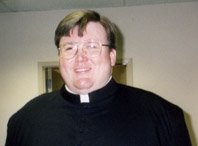
Of Course, This Happens Now...
After I go to the trouble to install Haloscan comments, and pay for their "premium" service, what happens?
Haloscan goes all wacky, and stops working.
Sheesh, great job, people.
Sorry for any inconvenience. Hopefully they'll get it sorted out soon.
[Update (5:15 PM): Oh joy, unconfined! It appears that Haloscan is working again. Here's hoping it stays that way.]
Wednesday, July 02, 2008
A Week of Musical Heaven In Chicago!
I participated in the annual Church Music Association of America (CMAA) Sacred Music Colloquium in Chicago during the week before last. It was billed as "7 Days of Musical Heaven", and that description wasn't far off at all. I had the opportunity to work with some world-class experts in sacred music, priests who were veritable fonts of liturgical knowledge, and make some great new friends. This year's Colloquium was held at Loyola University in Chicago, which was an excellent venue. But in addition, being there was a nifty experience for me, as I had lived just four blocks North of Loyola for three years after college. So it was kind of a homecoming for me as well. Loyola is set right on Lake Michigan, and is quite picturesque:

(Note: photos have been kept small to make loading of the blog less taxing - all photos can be viewed full-size by clicking on them.)
I had looked forward to going to the Colloquium. But after the first couple of days, I realized that I had really needed something like it. This thought struck me after my second rehearsal with Dr. Mahrt's polyphonic choir. I thought, "Wow! I really needed this." Being surrounded by, and being in the midst of making, so much beautiful music was a spiritual tonic.
The liturgies at the Colloquium were beautiful and inspiring. There was an even mix of Masses celebrated according to the Missal of Paul VI and that of Pius V (Extraordinary Form). What they all shared, regardless of form, was reverence, devotion, and superlatively beautiful music. All the liturgies were celebrated in Loyola's Madonna Della Strada Chapel, which is quite lovely, as well as having great acoustics:

A View of the Chapel

The Interior of the Chapel
On Thursday, June 19, Fr. Robert Pasley celebrated a sung Mass in the Extraordinary Form (Missa Cantata). Fr. Pasley is the Rector of a Extraordinary Form parish in the Diocese of Camden, New Jersey.

Fr. Pasley Incensing the Altar
On Friday, June 20, we had the privilege of having Bishop Salvatore Cordileone (auxiliary of San Diego) celebrate Mass in the Ordinary form. It was a votive Mass for the Holy Father, and so, fittingly, one of the polyphonic choirs sang Palestrina's Tu Es Petrus ("You are Peter, and upon this rock I will build my Church..." Matthew 16:18-19):
Tu Es Petrus
(Recording by Aristotle Esguerra, edited and optimized by me)
But one of the biggest moments for me, personally, came on Wednesday, June 18, for on this day I was the principal celebrant for a sung Requiem Mass in the Ordinary Form, celebrated ad orientem, with complete Gregorian propers. It was truly a privilege for me to celebrate this liturgy, and one of the highlights of my priesthood thus far. I was ably assisted by Fr. Scott Haynes and several servers from the Canons Regular of St. John Cantius. Here am I, Fr. Haynes, and some of the servers getting ready for Mass:

(photo courtesy of Jeffrey Ostrowski)
Here am I with the concelebrants, processing into the church (Photos courtesy of Roseanne Sullivan):

Note the black vestments!

Preparing to incense the altar.
And of course, while we were processing in and incensing, the women's schola sang the Introit, Requiem Aeternam (Eternal rest grant unto them, O Lord...):
Requiem Aeternam
(Recording by Carl Dierschow, edited and optimized by me)

Chanting the Collect
Here is the men's schola chanting the Gradual, Requiem Aeternam:
Requiem Aeternam - Gradual
(Recording by Aristotle Esguerra, edited and optimized by me)
Eternal rest grant unto them, O Lord,
and may perpetual light shine upon them.
V.The righteous shall be remembered forever;
he shall never fear evil tidings.

A good view of the sanctuary while I am chanting the Gospel.
(photo courtesy of Jeffrey Ostrowski)
In addition to the chant, there was excellent polyphony as well. One of the polyphonic choirs, directed by Horst Bucholz, sang Hernando Franco's Circumdederunt Me at the Offertory:
Circumdederunt Me
(Recording by Carl Dierschow, edited and optimized by me)
The groanings of the dead have surrounded me,
the sorrows of the netherworld have compassed me about.
Here I am chanting the Canon:

(photos courtesy of Roseanne Sullivan)
During Communion another polyphonic choir, under the direction of Scott Turkington, sang one of my favorite pieces of all time, William Byrd's Ave Verum Corpus (Hail true body...):

Ave Verum Corpus
(Recording by Carl Dierschow, edited and optimized by me)
Hail true body, born of the Virgin Mary,
truly suffering, sacrificed on the cross for mankind:
From whose pierced side flowed blood and water;
Be for us a foretaste in the final trial.
O sweet, O merciful, O Jesus, Son of Mary,
Have mercy on me. Amen.
We concluded Mass, and the ministers and I processed out, with the singing of the In Paradisum, sung by the whole congregation. Hearing this sung by some 250 people sent shivers down my spine!
In Paradisum
(Recording by Carl Dierschow, edited and optimized by me)
May the angels lead you into paradise:
may the martyrs receive you at your coming,
and lead you into the holy city, Jerusalem.
May the choir of angels receive you,
and with Lazarus, who once was poor,
may you have everlasting rest.

The congregation, ministers, and myself as we began the Recession.
(photo courtesy of Jeffery Ostrowski)
This was just one of the liturgies that week! And, musically speaking, it was perhaps the most "low-key" of all the liturgies. For real magnificence, I'll have another post up soon with photos and recordings of the Solemn Pontifical Vespers from the Friday evening of Colloquium week.
I participated in the annual Church Music Association of America (CMAA) Sacred Music Colloquium in Chicago during the week before last. It was billed as "7 Days of Musical Heaven", and that description wasn't far off at all. I had the opportunity to work with some world-class experts in sacred music, priests who were veritable fonts of liturgical knowledge, and make some great new friends. This year's Colloquium was held at Loyola University in Chicago, which was an excellent venue. But in addition, being there was a nifty experience for me, as I had lived just four blocks North of Loyola for three years after college. So it was kind of a homecoming for me as well. Loyola is set right on Lake Michigan, and is quite picturesque:

(Note: photos have been kept small to make loading of the blog less taxing - all photos can be viewed full-size by clicking on them.)
I had looked forward to going to the Colloquium. But after the first couple of days, I realized that I had really needed something like it. This thought struck me after my second rehearsal with Dr. Mahrt's polyphonic choir. I thought, "Wow! I really needed this." Being surrounded by, and being in the midst of making, so much beautiful music was a spiritual tonic.
The liturgies at the Colloquium were beautiful and inspiring. There was an even mix of Masses celebrated according to the Missal of Paul VI and that of Pius V (Extraordinary Form). What they all shared, regardless of form, was reverence, devotion, and superlatively beautiful music. All the liturgies were celebrated in Loyola's Madonna Della Strada Chapel, which is quite lovely, as well as having great acoustics:


On Thursday, June 19, Fr. Robert Pasley celebrated a sung Mass in the Extraordinary Form (Missa Cantata). Fr. Pasley is the Rector of a Extraordinary Form parish in the Diocese of Camden, New Jersey.

On Friday, June 20, we had the privilege of having Bishop Salvatore Cordileone (auxiliary of San Diego) celebrate Mass in the Ordinary form. It was a votive Mass for the Holy Father, and so, fittingly, one of the polyphonic choirs sang Palestrina's Tu Es Petrus ("You are Peter, and upon this rock I will build my Church..." Matthew 16:18-19):
Tu Es Petrus
(Recording by Aristotle Esguerra, edited and optimized by me)
But one of the biggest moments for me, personally, came on Wednesday, June 18, for on this day I was the principal celebrant for a sung Requiem Mass in the Ordinary Form, celebrated ad orientem, with complete Gregorian propers. It was truly a privilege for me to celebrate this liturgy, and one of the highlights of my priesthood thus far. I was ably assisted by Fr. Scott Haynes and several servers from the Canons Regular of St. John Cantius. Here am I, Fr. Haynes, and some of the servers getting ready for Mass:

Here am I with the concelebrants, processing into the church (Photos courtesy of Roseanne Sullivan):


And of course, while we were processing in and incensing, the women's schola sang the Introit, Requiem Aeternam (Eternal rest grant unto them, O Lord...):
Requiem Aeternam
(Recording by Carl Dierschow, edited and optimized by me)

Here is the men's schola chanting the Gradual, Requiem Aeternam:
Requiem Aeternam - Gradual
(Recording by Aristotle Esguerra, edited and optimized by me)
and may perpetual light shine upon them.
V.The righteous shall be remembered forever;
he shall never fear evil tidings.

(photo courtesy of Jeffrey Ostrowski)
In addition to the chant, there was excellent polyphony as well. One of the polyphonic choirs, directed by Horst Bucholz, sang Hernando Franco's Circumdederunt Me at the Offertory:
Circumdederunt Me
(Recording by Carl Dierschow, edited and optimized by me)
the sorrows of the netherworld have compassed me about.
Here I am chanting the Canon:

During Communion another polyphonic choir, under the direction of Scott Turkington, sang one of my favorite pieces of all time, William Byrd's Ave Verum Corpus (Hail true body...):

Ave Verum Corpus
(Recording by Carl Dierschow, edited and optimized by me)
truly suffering, sacrificed on the cross for mankind:
From whose pierced side flowed blood and water;
Be for us a foretaste in the final trial.
O sweet, O merciful, O Jesus, Son of Mary,
Have mercy on me. Amen.
We concluded Mass, and the ministers and I processed out, with the singing of the In Paradisum, sung by the whole congregation. Hearing this sung by some 250 people sent shivers down my spine!
In Paradisum
(Recording by Carl Dierschow, edited and optimized by me)
may the martyrs receive you at your coming,
and lead you into the holy city, Jerusalem.
May the choir of angels receive you,
and with Lazarus, who once was poor,
may you have everlasting rest.

(photo courtesy of Jeffery Ostrowski)
This was just one of the liturgies that week! And, musically speaking, it was perhaps the most "low-key" of all the liturgies. For real magnificence, I'll have another post up soon with photos and recordings of the Solemn Pontifical Vespers from the Friday evening of Colloquium week.
Tuesday, July 01, 2008
Haloscan Commenting Added!
I've made a change to the commenting feature of the blog: Namely, I've dropped the limited Blogger comment function and instead gone with the Haloscan commenting service.
This means that you no longer need to be a registered user or sign in in order to comment.
But the Haloscan service allows me to see the commentor's IP address, which is useful for tracking down spammers, as well as allowing me to ban the obscene, obnoxious, or socially oblivious.
So, comment away! Just don't forget that you're in my (virtual) living room.
Monday, June 02, 2008
How Big a Problem is Clericalism in the Church Today?
Over at Inside Catholic, I participated in a symposium titled "Ending Clericalism". Prominent Catholics such as Bishop Michael Sheridan of Colorado Springs, Bill Donohue, Mark Shea, and others contributed their thoughts, so I am honored to be among such company.
Some, such as Leon Suprenant, commented on the problem of clericalization of the laity, the idea that the laity being "involved" in the Church means they must be engaged in some public ministry:
I focused on the confusion of vocations that has occured in the post-Vatican II period. Among other things, I wrote:
I also wrote:
My piece is here. But do read the whole thing - there's a lot of food for thought here!
Over at Inside Catholic, I participated in a symposium titled "Ending Clericalism". Prominent Catholics such as Bishop Michael Sheridan of Colorado Springs, Bill Donohue, Mark Shea, and others contributed their thoughts, so I am honored to be among such company.
Some, such as Leon Suprenant, commented on the problem of clericalization of the laity, the idea that the laity being "involved" in the Church means they must be engaged in some public ministry:
Today, clericalism often manifests itself in a radically different way, through what is sometimes called the clericalization of the laity, which involves lay people's aspiring to roles normally reserved to priests in order to feel as though they're an important part of the Church. This mindset is seen in the proliferation of liturgical ministers, but perhaps most clearly in the demand for the ordination of women, married men, and openly homosexual men.
I focused on the confusion of vocations that has occured in the post-Vatican II period. Among other things, I wrote:
While I have no doubt that in some places the old-fashioned "my-way-or-the-highway" autocratic clericalism still exists, I have found that what is far more prevalent is the confusion of vocations and roles described by Mark Shea and others here at Inside Catholic.
I also wrote:
Both of these abuses [of authority] involve those with legitimate authority in one sphere attempting to usurp authority in another sphere, not properly theirs. And whether it's priests or laypeople doing it, it's destructive.
My piece is here. But do read the whole thing - there's a lot of food for thought here!
Sorry For Any Inconvenience...
But I've had to restrict commenting to registered users only. If you have a Google account, an account with any of the major blogging services such as WordPress or LiveJournal, or are registered with Open ID, you can comment.
I've had a spate of childish comment spam of late, mostly dealing with bodily functions, which has made this step necessary. Hopefully it will only be a temporary measure.
Friday, May 23, 2008
Re-building a Catholic Culture...
By restoring continuity with Tradition.
That, it seems to me, is what Pope Benedict's pontificate is all about.
Here at St. Stanislaus, one of the ways I'm trying to follow the pope's lead is in a program we started in our parish school last year, Liturgical Music.
In this program (which I am currently teaching) our children learn about the liturgy and learn the basic Catholic prayers, as well as the Ordinary of the Mass, in Latin. I also teach them Gregorian Chant as well as other Catholic sacred music, and we try to give them an exposure to some of the treasures of our rich tradition.
And the program is bearing fruit. You can hear that in the recording I posted last week of our children chanting the Gloria at a school Mass.
Here is another recording, this time of our fifth and sixth graders. I taught them the Regina Coeli, and this is them singing it at one of our Masses during the Easter season.
Regina Coeli
I am tremendously proud of our kids!
Music from St. Stanislaus
Here is a recording of our current Music Director, Gavin Craig, playing Dietrich Buxtehude's (1637-1707) Prelude in G.
Prelude in G
Here is a recording of our current Music Director, Gavin Craig, playing Dietrich Buxtehude's (1637-1707) Prelude in G.
Prelude in G
Music Director Position Announcement
Our Music Director here at St. Stanislaus is leaving us in a few weeks, in order to return to school full-time.
So, we are now searching for a new Music Director/Organist. I hope to fill the position by early July.
St. Stanislaus is a parish in the Diocese of Kalamazoo of about 250 families. We have a school whose enrollment is approximately 90 students, which I believe is one of the best little schools in our diocese.
The position is 1/2 to 3/4 time, depending on how we integrate certain aspects of the school music program. We may be able to combine this position with other responsibilities to create a full-time position.
The candidate should possess competency in organ: ability to accompany congregational singing and familiarity with simpler organ repertoire. Competency in other instruments would be a plus. He/she should also have basic knowledge of choral conducting. Knowledge of Gregorian Chant would be a plus.
The Music Director/Organist plays at the two Sunday Masses (Ordinary Form), and directs the adult choir, which rehearses once per week. The Music Director, in consultation with the pastor, also plans and provides music for the weekly school Mass.
Salary will be commensurate with education and experience.
Download the full job description.
If you are interested, or know someone who might be, please contact me! And please get the word out!

Friday, May 16, 2008
Speaking of Renewing the Culture...
Here at St. Stanislaus, I've been teaching the children in our school a regular weekly "Liturgical Music" class, designed to introduce our kids to the treasury of Catholic sacred music.
This has borne excellent fruit: our kids know the Ordinary of the Mass in Latin, and have been taught some wonderful music in both Latin and English. An example of what we've accomplished can be heard here - the kids singing Gloria VIII, recorded at a school Mass earlier in the Easter season:
Gloria VIII
Gloria in excelsis, indeed!
Beauty, Subjectivism, and Liturgical Music
As the conversation has gone across the Catholic web about liturgy and music, a frequent thread or tendency of thought has surfaced repeatedly: that is, the idea that "beauty is in the eye of the beholder". An example of this kind of thinking was seen in the comments of a Catholic blog a while back:
This attitude seems to me to sum up the thinking of many, if not most, Catholics, whether musicians or those in the pews. On numerous occasions, in my efforts to explain and promote the authentic vision of Vatican II regarding liturgy and music, I have heard from parishioners and others a response something like this:
Alasdair McIntyre, in his seminal book After Virtue, described this mode of thinking as emotivism, that is, the collapsing of all moral or qualitative judgments into mere expressions of personal preference. And this kind of thinking is the besetting sin of the post-modern West.
What is missing in the thinking illustrated above is any sense that the liturgy, and the music of the liturgy, has any objective quality whatsoever.
The fact is, the Church has never treated the liturgy and its music in the relativized and subjective fashion typified above. Indeed, to adopt that kind of relativism is to reject the mind of the Church. The Church has always insisted that there are norms for liturgical art and music which stem from the objective nature of the liturgy itself. The liturgy, being the re-presentation of the saving action of Christ, is the most objective thing in human experience. It is God Himself, making Himself present to us. As Pope Benedict taught earlier this week:
Thus, the liturgy has an objective nature to which we more or less perfectly conform ourselves. The Church expresses her appreciation of this objectivity by holding up certain forms or expressions as models which we are urged to adopt and which have been treated as sources or starting points for development which is "organic", that is, which always respects and makes reference to the model. In the area of music, the Church has held up chant and polyphony as those models.
The post-conciliar period has seen, in many if not most sectors of the Church, a loss of a sense of the objective nature of the liturgy. With the liturgy coming to be seen, as Pope Benedict has written, as the outlet for personal "creativity", the liturgy became something expressing not that which is universal and objective, but private and subjective. As I have argued previously, the liturgy was made a vehicle for all sorts of agendas and ideologies which, in many cases, were at odds with the Faith. As a result, our understanding of, appreciation for, and ability to apprehend the liturgy have all been compromised.
There is certainly an element of truth in the sentiment "beauty is in the eye of the beholder". If someone does not "see" beauty, they don't see it. But the problem is that the person uttering the sentiment treats it as though that is all there is to be said about the matter. If the "eye of the beholder" doesn't see it, well, that's it. The sentiment treats the "eye of the beholder" as though it were an infallible and final arbiter of the matter, and it isn't.
What if the "eye of the beholder" is blind? What if the ear of the beholder is deaf? What if the eye of the beholder has been perverted and deformed by a constant exposure to disorder and ugliness? What if the ear of the beholder has been corrupted by a steady diet of noise and chaos? In such cases, the beholder's ability to apprehend beauty is severely compromised, and his judgment is not to be relied upon. What we must be willing to say, and what the Church has not shied away from saying dowm through the ages, is that sometimes the eye of the beholder is wrong.
Aristotle taught that the ability to make correct judgments was about more than simply amassing the necessary data. It involves the training and formation of the person in virtue, so that he has the kind of mind and soul that can apprehend the True, the Good, and the Beautiful. These three Transcendentals have a moral quality, and the inculcation of moral excellence and the ability to make right moral judgments requires, as the ancients taught, and as the Church continues to teach, the proper formation of the mind and soul.
The culture in which we live is formative. It both shapes and expresses our attitudes, values, and tastes. The culture can be said to be an "incarnation" of our values and priorities. The Church has always understood the power of cultural expressions - music, art, etc., and because of this has always jealously guarded the way that the Faith is "incarnated" in cultural forms, particularly in the liturgy. The Church, understanding and living the principle of lex orandi, lex credendi, wants to make sure that there are no "mixed messages" to obscure the Faith that we pray. Frequently (and no more so than today), the dominant culture which surrounds us proposes to us attitudes, values, and tastes which are inimical to the Faith. And so she has insisted that the liturgy itself, it's texts and actions, be taken as the source of our cultural expression.
So the question is, have we, as Church, been forming our Catholic people according to the mind of the Church to understand and apprehend the objective nature of the liturgy? Have we been giving them a liturgical formation which takes the texts and actions of the liturgy, as lived in continuity thorough the ages, as the primary source of our music and art in the post-conciliar period? I would have to say, "No."
No, what has happened in large part is that extra-liturgical forms and even sometimes texts, many of which come from the dominant mass culture, have been imposed on the liturgy from without. And this has obscured the meaning and nature of the liturgy. It has led to confusion and a weakening of faith. A people that has been led to believe that the liturgy is whatever Father Feelgood or Sister Liturgist make it this week is not a people who will necessarily be able to properly apprehend truth or beauty when they encounter it. The moral equipment that they need to do this has been damaged, and it needs to be repaired.
And how is this repair to be effected? Slowly, firmly, and with great patience and charity. Pope Benedict has led the way to re-building the culture. Priests, musicians, and those of us who love and treasure the Church's great liturgical patrimony must engage in the work of leading people, often one by one, to a re-appropriation of what the Church offers us. And, first and foremost, we must give an example of joy and love, so that all will see that Beauty does indeed lead to God.
As the conversation has gone across the Catholic web about liturgy and music, a frequent thread or tendency of thought has surfaced repeatedly: that is, the idea that "beauty is in the eye of the beholder". An example of this kind of thinking was seen in the comments of a Catholic blog a while back:
And so I think that beauty is in the eye of the beholder, so therefore if you consider something beautiful, that is your perorgative [sic]...
This attitude seems to me to sum up the thinking of many, if not most, Catholics, whether musicians or those in the pews. On numerous occasions, in my efforts to explain and promote the authentic vision of Vatican II regarding liturgy and music, I have heard from parishioners and others a response something like this:
Well, Father, you like all that classical music and chant, and the traditional hymns, and that's fine for you. But I [we] like [insert musical genre here], and, after all, it's all for God's praise. One kind of music is just as good as another.
Alasdair McIntyre, in his seminal book After Virtue, described this mode of thinking as emotivism, that is, the collapsing of all moral or qualitative judgments into mere expressions of personal preference. And this kind of thinking is the besetting sin of the post-modern West.
What is missing in the thinking illustrated above is any sense that the liturgy, and the music of the liturgy, has any objective quality whatsoever.
The fact is, the Church has never treated the liturgy and its music in the relativized and subjective fashion typified above. Indeed, to adopt that kind of relativism is to reject the mind of the Church. The Church has always insisted that there are norms for liturgical art and music which stem from the objective nature of the liturgy itself. The liturgy, being the re-presentation of the saving action of Christ, is the most objective thing in human experience. It is God Himself, making Himself present to us. As Pope Benedict taught earlier this week:
...[T]he liturgy is not something constructed by us, something invented to produce a religious experience during a certain period of time; it is singing with the choir of creatures and entering into the cosmic reality itself [emphasis mine].
Thus, the liturgy has an objective nature to which we more or less perfectly conform ourselves. The Church expresses her appreciation of this objectivity by holding up certain forms or expressions as models which we are urged to adopt and which have been treated as sources or starting points for development which is "organic", that is, which always respects and makes reference to the model. In the area of music, the Church has held up chant and polyphony as those models.
The post-conciliar period has seen, in many if not most sectors of the Church, a loss of a sense of the objective nature of the liturgy. With the liturgy coming to be seen, as Pope Benedict has written, as the outlet for personal "creativity", the liturgy became something expressing not that which is universal and objective, but private and subjective. As I have argued previously, the liturgy was made a vehicle for all sorts of agendas and ideologies which, in many cases, were at odds with the Faith. As a result, our understanding of, appreciation for, and ability to apprehend the liturgy have all been compromised.
There is certainly an element of truth in the sentiment "beauty is in the eye of the beholder". If someone does not "see" beauty, they don't see it. But the problem is that the person uttering the sentiment treats it as though that is all there is to be said about the matter. If the "eye of the beholder" doesn't see it, well, that's it. The sentiment treats the "eye of the beholder" as though it were an infallible and final arbiter of the matter, and it isn't.
What if the "eye of the beholder" is blind? What if the ear of the beholder is deaf? What if the eye of the beholder has been perverted and deformed by a constant exposure to disorder and ugliness? What if the ear of the beholder has been corrupted by a steady diet of noise and chaos? In such cases, the beholder's ability to apprehend beauty is severely compromised, and his judgment is not to be relied upon. What we must be willing to say, and what the Church has not shied away from saying dowm through the ages, is that sometimes the eye of the beholder is wrong.
Aristotle taught that the ability to make correct judgments was about more than simply amassing the necessary data. It involves the training and formation of the person in virtue, so that he has the kind of mind and soul that can apprehend the True, the Good, and the Beautiful. These three Transcendentals have a moral quality, and the inculcation of moral excellence and the ability to make right moral judgments requires, as the ancients taught, and as the Church continues to teach, the proper formation of the mind and soul.
The culture in which we live is formative. It both shapes and expresses our attitudes, values, and tastes. The culture can be said to be an "incarnation" of our values and priorities. The Church has always understood the power of cultural expressions - music, art, etc., and because of this has always jealously guarded the way that the Faith is "incarnated" in cultural forms, particularly in the liturgy. The Church, understanding and living the principle of lex orandi, lex credendi, wants to make sure that there are no "mixed messages" to obscure the Faith that we pray. Frequently (and no more so than today), the dominant culture which surrounds us proposes to us attitudes, values, and tastes which are inimical to the Faith. And so she has insisted that the liturgy itself, it's texts and actions, be taken as the source of our cultural expression.
So the question is, have we, as Church, been forming our Catholic people according to the mind of the Church to understand and apprehend the objective nature of the liturgy? Have we been giving them a liturgical formation which takes the texts and actions of the liturgy, as lived in continuity thorough the ages, as the primary source of our music and art in the post-conciliar period? I would have to say, "No."
No, what has happened in large part is that extra-liturgical forms and even sometimes texts, many of which come from the dominant mass culture, have been imposed on the liturgy from without. And this has obscured the meaning and nature of the liturgy. It has led to confusion and a weakening of faith. A people that has been led to believe that the liturgy is whatever Father Feelgood or Sister Liturgist make it this week is not a people who will necessarily be able to properly apprehend truth or beauty when they encounter it. The moral equipment that they need to do this has been damaged, and it needs to be repaired.
And how is this repair to be effected? Slowly, firmly, and with great patience and charity. Pope Benedict has led the way to re-building the culture. Priests, musicians, and those of us who love and treasure the Church's great liturgical patrimony must engage in the work of leading people, often one by one, to a re-appropriation of what the Church offers us. And, first and foremost, we must give an example of joy and love, so that all will see that Beauty does indeed lead to God.
Monday, March 24, 2008
Resurrexit, Sicut Dixit, Alleluia!

Jaroslav Pelikan once wrote:
If Christ is risen from the dead, nothing else matters.
If Christ is not risen from the dead, nothing else matters.
Yesterday we sang the Easter Sequence, and may do so at all the liturgies of this week:
Christians to the Paschal Victim
Offer your thankful praises!
A Lamb the sheep redeemeth;
Christ who only is sinless,
Reconcileth sinners to the Father.
Death and life have contended in that combat stupendous:
The Prince of Life, who died, reigns immortal.
Speak, Mary, declaring what thou sawest, wayfaring
The tomb of Christ, who is living,
The glory of Jesus' resurrection:
Bright angels attesting,
The shroud and grave clothes resting.
Yea, Christ my hope is arisen:
To Galilee He goes before you.
Christ indeed from death is risen, our new life obtaining.
Have mercy, victor King, ever reigning!

Have mercy, victor King, ever reigning!

Jaroslav Pelikan once wrote:
If Christ is not risen from the dead, nothing else matters.
Yesterday we sang the Easter Sequence, and may do so at all the liturgies of this week:
Offer your thankful praises!
A Lamb the sheep redeemeth;
Christ who only is sinless,
Reconcileth sinners to the Father.
Death and life have contended in that combat stupendous:
The Prince of Life, who died, reigns immortal.
Speak, Mary, declaring what thou sawest, wayfaring
The tomb of Christ, who is living,
The glory of Jesus' resurrection:
Bright angels attesting,
The shroud and grave clothes resting.
Yea, Christ my hope is arisen:
To Galilee He goes before you.
Christ indeed from death is risen, our new life obtaining.
Have mercy, victor King, ever reigning!

Have mercy, victor King, ever reigning!
Friday, February 29, 2008
Holy See Makes It Clear: Baptism in "Non-Standard Formulae" Invalid
From the Vatican Information Service:
Fortunately, the stupidity of using "creative" baptismal forms isn't as prevalent today as it was in the 80's and early '90s. Back then, it seemed like every wifty, self-styled "hip" priest was coming up with his own baptismal formula, marked by his own oh-so-personal style. Never mind the Lord's specific command and the universal practice of the Church for 20 centuries...
Back when I was in graduate school at Catholic University (early-mid '90's), such a baptism took place on campus. It was not conducted by a university chaplain, but by an outside priest for an alumnus in one of the University chapels. The story got out and created a bit of a stir: the Archdiocese of Washington apparently got involved and insisted the child be re-baptized using the proper formula. Why? The response of the CDF explains:
From the Vatican Information Service:
The first question is: "Is a Baptism valid if conferred with the words 'I baptise you in the name of the Creator, and of the Redeemer, and of the Sanctifier', or 'I baptise you in the name of the Creator, and of the Liberator, and of the Sustainer'"?
The second question is: "Must people baptised with those formulae be baptised 'in forma absoluta'?"
The responses are: "To the first question, negative; to the second question, affirmative".
Fortunately, the stupidity of using "creative" baptismal forms isn't as prevalent today as it was in the 80's and early '90s. Back then, it seemed like every wifty, self-styled "hip" priest was coming up with his own baptismal formula, marked by his own oh-so-personal style. Never mind the Lord's specific command and the universal practice of the Church for 20 centuries...
Back when I was in graduate school at Catholic University (early-mid '90's), such a baptism took place on campus. It was not conducted by a university chaplain, but by an outside priest for an alumnus in one of the University chapels. The story got out and created a bit of a stir: the Archdiocese of Washington apparently got involved and insisted the child be re-baptized using the proper formula. Why? The response of the CDF explains:
"Variations to the baptismal formula - using non-biblical designations of the Divine Persons - as considered in this reply, arise from so-called feminist theology", being an attempt "to avoid using the words Father and Son which are held to be chauvinistic, substituting them with other names. Such variants, however, undermine faith in the Trinity".Let's hope this declaration puts an end to such nonsense once and for all.
"The response of the Congregation for the Doctrine of the Faith constitutes an authentic doctrinal declaration, which has wide-ranging canonical and pastoral effects. Indeed, the reply implicitly affirms that people who have been baptised, or who will in the future be baptised, with the formulae in question have, in reality, not been baptised. Hence, they must them be treated for all canonical and pastoral purposes with the same juridical criteria as people whom the Code of Canon Law places in the general category of 'non-baptised'". (my emphasis)
Wednesday, February 27, 2008
A New Bishop For Diocese of Lansing

The Press office of the Holy See announced this morning that Bishop Earl Boyea, auxiliary of the Archdiocese of Detroit, will be the next bishop of Lansing, succeeding the retiring Bishop Mengeling.
This is a great development for the Diocese of Lansing and for the Church in Michigan.
Bishop Boyea was my spiritual director while I was at Sacred Heart Major Seminary in Detroit, and he was my professor for Church History. We have remained friends since then, and I am proud to be able to call myself such.
Bishop Boyea is a man of great learning, and is wholeheartedly loyal to the Church and to the Magisterium. He is deeply rooted in the Church's Tradition, and is committed to preserving and advancing that Tradition. While he was at Sacred Heart Seminary, he frequently celebrated Mass in Latin for the theologate on Saturday mornings. He is well known in the Detroit area for regularly celebrating Mass according to the Extraordinary Form (Traditional Latin Mass).
He was quite public in his support of the 2005 Vatican "Instruction" concerning homosexuality in the seminaries (sometimes called the "Doomsday Document"), as can be seen in my 2006 Crisis article on the subject.
On a personal note, those who know the bishop will attest to his great good humor and joyfulness. At Sacred Heart Seminary, he had the reputation of being somewhat of a prankster.
The Diocese of Lansing is getting a devoted and loyal son of the Church, and a smart and joyful man in their new bishop. Ad multos gloriosque annos!
Tuesday, February 12, 2008

Are You A "Not Really" Disciple?
Homily for the First Sunday of Lent
Genesis 2:7-9, 3:1-7
Romans 5:12-19
Matthew 4:1-11
In our Gospel we heard about Satan's temptation of Jesus. Notice that Satan didn't beat around the bush with Jesus. He didn't try to get into subtle arguments; he came at Jesus "head on" and offered him power, dominion, and the rest. Now usually Satan is more subtle with us - he tries to seduce us, to trick us. That's what we heard in our first reading, from Genesis. Satan says to Eve "Did God really tell you not to eat from the Tree?" And the implication is clear: "Oh, no, God didn't really mean for you not to eat of the fruit..." And it all went downhill from there.
This is what I call "not really" kind of thinking. We've all heard that sort of thing: "Surely God didn't really mean that." "Of course, nobody really believes that sort of thing anymore." Notice that when people say that sort of thing, they don't actually make an argument or give reasons why one shouldn't believe this or that. No, the trick here is to imply that such beliefs are stupid or silly, and that if you believe them, it's because you're silly or just not very bright.
A few years ago I was on airplane flying out East on vacation. I usually wear my clerics when I fly. Not that it gets me any special treatment - in fact I'm more likely to get put in the "special" security line at the airport when I am wearing my clerics than if I'm dressed in lay clothing. Go figure...
But after we took off and had been flying for a little while, the gentleman across the aisle from me leaned over and said "Excuse me, but are you a Catholic priest?" "Yes, I am", I answered. He then said "Wow, I haven't actually met a Catholic priest in years. And to meet one so young! I figured all you guys were getting old and dying out." I answered saying, "well, no, there are quite a few of us still around." We talked for a few more minutes, (it was clear he was not Catholic) and then went back to our own pursuits. After a few more minutes, he leaned over again and said "Excuse me again, I'm sorry to bother you, but I just have to ask, do you really believe all that stuff?" I was somewhat put-off by this, but I figured he wasn't trying to be offensive, so I answered him, saying "I'm not sure what you mean by "all that stuff", but yes, I believe in the Catholic faith. I wouldn't be dressed like this if I didn't." He then said "well, you know, heaven, angels, the devil, sin, all that stuff." I responded "Yes, I believe that the Catholic faith is true." We chatted for a few more minutes, and then he went back to his magazine.
As soon as I read our first reading from Genesis, I thought of that gentleman and our conversation. But the fact is, that kind of "not really" thinking has permeated, has filtered into, even our thinking as Catholics. You don't have to look very hard or very far to find it. Unfortunately, you can even find priests here and there that will talk that kind of "not really" talk. I'm sure we've all heard it, and maybe we've even said things like this ourselves: "Oh, the Church doesn't really teach that anymore". "You don't really have to do that." "You don't really have to go to confession". "We don't really have to do what the Church asks of us in the liturgy." And so on. A few weeks ago, I read that in a survey of Catholics, again, let me stress these are people who identify themselves as Catholic, that over 70% of them said that you could be a good Catholic without attending Mass regularly. There it is: "You don't really have to go to Mass on Sunday. You can stay home, or go play golf, and still be a good Catholic."
Now, that's not the thinking of a disciple. A disciple doesn't ask "how little can I get away with doing?" A disciple asks "how can I be more faithful?" And this season of Lent is the antidote to "not really" thinking. "Not really" thinking is just one more way we try to put Self in front of God. It's just one more way we try to shape the Gospel according to my priorities and desires. And Lent, and the disciplines of Lent, are given to us to get our attention off of our Selves and on to Christ.
By our Prayer, we draw closer to Christ. We learn not only to talk to Him and give ourselves to Him, but we learn to listen to Him, so that His mind and will become my mind and will. By our almsgiving we do without things for ourselves in order to serve the needs of others, in whom we serve Christ. And by our fasting we join ourselves to Christ's Passion, and train ourselves to put aside the clamor of our appetites and desires, in order to allow Him to become more truly our Lord.
The challenge before us this Lent is this: Will I put my self aside for Him? Will I refocus my heart, mind, and will, on Him? Will I be a more faithful follower of Christ?
What are we going to be? Wholehearted disciples of Christ, or "not really" disciples?
Obama Is the Light of the World

Behold, the People who walked in darkness have seen a Great Light.
Source

Source
Thursday, February 07, 2008
Oh, The Weather Outside Is Frightful...
It's been a tough winter here in Western Michigan. The school has had 7 snow days so far, and we're nowhere near a hint of Spring yet.
We had quite a display of winter's worst yesterday afternoon, with over a foot of snow falling in about 12 hours.
Here's a photo of the church and rectory at the storm's worst:

And my humble abode:

A winter wonderland!

The View of My Backyard
It's been a tough winter here in Western Michigan. The school has had 7 snow days so far, and we're nowhere near a hint of Spring yet.
We had quite a display of winter's worst yesterday afternoon, with over a foot of snow falling in about 12 hours.
Here's a photo of the church and rectory at the storm's worst:

And my humble abode:

A winter wonderland!

Tuesday, January 22, 2008
A Day of Penance
Today, 35 years ago, the United States Supreme Court, in an exercise of "raw judicial power" struck down all legal protection on infants in the womb. In one blow, the Court made a whole class of human beings "unpersons" and ushered in the regime of abortion-on-demand that now results in the deaths of some 3,500 unborn children every day, with a ghastly toll of over 40 million dead since 1973.
The U.S. Bishops have designated this day as a "Day of Penance" for abortion, and ask us to engage in prayer and works of penance in reparation for abortion and to bring about an end to abortion. Here at St. Stanislaus, our Mass will be at 5:30 PM. Today , I am praying the Office of the Dead for all the victims of abortion:
Psalm 129
From the depths I have cried to thee O Lord: Lord hear my voice.
Let thine ears be attentive: unto the voice of my petition.
If thou wilt observe iniquities O Lord: Lord who shall endure it?
Because with thee there is pitifulness:
and for thy law I have expected thee O Lord.
My soul hath stayed in his word: my soul hath hoped in our Lord.
From the morning watch even until night: let Israel hope in our Lord.
Because with our Lord there is mercy:
and with him plentiful redemption.
And he shall redeem Israel: from all his iniquities.
Requiem aeternam dona eis Domine: et lux perpetua luceat eis.
Please pray for the victims of abortion, and for those who have had abortions or cooperated in abortion, for their repentance and conversion of heart. Pray also for our land, that we would once again protect the lives of the most innocent and vulnerable.
Today, 35 years ago, the United States Supreme Court, in an exercise of "raw judicial power" struck down all legal protection on infants in the womb. In one blow, the Court made a whole class of human beings "unpersons" and ushered in the regime of abortion-on-demand that now results in the deaths of some 3,500 unborn children every day, with a ghastly toll of over 40 million dead since 1973.
The U.S. Bishops have designated this day as a "Day of Penance" for abortion, and ask us to engage in prayer and works of penance in reparation for abortion and to bring about an end to abortion. Here at St. Stanislaus, our Mass will be at 5:30 PM. Today , I am praying the Office of the Dead for all the victims of abortion:
From the depths I have cried to thee O Lord: Lord hear my voice.
Let thine ears be attentive: unto the voice of my petition.
If thou wilt observe iniquities O Lord: Lord who shall endure it?
Because with thee there is pitifulness:
and for thy law I have expected thee O Lord.
My soul hath stayed in his word: my soul hath hoped in our Lord.
From the morning watch even until night: let Israel hope in our Lord.
Because with our Lord there is mercy:
and with him plentiful redemption.
And he shall redeem Israel: from all his iniquities.
Requiem aeternam dona eis Domine: et lux perpetua luceat eis.
Please pray for the victims of abortion, and for those who have had abortions or cooperated in abortion, for their repentance and conversion of heart. Pray also for our land, that we would once again protect the lives of the most innocent and vulnerable.
Friday, January 18, 2008
Liturgy Column for Diocesan Newspaper, The Good News
Last fall, I began contributing a regular column to the newspaper of the Diocese of Kalamazoo, The Good News. In it I'm trying, as the title of the column suggests, to help people not only to understand the Liturgy in and of itself, but understand how it is meant to form how we live our faith. So, here is the first column I published, last September. I'll post my columns here periodically for my web readers as well.
“Living the Liturgy”
Every Sunday, Catholics in the Diocese of Kalamazoo and throughout the world gather in their parish churches. In our churches we continue to do the things we have been doing for 2000 years: We hear the Word of God, we pray, and we sing. But even more than that, we fulfill the Lord’s command to “do this in remembrance of me”. In fulfilling the Lord’s command we offer God the worship that He asks of us, and we are given the most amazing gift of all, the gift of the Lord Jesus Himself.
This way we have of offering worship “in spirit and in truth” is called the Liturgy. The Liturgy most familiar to us is the Liturgy of the Mass. But there are others – there is the Liturgy of Baptism, a liturgy of Confirmation, and the other liturgies by which the Sacraments are celebrated and ministered to us. In fact, though you may not be accustomed to think of it as such, even the celebration of the Sacrament of Reconciliation is a liturgical one, for in it the forgiveness of Christ is given to us through His Church. There is even a Liturgy of the Hours, by which Christians for centuries have sanctified each and every day and offered it to God.
We offer our worship to God through the liturgy. We are given sanctifying grace in the Sacraments through the liturgy. We are given Christ Himself, in His Body and Blood, in the liturgy. In the liturgy Christ makes Himself known to us, and He invites us to enter ever more deeply into the mystery of His life, death, and resurrection. So, quite literally, our life in Christ is bound up inextricably with the liturgical life of the Church. The fathers of Vatican II summed it up best in their Constitution on the Sacred Liturgy when they wrote “…the liturgy is the summit toward which the activity of the Church is directed; it is also the fount from which all Her power flows.”
If the liturgy is so vital to our life in Christ, then the better we understand it, the more fully we are able to enter in to it, then the more fully we will be able to live our lives as Catholics. The liturgy, as the council fathers also wrote, “ pertains to the whole Body of the Church.” In other words, we are all participants, sharers, in the liturgical “work” of the Church. And our spiritual well being, our capacity to sanctify the world according to our Baptismal vocation, depends on how fully we are integrated into that work.
An ancient principle of the liturgy is “Lex orandi, lex credendi.” That means, “the rule of prayer is the rule of faith.” In other words, how we pray forms what we believe – what we do in church shapes our life outside of church. Since the Holy Spirit is at work through the Church in Her liturgy, the more closely we live that “lex orandi”, the rule of prayer, according to the mind of the Church, the more rich and fruitful will be the faith that we live.
Hence, this column. In the coming months we’ll be exploring the meaning of the liturgy. The Church has set before us riches of great depth and scope: everything from the 22 different Eastern rites of the Church to the Extraordinary Form of the Roman Rite (sometimes known as the “old” Latin Mass), which our holy father recently made more widely available to enrich the life of the Church. My purpose is not only to help the reader to understand the liturgy, but to enter in to the liturgy. The liturgy isn’t just “what we do on Sundays” – it’s given to us in order to communicate Christ’s life to us, and empower us to then go out into the world as disciples. And that power is there – Christ is waiting to give it to us, if we will just “Live the Liturgy”.
Last fall, I began contributing a regular column to the newspaper of the Diocese of Kalamazoo, The Good News. In it I'm trying, as the title of the column suggests, to help people not only to understand the Liturgy in and of itself, but understand how it is meant to form how we live our faith. So, here is the first column I published, last September. I'll post my columns here periodically for my web readers as well.
Every Sunday, Catholics in the Diocese of Kalamazoo and throughout the world gather in their parish churches. In our churches we continue to do the things we have been doing for 2000 years: We hear the Word of God, we pray, and we sing. But even more than that, we fulfill the Lord’s command to “do this in remembrance of me”. In fulfilling the Lord’s command we offer God the worship that He asks of us, and we are given the most amazing gift of all, the gift of the Lord Jesus Himself.
This way we have of offering worship “in spirit and in truth” is called the Liturgy. The Liturgy most familiar to us is the Liturgy of the Mass. But there are others – there is the Liturgy of Baptism, a liturgy of Confirmation, and the other liturgies by which the Sacraments are celebrated and ministered to us. In fact, though you may not be accustomed to think of it as such, even the celebration of the Sacrament of Reconciliation is a liturgical one, for in it the forgiveness of Christ is given to us through His Church. There is even a Liturgy of the Hours, by which Christians for centuries have sanctified each and every day and offered it to God.
We offer our worship to God through the liturgy. We are given sanctifying grace in the Sacraments through the liturgy. We are given Christ Himself, in His Body and Blood, in the liturgy. In the liturgy Christ makes Himself known to us, and He invites us to enter ever more deeply into the mystery of His life, death, and resurrection. So, quite literally, our life in Christ is bound up inextricably with the liturgical life of the Church. The fathers of Vatican II summed it up best in their Constitution on the Sacred Liturgy when they wrote “…the liturgy is the summit toward which the activity of the Church is directed; it is also the fount from which all Her power flows.”
If the liturgy is so vital to our life in Christ, then the better we understand it, the more fully we are able to enter in to it, then the more fully we will be able to live our lives as Catholics. The liturgy, as the council fathers also wrote, “ pertains to the whole Body of the Church.” In other words, we are all participants, sharers, in the liturgical “work” of the Church. And our spiritual well being, our capacity to sanctify the world according to our Baptismal vocation, depends on how fully we are integrated into that work.
An ancient principle of the liturgy is “Lex orandi, lex credendi.” That means, “the rule of prayer is the rule of faith.” In other words, how we pray forms what we believe – what we do in church shapes our life outside of church. Since the Holy Spirit is at work through the Church in Her liturgy, the more closely we live that “lex orandi”, the rule of prayer, according to the mind of the Church, the more rich and fruitful will be the faith that we live.
Hence, this column. In the coming months we’ll be exploring the meaning of the liturgy. The Church has set before us riches of great depth and scope: everything from the 22 different Eastern rites of the Church to the Extraordinary Form of the Roman Rite (sometimes known as the “old” Latin Mass), which our holy father recently made more widely available to enrich the life of the Church. My purpose is not only to help the reader to understand the liturgy, but to enter in to the liturgy. The liturgy isn’t just “what we do on Sundays” – it’s given to us in order to communicate Christ’s life to us, and empower us to then go out into the world as disciples. And that power is there – Christ is waiting to give it to us, if we will just “Live the Liturgy”.
Ich bin in Deutschen übersetzt worden!
Or, "I have been translated into German!" A German reader, Michael Charlier, was so taken by my thoughts on "The Ideologized Liturgy" that he translated my whole essay into German for the website he maintains, Motu Proprio: Summorum Pontificum. I am very flattered and grateful. The translation of my essay can be found here at the page "Liturgie und Ideologie".
I also got a kick of some of the photos he put up to illustrate some of my points about the "ideologized" liturgy, such as this, which could be used to illustrate several different flavors of liturgical abuse:

For those of you who read any German, his site is worth a visit, quite apart from his appreciation of my efforts!
Thank you, Michael!
Subscribe to:
Comment Feed (RSS)