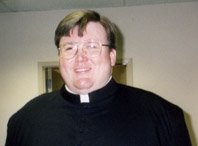
An Occasion of Joy!
Fr. Jeffrey Keyes at The New Gasparian rightly laments that the conversation at St. Blog's about the priesthood has centered around the admittedly-dismal topic of what to do about those priests who have sullied their vocations by the crime of sexual abuse. The topic is painful for Fr. Keyes, as it is indeed for myself, my brother priests, and most Catholics. I hope in this post to provide something of an antidote to that pain and disappointment.
Today and tomorrow are days that give me hope, and I hope will be a source of encouragement to my readers. For tomorrow is a day of particular joy for me, as it is the 1-year anniversary of my priestly ordination. By God's good grace, one year ago tomorrow, Bishop James Murray laid hands upon me and imparted to me the gift of priestly ordination, making me a priest forever after the order of Melchizedek, and giving me the awesome privilege and responsibility of acting in Persona Christi.
I feel particularly favored to have been ordained on the feast of St. John Marie Vianney, patron saint of parish priests. On that day I adopted him as my special patron: I have asked and will continue to ask for his intercession, that I can have some share of the zeal and love for souls that marked his priesthood. I feel especially close to him in regards the sacrament of reconciliation: St. John Marie was renowned for his skill and insight as a confessor. He had the gift of reading souls and people would come from all over France to his humble parish in Ars in order to go to confession with him. He was known on occasion to spend 18 hours in the confessional at a stretch. While I certainly do not claim anything like his gifts or sanctity, I do feel a kinship to him in that I truly love hearing confessions, and dispensing the healing mercy of Christ in that sacramant. The joy and wonder of being a confessor, of seeing souls cleansed and made whole, of seeing the redemptive grace of Christ at work through myself as priest, is something that the seminary didn't (and really couldn't) prepare me for. It is an awesome privilege. It is also a source of great edification to me, for in the sacrament of reconciliation I have been privileged to encounter people who, I am certain, are saints. They are people who look, on the outside, like "ordinary" Catholics, but the depth and richness of their interior lives is a source of wonder to me.
I ask all of my readers to say a prayer for me on my anniversary day, and join me in asking for St. John Vianney's intercession on behalf of all priests.
Another Occasion of Joy!
But today is a day of perhaps even greater joy, for it is a day of joy not only for me but for my whole diocese, and indeed for the whole Church. For today a new priest was added to Christ's Church, and I was privileged to participate in the ordination of Fr. John Fleckenstein to the priesthood of Jesus Christ. Every time a new priest is ordained the Triumph of Christ over sin and death is made that much stronger. Every time a new priest is ordained the Kingdom of God is brought to a fuller realization. Every time a new priest is ordained the boundaries of the kingdom of this world are pushed back a little farther. So it is a day on which all Christians should rejoice. I tell you that the Angels and Saints in heaven are rejoicing!
In spite of the scandal of The Situation and the dismal failure of our bishops I am very hopeful, and I think you should be as well, because the rising generation of young priests and seminarians, like Fr. Fleckenstein, are men of zeal for the authentic Catholic Faith: they are men inspired by, loyal to, and eager to imitate our Holy Father. They not only assent to Church teaching and discipline, they willingly embrace it. And their numbers are growing. I encountered this phenomenon in microcosm, as many recently-ordained priests and seminarians were there at the ordination. I had the good fortune of meeting Fr Raymond D'Souza, about whose First Mass several bloggers wrote a couple of weeks ago. It was an impressive gathering, and something that should give hope to all Catholics.
Let us pray for more such men to follow Christ in the priesthood, and see to it we give these men our support and encouragement.

Friday, August 02, 2002
The Critics Weigh In
Greg Popcak and Woodene Bricker-Koening at the Heart, Mind, & Strength blog voice their objections to the issues raised by Mark Shea and myself yesterday concerning Zero Tolerance. Greg is nothing if not witty: he compares Mark and I to a "Scalia/Thomas tag team". Woodene asks "Do we keep priests around after they've abused someone until they do it a second time and then get rid of them because a second fall indicates they haven't been redeemed?"
Mark Shea answers them brilliantly, and reiterates the problem that Zero Tolerance is not a suitable instrument for balancing mercy and justice, because of its inflexibility.
Now that Mark has said it better than I could have hoped, I have to re-think what I am going to say, since he stole more than a little of my thunder. Not that I mind, of course...
I'll have to get back to the subject later: I have to go and do like, "priest stuff" now, and then I get to go to a birthday party!
Rising Above Lawlessness
I'm going to blog more on the repsonses I've had to my posts about Fr. DeVita later today, but first I'd like to share this with you:
No doubt by now most of you have heard about the senseless and primitive outbreak of mob violence in Chicago that led to two men being beaten to death after a traffic accident Tuesday. Two men whose van ran off the road into a house, injuring three girls, were, within moments, set upon by a mob of angry onlookers and beaten to death with stones and bricks. According to witnesses, the perpetrators were egged on by the crowd with shouts of "kill them" and "bash their heads in" and the like. Though more than 80 people witnessed the beating, police have been stymied by a wall of silence in the neighborhood, as people, either fearful or mistrustful of police, have refused to come forward and provide evidence.
I'm from Chicago: I was born there, grew up in the suburbs, and lived there for a couple of years after college. The parish I'm assigned to is almost directly across Lake Michigan from Chicago: we get Chicago TV and radio stations here, and culturally we're very much in Chicago's orbit. The city (when locals here refer to "The City", they mean Chicago) is only an hour and 15 minute drive away. So this story hits home, it hurts to see something like this happen in the city I love and still consider my home.
But there are still people determined to rise above the lawlessness demonstrated by that mob on Tuesday. In a story in today's Chicago Tribune, community leaders are trying to mobilize local residents to fight back against mob violence:
"It will be devastating if the community does not rise to the challenge and address this," [Najee] Ali said as he slipped fliers under the windshields of cars calling for cooperation with police."
Another resident said "This community is trying to get better but there are people who just don't care. You have to get rid of these bad apples."
I for one am glad to see people are still trying to make things better: to rise above lawlessness and vigilantism to promote a more human city. I want the city I love to be a city I can feel proud of loving.
Thursday, August 01, 2002
More Thoughts on Fr. DeVita and "Self-Aggrandizement"
A couple of bloggers and their readers, among them Amy Welborn and Greg Popcak, have remarked on what they see as evidence of Fr. Tom DeVita's "self-aggrandizement" or "showmanship" in the article on him in today's New York Times. I take a different view of it in my blog below. I am glad that someone like Mark Shea is in agreement with me, but a recent glance at Amy's comments shows more readers who question everything from Fr. DeVita's "exquisite" (the word used by the Times reporter) planning of his "Last Mass" to his decision to cooperate with the press in the first place.
Firstly, it seems that critics of Fr. DeVita's planning of his last Mass at his parish are getting hung up on a word. Shouldn't every Mass be "exquisitely" planned? The fact is, because the Mass in question was his "last", it was de factonot going to be ordinary. Therefore extra (special) planning was needed to deal with such questions as "Will I remain after Mass and let maudlin "good-bye" scenes proliferate?" No. "Will I allow this Mass to take on a somber "funereal" tone?" No. Will I reiterate my hopefulness and trust in Christ?" Yes. To get hung up in criticizing planning seems to me to strain at gnats.
And to those, such as a commentor on Amy's blog called "mary-m", who question his decision to allow himself to be interviewed or photographed in the first place, and take that of evidence of his search for "self-aggrandizement", I submit, as someone who has been interviewed by various organs of the press from time to time, that things one says or does with complete innocence can be transformed by a reporter with an agenda. Last year I was interviewed by a local paper looking for a "Catholic" perspective on the war in Afghanistan. My remarks that the campaign there was substantively self-defensive and limited, and therefore justifiable, was boiled down to "Fr. Johansen favors an aggressive campaign against the Afghans."
For those seeking to understand possible motives for Fr. DeVita's cooperation with the press, I point out that Fr. DeVita is originally from New York (Long Island), and that is where the incident of his abuse took place. I think that fact alone is sufficient to explain the Times' interest, and Fr. DeVita's willingness to cooperate with the press. I suppose he could have told the reporters to "get lost" and not cooperate with them, but that usually only makes them more aggressive and antagonistic. Everyone knows that when a newspaper prints things like "no comment" or "Fr. X refused to grant an interview" it creates the impression of cover-ups or other more sinister activities under the surface, and induces reporters to tear people's lives apart trying to find those things. I think Fr. DeVita can be forgiven for wanting to avoid that situation.
Furthermore, the more I think about the charge that Fr. DeVita is seeking notoriety or self-aggrandizement, the more the charge appears to be patently absurd. Why? Because Fr. DeVita's notoriety is as an admitted priest-abuser. Forever after, Fr. DeVita will be known across the country as "one of those pedophile priests" (Not that he is in fact a pedophile: he is not). That is a very strange form of self-aggrandizement.
The fact is that neither mary-m nor I knows Fr. DeVita's motivation for cooperating with the press. What I know of the man makes me doubtful that he is seeking fame or
self-aggrandizement. As I showed above, the charge is absurd on its face. It is unjust to attribute motives to the behavior of people we don't know. That is precisely the sort of thing Our Lord was talking about when He said "Judge not, lest you be judged". We can make moral judgments about behavior, but we tread on perilous ground when we start ascribing motives to that behavior.
Zero Tolerance Hits Home
I haven't published anything about this so far, since, frankly, I haven't been sure what to say. Today's New York Times ran an article on Fr. Tom DeVita, (LRR) who stepped down as pastor of St. Mary of the Lake Parish in New Buffalo, Michigan, yesterday. Fr. DeVita was the subject of an earlier NYT piece shortly after the Dallas conference, when it became apparent that Fr. DeVita would have to leave under the "Zero Tolerance" guidelines.
Fr. DeVita is a priest of my diocese, and in fact, his parish neighbors my own. As I have watched this drama unfold, I have had many conflicting reactions, hence my reticence to write on it. But I have several observations to make which I think are relevant to Fr. DeVita's situation. I don't claim to know Fr. DeVita well, but I have talked with him on a number of occasions, and I know he has been well regarded and respected by my brother priests.
Firstly, I would point out, that though the story is written in a style characterized by Amy Welborn as "self-aggrandizing rot", the aggrandizing is being done by the Times and its reporter, not Fr. DeVita himself. Fr. DeVita didn't write the piece. The reporter did, and she clearly has an agenda, as she demonstrates by using words like "secretive" to describe the canonical process by which Fr. DeVita is appealing his removal. Being acquainted with Fr. DeVita, the last word I would use to describe him is "self-aggrandizing." He is a soft-spoken, quiet, and humble man. The Times may be trying to turn Fr. DeVita into a "poster boy", but that has much more to do with the Times' agenda to portray the Big Bad Church as the heavy than anything Fr. DeVita intended.
Secondly, back in June, after the original Times article came out, Nightline ran a segment about Fr. DeVita, which included a rather lengthy (by TV standards) interview. Fr. DeVita's humility and resigned acceptance of my bishop's judgement were apparent to me. He spoke movingly of his willingness to accept his punishment, if that was what the Church required of him. "I did something terrible 25 years ago," he said, "and I have to pay the price for it now." Fr. DeVita has never encouraged parishioners to lobby or agitate for him, as some others have done. In fact, he has done the opposite: he has encouraged parishioners to accept the bishop's judgment and acccept his replacement willingly. He said at one of his Sunday Masses, "This isn't about me, it's about Him," as he pointed at the crucifix.
Thirdly, by every evidence I can see, Fr. DeVita is one of those perhaps rare cases where a priest fell terribly, did something grievously wrong, but then repented, did penance, got help, and has genuinely straightened himself out. Fr. DeVita's priesthood has been exemplary since then, especially since he came to my diocese about ten years ago. To say these things is in no way to diminish the wrong that he did, as he himself has readily admitted (and is the reason he has publicly stated his acceptance of the Church's judgment).
If the issue is one of strict justice, removing Fr. DeVita is just, and there is an end of the matter. But as Catholics, the issue cannot be solely about strict justice. As the Holy Father himself said, we must also take into account repentance and the restorative grace and mercy of God. Under that standard, it becomes more problematic to decide what to do with Fr. DeVita. I am not qualified or worthy to make that judgment. Fr. Andrew Greeley has rather insightfully observed that the brother priests of an accused or offending cleric cannot be the ones to render judgment about him, as they will be tempted to give in to a "false compassion." So I will not suggest what could be done with Fr. DeVita. But I will suggest that satisfying the demands of "justice" cannot be the end of the matter.
If the issue is about more than strict justice, then a logical question is, "is the priest a further threat?" My bishop's judgment on that matter, when he reviewed the matter shortly after becoming bishop 4 years ago (Fr. DeVita came to my diocese before our current bishop took office, under the reign of his predecessor), was that Fr. DeVita was in no way a danger to anyone (having served 20-plus years in a fruitful ministry). He reaffirmed that judgment this spring when, under criticism by the local press, which demanded Fr. DeVita's removal, he stated that he had full confidence in Fr. DeVita. Now some may howl at my bishop's judgment in this circumstance, but my bishop was actually doing what bishops are supposed to do: He examined the circumstances personally, weighed the facts, and came to a judgment, which he put his name to and stood behind. And the fact is that I trust my bishop's judgment. I know my bishop, and his care for his office and his flock. I know his orthodoxy and love for the Church. So I trusted his judgment about Fr. DeVita, as I do on other matters. It is a great misfortune and scandal, that because some bishops misused or abused their discretion, most people no longer trust any bishop to make such judgment calls. But the fact the some bishops made bad or self-serving judgments does not mean that my bishop did so in deciding to keep Fr. DeVita before the Dallas conference norms (seemingly) precluded that possibility.
Is removing Fr. DeVita just? Yes. But, as I wrote above, justice is not the only consideration. The fact that the wrong-headedness of the bishops' Zero Tolerance policy plays into the New York Times' agenda is unfortunate, but the bishops are the architects of that situation, not Fr. DeVita. If the case of Fr. DeVita leads the bishops to re-work their "Norms" and come up with something that is actually Catholic, then that will be a good thing. If Fr. DeVita's situation remains merely one more thing that the establishment media can use to flog the Church, that will be unfortunate, but that outcome will not be of Fr. DeVita's doing.
I don't have any fancy comment function (yet), but I welcome your feedback or observations. E-mail me! I'll publish relevant comments on my next blog.
Wednesday, July 31, 2002
Some Thoughts on Clerical Celibacy
I recently had a conversation with an acquaintance about celibacy in the priesthood. This person (a friend of a friend that I met at a party), a non-Catholic, rather innocently, out of his ignorance, suggested that the way for the Church to "get past" the scandals would be for the Church to drop its celibacy requirement. I was able to pretty handily lay that idea to rest by pointing out to him that allowing priests to marry would in no way alter the disordered sexual desires of pedophiles who had made their way into Holy Orders. Priestly Celibacy and The Scandal only seem related because both have to do with sexuality.
But, unfortunately, it is not only non-Catholics who labor under the misapprehension that if the Church were to drop clerical celibacy, that would in some way lead us to a solution to the problem. Most recently, a debate has been raging about this issue in the comments to one of Amy Welborn's posts. Those arguing in favor of abandoning clerical celibacy seem to me to have an insufficiently formed understanding of the nature of Church discipline and on the nature of the priesthood.
Firstly, I have to clear up an illusion commonly held by many people, Catholics and non-Catholics. The illusion is that celibacy is the "make or break" issue for those discerning a vocation or in seminary formation. This is, in my experience, simply not the case. Most seminarians do not spend sleepless hours agonizing over whether they can live with celibacy or not. And that is not because they are immature or sexually maladjusted, either. I was continually impressed during my years in seminary at how extremely well-adjusted and "normal", on the whole, my brother seminarians were. They do not agonize over celibacy because, for the most part, by the time they reach the Theologate they have made a decsion to embrace celibacy. Much of the talk about dropping clerical celibacy seems to me to implicitly contain the assumption (taken as an unquestionable precept) of our hyper-sexualized post-modern society that sex is a fundamental and almost uncontrollable drive, and that suppressing it is potentially psychologically dangerous. This is pseudo-Freudian claptrap. I say "pseudo-Freudian" because not even Freud actually subscribed to this twaddle. The Catholic understanding of the human person is that our drives and emotions are subject to the will. Part of embracing celibacy is training yourself to subject your drives and desires to your will, which has made a decision to embrace celibacy. I know this is do-able by personal experience: I am much better at doing this now than I was, say 10 years ago. Part of it is growing in maturity, part of it is growing in holiness, part of it is learning to recognize one's own faults and weaknesses.
This disciplining one's drives and desires to be subject to one's will is not easy. In fact, it is difficult. But so is acquiring any kind of discipline. And learining this discipline is essential to any Christian vocation, not just priesthood. Living in marital fidelity is difficult. Forgiving those who injure us is difficult. But all of these things, in different ways, call us to place our drives and desires in subjection.
Secondly, those who advocate dropping the celibacy requirement are frequently ill-informed about the history of celibacy. There is no evidence that any Church of Apostolic origin has ever allowed those in Holy Orders to marry. It is true that in the very early Church, and in some of the Eastern Churches today, married men have been ordained. But once ordained, marriage has always been barred to those in Orders. Furthermore, appeals to evidence such as "St. Peter was married" are not on-point. St. Peter could not have been expected to leave his wife. St. Peter himself nowhere counsels the Apostles or their successors to take wives. In fact, the only apostolic treatment of the issue is from St. Paul, who makes it quite clear that for those engaged in Apostolic ministry, celibacy is best. Since it was recommended as best, it is not surprising that the Church quickly adopted celibacy as normative. Celibacy was seen as normative and binding (by local legislation) within most of the Churches of the West by the 6th century. The frequently-adduced canard that "celibacy was mandated in the Middle Ages to protect church property" is simply false. A reading of local Church synods and councils from the 4th-6th centuries will shred that contention to tatters.
Finally, it seems to me that those who advocate dropping celibacy frequently have bought into the "dogmatic minimalism" foisted upon us by "progressives" in the wake of Vatican II. Dogmatic minimalism is the attitude that anything not explicitly defined as dogma by a council or ex cathedrapapal pronouncement is somehow extraneous to the Faith and therefore easily dispensed with. Those arguing that because celibacy is a matter of discipline and not dogma we can get rid of it are operating from the dogmatic minimalist assumption. But just because something hasn't been defined as de fidedoesn't mean it isn't from the Holy Spirit. Just because something is a matter of tradition doesn't mean it isn't spiritually good or useful. For example, the use of vestments by priests at Mass is purely a matter of tradition and discipline. We could dispense with vestments tomorrow and it would not change the content of the Faith by one iota. But does anyone (70's liturgical goofiness aside) seriously think it would be a good idea for priests to start celebrating Mass in Dockers and Polo shirts? I don't think so. The use of vestments, while perhaps not integral to the Faith in the way that the Trinity is, is nonetheless not peripheral.
And so, I think that priestly celibacy, while not being a matter of dogma, illustrates something that is. In that sense it is akin to a sacramental: it points an article of Faith, though is not the article of Faith itself. Priestly celibacy points to the identity of the priest as the Alter Christus, the "Other Christ". For Christ is the Bridegroom of the Church, and as such He takes the Church as His bride, in a mystical marriage. For this reason it was fitting and proper that Christ had no earthly wife (it wasn't just an accident). The priest, by his ordination, is configured to Christ and made the Alter Christus. For this reason I think it makes perfect sense that priests be celibate. It is a sign of the mystical union of Christ and the Church. A married priesthood would obscure this sign and witness. I think that the realization of the importance of this sign is what has kept, even in those Eastern churches that allow married priests, the office of Bishop reserved to those men who are celibate. For the Bishop, as the high-priest and chief shepherd of his Church, is even more a sign of the the mystical union: he holds the fullness of Sacred Orders.
In short, I think that celibacy is the work and a gift of the Holy Spirit to the Church. It is a sign and witness of great power and importance, whose full meaning has yet to be explicated.
New Acquaintances
One of the ways that the St. Blog's virtual "parish" is like a real parish is the wide variety of personalities (dare I say characters) within it. And like a real community, one finds oneself meeting new people from time to time, and being really impressed.
Two bloggers that I have recently discovered and really like are Gerard Serafin at Blog for Lovers and the Brothers Schultz at Catholic Light. Gerard seems to be an inexhauastible blogger, and his commentary on WYD was inspiring and excellent. Steve and John Schultz seem to comment mostly on liturgical or musical matters, and do so with great insight and wit. John' post on wedding preparation is very funny, and right on target.
Both have been on the web longer than I have, but they're new to me. So if you haven't yet, check them out!
Sunday, July 28, 2002
The Pearl of Great Price
Some excerpts from my homily for today:
Matthew 13:44-52
The history of our church is filled with people who, upon encountering Christ, and coming to have faith in Him, gave up all they had, sold all of their possessions in order to posess Him, the Pearl of Great Price. These are people who made spectacular sacrifices, like St. Matthew or St. Francis of Assisi.
So our Lord poses a challenge for us in His parable today: what is our Pearl of Great Price? Is Our Lord and his Kingdom truly the great treasure for which we would give up, forsake, all else? How many of us would be willing to give up all that we have in order to follow Christ?
But you know, before we can take up such spectacular sacrifices we have to start small, start with more manageable ones and "work our way up". So let's start with something a little more modest: How many of us are willing to forego the newer, bigger, faster car, and keep driving our "old" car for another year or two? How many of us are willing to skip going out for dinner this weekend, and give the money we would have spent to a homeless shelter? Or, to make it a little smaller, how many of us are willing to give up an evening sitting in front of the TV drinking a beer, in order to go visit an elderly person in a nursing home, who's lonely and in need of companionship?
Or, to make it even a little more manageable, how many of us are willing to make small, everyday choices for God, and denying ourselves? We show what we really believe our Pearl of Great Price is by countless small acts: For example, and I recognize I'm mostly addressing the men here: How many of you have ever skipped Mass on Sunday because you've got a 9:00 tee time, and you really want to get out on the course with the guys? What are you making your Pearl of Great Price then? Or how many of you have ever left Mass early because you want to get back home in time to catch the kickoff? Aren't you saying, at that moment, that the game is your Pearl of Great Price?
These are small things, no doubt about it. Insignificant, you might be tempted to say. But each of our individual paths to redemption or perdition is made up of small choices like those I mentioned. Like a cobblestone road, our journeys to heaven or hell will be made up of countless choices, where we say either Yes or No to God in seemingly insignificant ways. But if we cannot learn to say Yes to Christ, to make Him our Pearl of Great Price in small things, how can we think we'll be able to do so in the big things?
Make no mistake, if there is nothing else I want people to understand, it is this: God does not want just some of your time, an hour or two on Sunday, and few minutes here and there duirng the week. God does not want part of your life: this bit here or there. God does not want some of your talent or treasure. He wants nothing less than all of you! He will not rest until He posesses you completely. He wants all of you because he doesn't want just part of you, this bit her, or that bit there, to be redeemed. He wants all of you to be redeemed, and dwell with Him, truly whole and entire, for eternity.
But if we are to belong God, whole and entire, we must give Him ourselves, all that we are, all that we have. He must be our Pearl of Great Price, for which we are willing to sacrifice all else. If God is to completely posess us, we must desire nothing better than to posess Him, and Him alone.
Tuesday, July 23, 2002
A New Auxiliary Bishop for Detroit
Yesterday Cardinal Maida, the Archbishop of Detroit, announced the appointment of Msgr. Earl Boyea, who is currently the rector of the Pontifical College Josephinum, as the newest auxiliary bishop of Detroit.
This is great news for Catholics in Detroit and elsewhere! Prior to becoming rector of the Josephinum, Msgr. Boyea was the Academic Dean of Sacred Heart Major Seminary in Detroit. I was privileged to have him as my spiritual director during my first two years at Sacred Heart. He was a great teacher, mentor, and friend to me then and now. He honored me further by serving as the homilist for my First Mass. I can personally testify to his love for and fidelity to the Church, his loyalty to our Holy Father John Paul II, and his love for the priesthood.
Msgr. Boyea was one of the more popular members of the faculty at Sacred Heart, because of his down-to-earth good humor and generosity. He was also known as something of a prankster and practical joker. But he was also one of our more demanding professors (he taught Church history): He expected that we mastered the material, and the unstinting workload of his classes caused a fair bit of grumbling (never, of course, on my part...).
Most of all, he imparted to me and my brother seminarians zeal and the desire for excellence. I think he will strive to impart those same qualities to the people he serves as bishop. I think his appointment as bishop bodes well for the future of the Church in Michigan and for our country. I will be happy to pray for him: that his service as bishop will be long and fruitful, that he will grow in zeal and holiness, and that he will merit the reward of his labors one day in heaven.
Monday, July 22, 2002
Well, I'm back...
I'm back at my parish, after two weeks of vacation. As I mentioned in my post from last week, I spent much of the time out on the East coast. I have a number of friends there from my years in graduate school (at Catholic University in Washington, DC) and and seminary (my first two and a half years of seminary were at St. Charles in Philadelphia). I got caught up with some old friends I hadn't seen in a a while, and I made a few new friends. It was an enjoyable and productive trip.
Upon returning to St. Joseph, I was immediately plunged into the highlight of the summer here, our town's annual Venetian Festival. About 250,000 people descended on our little lakefront burg for our celebration of summer. We had the usual round of concerts by second, third, and fourth tier musical groups (the headliner act was the Beach Boys), the usual carnival rides whose appeal lies in their appearance of unsafety (the Zipper is my personal favorite), and the usual booths selling overpriced food of dubious nutritive value. For me, the best part of the weekend was the fireworks display Friday night. Our rectory porch has an ideal view of the fireworks, so I was able to sit on our porch, drink a rum & coke, and munch on chips.
The rest of the festival was, I must confess, rather tiresome for me. I admit this with some trepidation, for I fear I will be accused by parishioners and townspeople (many of whom work quite hard to organize the festival) of lacking in civic-mindedness. But it's not that I lack enthusiasm for my town: I truly enjoy living here. It's a great town, I like living on Lake Michigan, and I love my parish. But I don't enjoy crowds or extreme heat, both of which seemed to me the principal features of the weekend.
I am willing to consider that my reaction to the festival is merely a manifestation of my own misanthropic temperament. So I invite those readers of mine who enjoy getting out into massive throngs of people in 95-degreee + heat to tell me why they think it's fun. Because, frankly, I don't get it. As far as I'm concerned:
Being outside in 95 degree heat (with it's usually attendant 95 percent humidity) is tolerable per se, given that one is sufficiently provided with refreshing beverages such as gin & tonic, Pimm's & soda, and/or mint juleps, and given that you are in the shade and that one doesn't have to move around too much.
Crowds are tolerable per se as long as they are at a distance and you don't have to mingle with them.
Overpriced food of dubious nutritive value is OK, as long as, after having sampled some of it, you can either go home or to a decent restaurant to have a real dinner.
Sitting on the ground surrounded by 200,000 people for two hours to listen to a has-been musical act just plain isn't ok, in my estimation.
I went down to the festival on Saturday evening for a while. I talked to some parishioners, had an Elephant Ear and a lemonade, and mingled with the vast press of humanity.
I was struck by the general demeanor of the crowd. I presume that most of the people there, many of whom had travelled some distance, had come to "have fun". But I did not see many people showing evidence of having fun. I saw many people grimly shouldering their way through the crowds; I saw parents snapping at their unruly children, and I saw idle teenagers leering at passers-by. The only people I saw who showed evidence of "having fun" were the parishioners I encountered who were "working" at various booths. The experience made me recall something C.S. Lewis once wrote about the modern quest for "fun", and how we moderns substitute excitement and "fun" for Joy.
If I'm merely showing my misanthropy, then please tell me. But someone out there, please explain the appeal of things like this, because, as I wrote above, I just don't get it.
Monday, July 15, 2002
Fr. Rob's Excellent East Coast Adventure
OK, so I didn't get back to blogging on Zero Tolerance and the Stockholm Syndrome the next day... It's been more like 2 weeks. And "nonexistent" would be a better word to describe my blogging than "sporadic". But I'm on vacation, and besides the fact that I haven't had much internet access in my travels, I've been too busy having fun and spending time with friends to do any blogging. The last few days have been spent at a friend's fishing shack on the Shenandoah River, where there's no phone, no internet, no computer, no nothing. I have been visiting friends in Virginia (most recently at Christendom College) and drank good beer and red wine with them. I also spent a few days in Philadelphia visiting friends there from my St. Charles days, and enjoyed good beer there as well. I'm proceeding to Washington, DC for the next few days, where I intend to drink more good beer. If you perceive a thread running through my trip, you have perceived correctly.
I celebrated Mass for the feast of St. Bonaventure today at the fishing shack, and did so "al fresco": My friend (a priest) has a makeshift altar one can set up on the little porch, overlooking the river. It was idyllic. I flatter myself that St. Bonaventure, who wrote beautifully and exhaustively on the marvels of creation, would have approved of the setting for my celebration of the Mass for his feast.
I return to my parish on Friday. I'll try to blog some more between now and then, but I'm not making any promises...
Monday, July 01, 2002
Gettin' Outta town...
I've been remiss in blogging in the last few days, but it was a busy weekend. I spent Sunday afternoon and evening with some parishioners: I took them and their kids out to a nearby park to launch some of my model rockets (one of my geeky yet cool hobbies), which the kids got a big kick out of. We then enjoyed a cookout and a relaxing evening.
One reader chided me for not blogging, demanding that I "get back to work". Well, my "work" (if you can call it that: it doesn't feel like work) is being a priest. And that keeps me quite busy, thank you. I enjoy writing, on the blog and elsewhere, but sometimes I just have go out and launch rockets and drink beer.
I am beginning my vacation this afternoon. I'll be spending a few days up at my dad's in Wisconsin, then I'm off East to visit friends in Phildelphia and Virginia. My blogging will be somewhat sporadic for the next couple of weeks.
However, despair not, if you are waiting for more of my fevered rantings. I have been storing up more thoughts on Zero Tolerance, removing priests, and the Stockholm Syndrome. I will unburden myself of these either later tonight or tomorrow morning. I'm also working up for what I hope will be my Definitive Word on The Situation, Seminaries, Homosexuals and Michael Rose. You can look forward (with either anticipation or apprehension) to that later in the week.
Friday, June 28, 2002
Ite, Missa Est
My more observant readers will no doubt notice that I have corrected my suggested translation of the Epiclesis from the Second Eucharistic Prayer, which I provided as an example of problems faced by translators, such as those who will be employed by Vox Clara in rendering liturgical texts into English. A reader pointed out that I had made an error in the sequence of tenses, and in the use of the pronouns "thee" and "thy". So I fixed my mistake. That's the sort of thing that happens when you toss off an offhand translation at 1:00 in the morning. So what, you may be wondering, am I doing further ruminating on Latin at 3:00 in the morning? Well, I woke up and couldn't get back to sleep, so it seemed like a good time to blog.
If anyone was left unsatisfied by my explanation of the troublesome formula for the dismissal of Mass, "Ite, Missa est", don't worry, I too was unsatisfied. I have consulted with my learned Latinist colleagues about the phrase, and they are also unsatisfied. The thing that we (two Ph.D's and 2 M.A.'s in Classics or Patristics) all agree on is that no one is exactly sure what it means. The problem, for those who know Latin, is that a word seems to be missing. But we have only "educated" guesses as to what that word may be. Now the Romans valued conciseness, and so were very free about leaving words out of phrases or sentences. The more stock or idiomatic the phrase or formula was, the free-er they felt about leaving things out. This Roman habit has been the bane of second and third year Latin students from time immemorial. It seems that the Romans thought "everyone knows what we're talking about anyway, so why bother saying the whole thing?" Except that we, coming along centuries or even millenia later, don't always know what they were talking about, so we are left with verbal puzzles.
The most plausible explanation I have heard is that the phrase "Ite, missa est" was borrowed from a standard Roman formula for ending a public meeting or hearing. According to my friend Prof. John Pepino, who teaches Latin and Greek at Our Lady of Guadalupe Seminary in Lincoln, NE, the phrase may originally have been "Ite, [causa] missa est." Causais the Latin word for "case," or "matter", as in a court case or a matter of public proceeding. Thus, the formula means "Go, the matter is ended." He adds that the early Roman Christians "would have been accustomed to clearing out of a basilica upon those words."
This may not be the deep "theological" explanation some would hope for. But it has the ring of truth to me. The early Roman liturgy was rather austere and no-nonsense. It became more elaborate as time went on and the Church's understanding of her own prayer developed. But the explanation offered here, and any other, is more conjecture than anything else. So Mark, if you are waiting for the definitive translation of "Ite, Missa Est", I hope you don't hold your breath.
Thursday, June 27, 2002
What Mark Shea Wants, Mark Shea Gets!
Mark Shea was kind enough to describe my thoughts Tuesday on Archbishop-elect Dolan of Milwaukee as "sage". I am grateful to Mark for recognizing my heretofore underappreciated sagacity.
Since I have been elevated to the exalted rank of Sage, Mark asked me to share more of my insights regarding Romanitas and Vox Clara, the new commission established by the Holy See to oversee English liturgical translations. I will be happy to comply. In my comments Tuesday I adduced the establishment of Vox Clara as a good illustration of Romanitasat work. For those unfamiliar with what has been going on, Cardinal Medina, the Prefect of the Congregation for Divine Worship ("Divino Cultu") began trying in 1999 to get our Bishops and ICEL, the organization responsible for our dreary and inaccurate English version of the Roman Liturgy, to reform itself. After going around in circles with them for three years and meeting with nothing but excuses, footdragging, and lame attempts at self-justification, Cardinal Medina apparently concluded that ICEL was incapable of being reformed. So he got Archbishhop Pell of Sydney, Australia, Cardinal George of Chicago, and other bishops together to form Vox Clara, which has taken over from ICEL the responsibility for producing a new English version of the Roman Missal. If you consult my Principles of Romanitas below, you'll see that the second is "If you can't convert [your enemies], then render them harmless." By creating Vox Clara Rome has all-but rendered ICEL harmless. ICEL's temporizing and stalling tactics, and indeed, ICEL itself, has been obviated by Rome. I think that John Page, the long time Secretary of ICEL, saw that too, as he is resigning effective August 15. It seems to me that Rome finally realized that it was under no obligation to go on recognizing or "doing business" with ICEL.
Now I wrote above that Rome had "all-but" rendered ICEL harmless. I qualified my statement because ICEL still has some power, because it holds the copyright to all of the official liturgical translations still in use in the English-speaking world. Because it holds copyright, ICEL receives royalties virtually every time a liturgical text appears in print. That means that ICEL will be something of a "cash cow" for some time to come. Until we have new translations, we will be forced to endure the current bad ones.
Mark asks when we're going to get good translations. I don't have a crystal ball, but I expect it will take a few years. Translating something like the Missale Romanum is a daunting task, especially if you want to do it right. Merely knowing Latin well is not enough. You must know and understand the theology and liturgical semiotics behind the prayers and texts, because producing a literal word-for-word translation does not work. The translator must convey the thought expressed in the idiom of one language in the idiom of another. Msgr. Ronald Knox wrote an excellent essay called "The Trials of a Translator" which I would commend to all who are interested in the issue of accurate translations.
An example of these problems is found in the Second Eucharistic Prayer, where a faithful translator has to cope with the problem of what to do with the "dew" of the Holy Spirit which is found in the text of the epiclesis (the moment when the priest extends his hands over the gifts and calls down the Holy Spirit). ICEL deals with the "problem" of the dew by omitting any mention of it whatsoever.
The Latin text has:xxxxxxxxxxxxxxxxxxxxxxxxxxxxxxICEL translates:
Vere Sanctus es, Domine, fonsxxxxxxxxxxxxxxxxxxxxxLord, you are holy indeed,
omnis sanctitatis.xxxxxxxxxxxxxxxxxxxxxxxxxxxxxxxthe fountain of all holiness.
Haec ergo dona, quaesumus,xxxxxxxxxxxxxxxxxxxxxxLet your Spirit come upon these gifts
Spiritus tui rore sanctifica,xxxxxxxxxxxxxxxxxxxxxxxto make them holy, so that
ut nobis Corpus et Sanguis fiantxxxxxxxxxxxxxxxxxxxxthey may become for us the Body
Domini nostri Jesu Christi.xxxxxxxxxxxxxxxxxxxxxxxxand Blood of our Lord, Jesus Christ.
A more faithful translation might go like this:
Truly you are Holy, Lord, the Source of all Holiness.
Grant, we beseech Thee, that the sanctifying Dew of
Thy Spirit may descend upon these gifts, so that they
may become the Body and Blood of Our Lord, Jesus Christ.
Notice, as I mentioned, that the ICEL translation makes no attempt to render the image of the Holy Spirit descending like the dew. I'd also point out, as an aside, that the ICEL version leaves out the bit about "beseeching" (it is typical for the ICEL version to omit such "vertical" language of our humility before God). The image, the metaphor, is readily understandable, and in fact beautiful. But it is difficult to render concisely in English. Some might quibble with my version because the Latin text contains no words about "descend-ing". But I would argue that the meaning and import of the text is made plain by the use of the metaphor of the dew's descent. At any rate, I have gotten into arguments with other Latinists about how to go about rendering the language about the "dew."
Speaking of arguments, a minor one has been running in the "Comments" of Mark's blog about how to render the dismissal for Mass, "Ite, Missa est", in English. This is another translator's crux, because the phrase is idiomatic in Latin, and in fact remained the stock dismissal long after most people had forgotten what it actually meant. Firstly, the word "Missa" meaning "Mass" comes from the use of the dismissal formula, not the other way around. But it is an ancient usage, going back to St. Ambrose at least, and may be as old as the Latin Mass itself. Now, those of you wishing to avoid arcane points of Latin grammar may leave off here. Brad and David get caught up in figuring out what the participle "Missa" is referring to: Brad suggests the Church, David suggests the sacrificial victim, the hostia. I'm afraid that both suggestions, while well intentioned, are fanciful. There is no evidence for either. David's assertion that the use of a participle without antecedent "would make no sense" is also incorrect. Latin uses participles without antecedent all the time, especially in idiomatic or stock phrases. Both Jungmann and Parsch, two sources I trust on liturgical matters, agree that the phrase is a formal dismissal, addressed to the congregation. Jungmann leaves it at that, Parsch goes further, and interprets it as a sending forth. Parsch elaborates that the word "missa" is related to "missio", a sending or mission. Thus , "Ite, Missa est" may be rendered "Go, you have been sent," or, if you prefer Jungmann's more minimalist explanation, "Go, it is finished."
Monday, June 24, 2002
Quo Vadis, Amice?
Today is my day off, so I've spent it relaxing: slept in, caught up on some correspondence, and had a leisurely lunch with a friend.
I have also done some updating to my home page, Quo Vadis? I've uploaded a couple more of my homilies and slightly re-organized it. If you haven't seen it, please visit! In addition to my homilies and articles, you can also see some pictures of me, from my ordination. I hope to have more pics uploaded soon.
I selected the name of my home page because the question "where are you going?" (which is what Quo Vadis is Latin for) became a central one for me in the years I was discerning my vocation. For those unfamiliar with the story, legend has it that during the persecution of Nero, St. Peter decided to flee Rome for safety. On his way out, he passed Jesus, who was walking into the city. Peter asked Christ "Quo Vadis, Domine?" The Lord replied that he was going back into the city: since Peter was fleeing and abandoning his flock, He would have to go back into Rome and be crucified again. This vision had the effect of recalling Peter to his duty: he returned to Rome where he was later martyred. There is a Church on the outskirts of Rome where this event is believed to have taken place.
The Polish author Henryk Sienkiewicz wrote a novel based on the Quo Vadis? legend which had two important effects on me: It fired my imagination with enthusiasm for the faith and helped strengthen my then-nascent sense of vocation. It also inspired me with curiosity and the desire to learn and study more the foundation of our Church on the Apostles. This led me, eventually, to graduate study of Patristics at the Catholic University of America. So the book made quite an impact on me. Some of you may have seen the movie, based on the novel, starring Deborah Kerr. The movie is one of the less memorable examples of the 1950's religious/historical epic, a la The Robe. The book is much, much better than the movie: if you haven't read it, you should!
Friday, June 21, 2002
On Elephants, Anger, and Michael Rose
Mark Shea has once again proved himself the man on the spot by posting the honest admission of a gay radio talk show host, Al Rantel, made on CNN's "Talk Back Live" last Friday. Mr. Rantel said that the media has been unwilling to reveal that "there's this proverbial 3,000-pound elephant sitting in the room that no one wants to talk about." That "elephant" being the fact that "predatory gay men" have made their way into the priesthood in "in inordinately large numbers." I would be curious to know what would constitute an "ordinate" number of homosexual predators in the priesthood, but let's not quibble over words. To hear this kind of honesty from someone describing himself as "openly gay" is refreshing. Mr. Rantel further trod the heretofore-avoided path of insight and honesty when he said that the recent scandals in the Church made "the boy scouts look prescient with what they did."
Of course, our bishops are still avoiding the elephant. They avoided it last week in Dallas and, as I have discussed previously, are avoiding it in their own dioceses. The problem is priests who are contemptuous of Church teaching on sexuality, and of the Church's discipline of priestly celibacy. Catholics have been complaining of this problem for years, as they have in Dallas and in Brooklyn. The bishops haven't been listening, and many still seem to not be listening now.
This failure to listen has made many Catholics angry, and rightfully so. But anger cannot be what motivates us, if we claim to be followers of Christ. I think that among many Catholics their anger is in danger of blinding them and drying up their charity. That leads to injustice. And injustice in one direction does not make up for or compensate for injustice in another. In other words, we can't go off on a crusade, leveling charges and blame wherever we will, because we're confident in our own righteousness.
Many of the great saints, among them St. Ignatius Loyola and St. John of the Cross, warn against the dangers of anger, even righteous anger. The only passion that clouds the intellect more than anger is lust. I had to learn a long time ago to try not to give in to the temptation to anger (not that I'm always successful), precisely because it led me to say and do rash and unjust things. I think one of the reasons that conservatives have been so ineffective until recent years is precisely because they have allowed anger, in all too many cases, to be their motivation.
The current crisis in the Church has gotten many people angry, and has exposed or laid bare the anger of many more which has been simmering for many years. For many years orthodox Catholics have endured outrageous liturgical abuses, watered-down self-help pap for homilies, denial of essential doctrines of the faith, and every manner of trendy experiment. And they are angry!
And then, along comes a book like Goodbye! Good Men. "At last," people have been saying, "someone has come out and told what we've known for all these years. Finally, someone is telling the Truth!" Michael Rose's book has struck a nerve precisely for that reason. There is a tremendous resonance out there for what Rose is saying.
But when people have been angry for a long time, anger begins to feel normal, almost comfortable. And you develop a voice inside you which warns you not to believe anyone who tells you that things may not be quite as bad as you thought. I see this mindset in publications like The Wanderer all the time. They almost seem to take a perverse pleasure in publicizing the latest outrage. But how healthy is a steady diet of that for one's soul? The effect of a steady diet of that stuff is to cause bitterness and dry up one's charity. That's why I rarely read such things anymore. Not because I'm a pollyanna, but because reading yet another story of Bishop Matthew Clark's support of heterodoxy will only make me mad and not tell me anything new.
So when I came along and criticized Michael Rose's book, I too tapped into that stream of anger. Only for me it was like touching a live wire. I tried to raise questions of methodology and accuracy, and was greeted with shouts of "shut up!" For the comments of Mr. Rose and some of his supporters amounted, more or less, to just that. When my criticisms are met with the charge that I am in the same league as those who protected child abusers, that is an attempt to dismiss my criticisms out-of-hand, and therefore stifle debate. When someone asks at "whose behest" I wrote, and my review is labeled "schizophrenic", those are other attempts to stifle debate.
I bear no ill-will to Michael Rose. I believe he is well-intentioned. But I think that there are inaccuracies in his book, and in some places they are serious. Does that dismiss his entire thesis? No, and I never claimed it did. But the people who are holding the book up and shouting "See, see, we were right all along!" do so at their own peril. Because if I hadn't exposed the problems in his book, someone else would have. The Truth is like that. It will always find a way out. And the longer it takes to come out, the more damage it does to those who try to ignore or suppress it. That's one of the reasons I think the bishops who have tried to cover up The Situation will be in for such a severe judgment. But that kind of judgment isn't only reserved to bishops.
The Truth has to be what we are all about. We claim to follow a man who is Truth. We can't be satisfied with anything less, no matter how inconvenient it may seem to be at the moment for our side or our cause.
I have been dismayed by some of the e-mails (thankfully few) I or Michael Jones have received which have said, in essence, "so you differ with Rose on a few points; so he may have been wrong about this or that point. He's on the right side, so why don't you just back off." Well, I think we have a higher obligation than to our "side" or our "cause". I said in my review that abuses have happened in some seminaries. But that truth doesn't give Mr. Rose, or anyone else, a pass on publishing inaccuracies because they fit our idea of the Cause of Right. Real people can be unjustly injured by carelessness or inattention to the Truth. We cannot allow our righteous anger to cause us to overlook or defend such injustice. No cause or campaign can justify this.
Some people are apparently willing to overlook the problems with Goodbye! Good Men because it fits in to some "bigger picture". But does that give honor and glory to God? If the "big picture" is not about the Truth, what is it about? Can the big "Truth" be served by what some are willing to dismiss as "little" inaccuracies? Remember, real people can be hurt by "little" inaccuracies. If we are going to claim to serve the side of Truth, we can't do so with anything less than the truth.
Tuesday, June 18, 2002
At last, The Real Truth behind The Situation
I am what you might call a talk radio "junkie". I'm sure this is a fault, but sometimes I can't help myself. But occasionally facts and information come to light on talk radio that don't get revealed anywhere else, such as the real, sinister truth about The Situation.
And what's the real story, you may ask? Well, according to one caller yesterday on WLS Radio Chicago, the CIA is behind the clergy abuse crisis! Yes, that's right, the CIA engineered the whole thing as part of their MK Ultra project! This project was the CIA's attempt at developing mind-control technology, and goes back all the way to the '50's. This shouldn't surprise anyone, he said. After all, it's well known that Cardinal Cushing was on the CIA payroll for years.
At last, the real truth is out! It's all part of the grand conspiracy by the CIA, the Trilateral Commission, and the Council on Foreign Relations to control our society and institute a one-world government. He didn't go into how the Queen of England is involved in this, but I'm sure he'll fill us in on that detail once he uncovers the connection.
Sunday, June 16, 2002
Nuntio Gaudium Magnum! Habeo Paginam Interretis Familiarem!
For those of you who are Latin-challenged, it means I have a Home Page!
You can get even more info about me, and stuff by me, at Quo Vadis?. The title is Latin for "Where are you going?" That's the most important question of all, it seems to me.
Check out my page, and some of the other sites I link.
Saturday, June 15, 2002
What's Really Important
Yesterday afternoon I had an emergency call, to go and anoint a man who was dying. Some priests I have talked to have jokingly remarked on how emergency calls always seem to come at 3:00 in the morning. In my experience, they always seem to come either as I'm just sitting down to lunch or have just sat down and begun to unwind in the evening. Once a call came just after I had lit up a cigar and taken a couple of puffs (those of you who like a good stogie, you know how painful that could be).
So I drove out to the home, and most of the dying man's family was there. I hadn't met them before, but they recognized me, and were very glad to see me. I began the rite of Anointing, and the family alternated between trying to participate and quietly weeping.
Anointings are always moving for me, especially if the person is actually in the process of dying and I pray the prayers of commendation. I think the Prayers for Commendation of the Dying are some of the most moving, powerful prayers in our Tradition.
After the rite was finished, I stayed and talked to some of the family for a little bit. They were very profusely grateful. I always feel a little awkward about that: I think "it's nothing I did, it's the Sacrament working through me." But on the drive back to the rectory, I began reflecting on their gratitude. They weren't grateful to me, Rob Johansen. They were grateful that a priest of Jesus Christ had come to administer the Last Sacraments to their dying father.
While the Bishops were debating their important policies, rules, and position papers, the real Work of the Church was going right along, in obscure, unknown situations like me anointing that dying man. All of the policies and rules and Important Debates are just so much wind compared to that.
And I began thinking about my new blog, and blogging, and about all of the indignation and anger and feelings of betrayal expressed in blogdom about our corrupt and incompetent Shepherds. While it's important that we discuss these things, if they distract us from the Real Work of the Church, then we're part of the Problem.
All the bloggings, bleatings, and bloviations in the world don't amount to beans against the Sacrament by which I helped usher that one soul into eternity.
Blogging is fun, but Anointing that old man is why I Became a Priest.
Subscribe to:
Comment Feed (RSS)