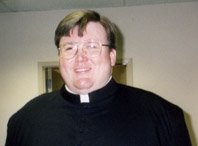
Well, I'm back...
From retreat, that is. I enjoyed the hospitality of the monks at St. Benedict's Monastery in Oxford, Michigan, which is about an hour north of Detroit. I had a good time of prayer and a sort of "taking spiritual inventory." One thing that becomes ever more apparent to me is the incredible grace and power of Christ. That Christ could take someone as flawed and limited as me and use me as his instrument speaks to the truth of St. Paul's words about power being "made perfect in weakness." (2 Cor. 12:9)
I don't know about other people, but after a retreat I frequently experience, especially if it's been particularly good, what I have come to call a "post-retreat letdown". It's something I've experienced enough to recognize and no longer be surprised by. I attribute it to a reaction to being re-immersed in the day-to-day ordinariness of life after enjoying a period of "holy leisure." The experience is a feeling of overall malaise, sometimes accompanied by suspicions or fears that my ministry is an exercise in futility. And, if I'm keeping my head screwed on straight, this leads to some reflection on the truth that in fact, anything I do is an exercise in futility. It's all about what Christ does in and through me. I find that truth very liberating. It's NOT about ME! Deo Gratias! Hopefully, every day it's a little more of Christ coming through in my priesthood and a little less of me.
Well, yesterday was my "reaction" day. I felt kind of "blah" and I was in rampant "futility" mode. These apprehensions were, in no small part, fueled by the stories of stunning episcopal cravenness and misgovernment coming from Phoenix. It's hard to believe you're making any headway in the trenches when it seems like your superiors aren't working for the same side...
Luckily, I went to visit our parish elementary school yesterday. I find that when I'm starting to get discouraged, the kids will quickly snap me out of it. I love spending time with the kids at the school. I try to go there at least one day a week and visit the classes and talk to the kids. The teachers really appreciate it, too. I don't always visit to talk to them about religious subjects. For example, one of my hobbies is building and launching model rockets. So I've taken classes out to teach them about how rockets work and launch some of them. The kids think that is way cool. I'll even let the kids fire off some of the rockets, which gets them even more excited. I'll try to get some pictures up sometime soon of the last time I launched rockets with the kids.
Anyway, I visited the school yesterday, and it struck me again how privileged I am to be able to teach these kids about Jesus, and to be able to BE Christ to them. It's really amazing: These kids just have to see me in my clerics, even before they know me, and they're ready to love me. Not because of Me, but because of Jesus, and knowing that I represent Jesus in a special way. Shortly after I was ordained I was greeting parishioners after Mass, and a girl, around 6-7 years old, spontaneously came up to me and threw her arms around me in a big hug. I hadn't ever spoken to her before, but somehow she was drawn to me, or I should say, drawn to whatever of Christ she saw in me. It was both very moving and very humbling. Now, when I visit the school, lots of kids want to hug me when I come in or when I leave. When that happens, whatever fears of futility I may have had vanish: Some bishops may be cowards or fools, and some liberal nitwits may be trying to water down the Faith, but I know these kids are meeting Jesus, and putting their faith in him. That, in the long run, is what it's really all about.

Wednesday, May 28, 2003
No More Blogging 'till Next Week
I'm on retreat this week, enjoying a few days of prayer and meditation with the Benedictines of Oxford, Michigan. So the blog below is all you'll get till next week!
The Tridentine Mass at St. Mary Major
I know I'm a few days behind on this, but I'll chime in anyway. As many readers already know, last Saturday, May 24, Cardinal Dario Castrillon Hoyos, the president of the Pontifical Commission Ecclesia Dei, celebrated Mass according to the Tridentine Rite at the Basilica of St. Mary Major in Rome for the first time in over 30 years.
The public celebration of the Mass at one of Rome's major basilicas, by the Cardinal in charge of implementing of Pope John Paul's mandate to "generously" provide the traditional Mass to the faithful, has to be seen as sending a clear signal by Rome of how it sees the place of the Old Mass.
Several sources, particularly CWNews.com, have quoted the Cardinal as saying that the old rite "cannot be considered defunct". But the remark acquires more significance if it is seen in its entirety, for the Cardinal said (as quoted in Zenit): "The old Roman rite preserves its right of citizenship in the Church and cannot be considered extinguished..." This strikes me as more than a mere acknowledgment that the Old Rite is clinging on to life: it seems to me that this is a definitive statement that the Tridentine Mass belongs in and to the Church, and has a rightful place in the Church. Furthermore, it seems to me that the Cardinal is addressing those "progressives" who would derogate the old Mass to being of mere antiquarian interest, and try to dismiss the Ecclesia Dei indult as just a temporary concession to the elderly and to unreconstructed throwbacks in the Church.
If you take the above quotation with this remark by the Cardinal: "What unites the variety of rites is the same faith in the eucharistic mystery," then one can see that he is placing the Old and New rites on an even par, as embodying the same faith. While some Traditionalists might quarrel that the Novus Ordo does not express the Catholic Faith in the same way as the Old Rite, what is important about the Cardinal's statement is that it removes the possibility of relegating the Tridentine Rite to a "second-class citizen" status: something to be only grudgingly tolerated. The subtext of the Cardinal's remarks may be read as "The Tridentine Rite is a venerable and authentic expression of Catholic Faith, and it's not going anywhere."
Dom Bettinelli at Bettnet thinks that the Cardinal's failure to announce a Universal Indult allowing any priest to celebrate the Old Mass means that the "rumors appear to have been untrue". I think Dom may be jumping to conclusions here, for several reasons. Firstly, after more than two weeks of public speculation about such an indult, no Vatican official has said a word refuting or denying that an Indult is in the works. Secondly, none of the initial stories published, especially the first one published in the Catholic Herald, actually claimed to know when such an announcement would happen. Simon Caldwell, the author of that story, never said that the Indult was due to be announced at the Mass at St. Mary Major. The idea that the announcement would come at this Mass was second-order speculation (that is, speculation of those who read the story) based only on the plausibility of such a move. I personally didn't think it would happen at this Mass, since the story only said it would happen "before the end of the year". That it didn't happen now doesn't prove that it won't happen at all.
Finally, sources such as Inside The Vatican report that a document is in the works which could go so far as to "mandate" the celebration of the old Latin Mass "more widely, even on a weekly basis, in every parish in the world..." The source for this information is the prefect of the Congregation for Divine Worship himself, Francis Cardinal Arinze. So I'm going to keep an open mind, and wait to see what this promised document actually provides.
I think it is clear, since the promulgation of the new General Instruction of the Roman Missal in 2000, that Rome is moving to curb the abuses of the Novus Ordo and to tighten up liturgical discipline in general. It may very well be the case that Rome sees the rehabilitation of the Tridentine Rite as a desirable, or even necessary, part of securing the patrimony of Faith as it is expressed in our liturgy.
Wednesday, May 21, 2003
OK, People, Very Funny, Ha Ha...
I suppose it was a mistake for me announce the imposition of The Johansen Protocol at the end of my blog "Reforming The Culture, Part II". And some of you have leapt upon the opportunity to exercise your wit in pointing that out.
Of course, by posting things the way I did, everyone was drawn to comment on that rather than the more substantive post on the culture that preceeded it. So I've re-arranged it: If you want to wax wittily on the Johansen Protocol, feel free, below. But I'm putting the Culture II post here, and hopefully that will encourage more substantive commentary.
The "Burma Shave" bit was pretty funny...
Reforming The Culture, Part II
Against my better judgment, I'm going to respond to a commentor on Monday's blog. I've been advised by several other bloggers to simply ignore this person, but I'll indulge him with a response this one last time. This commentor has been wont to excoriate me and others, like Mark Shea, who assert that the Laity have some responsibility for The Situation. Firstly, nowhere have I ever said that the laity is "fundamentally" responsible for The Situation. Both clergy and laity have been to a certain extent compromised by the dominant culture. It is taken for granted in the dominant culture that there is, at bottom, nothing wrong with giving in to Appetite. And as I've said before, the problem is that once I've made it OK for me to give in to my appetite, I have no logical leg to stand on to say that it isn't OK for you to give in to yours. Hence it shouldn't surprise us that priests (some of whom eventually became bishops) who've made it OK for people to contracept, cohabitate, or engage in homosexual activity, were unable to muster the moral fortitude to condemn and punish pedophilia. To say that either bishops or laity are "fundamentally" responsible is a chicken-and-egg scenario. Both are influenced by and to have some extent accomodated themselves to the culture. And the bishops that some are so fond of denouncing came from the same generation that either welcomed or passively accepted the wholesale embrace of appetite that characterized the 70's and 80's.
The culture does influence attitudes and behaviors. Not that we're "amoebas" who simply absorb everything. But to counteract a poisonous environment requires constant care and vigilance, a vigilance which has been lacking at all levels in Catholic society. The priests and bishops who gave us things like Building Your Own Conscience have been walking in lockstep with lay "catholics" like those in Boston who have decided that the church needs to be more "up to date" on issues like contraception, homosexuality, women's ordination, etc. Both the clergy and laity imbibed the culture and have been poisoned by it. They enabled one another to be lulled into torpor and complacency.
As to the "powerlessness" of the laity with regard to their pastors: Poppycock! While the laity may have no "formal" say-so in the appointments of pastors or bishops, anyone with any experience of the real world knows that formally defined power isn't the only kind of power. I know priests who were transferred by their bishops when groups of disaffected parishioners banded together to complain about that priest's insistence on preaching the hard truths of church teaching. I know priests who were not allowed into their own parish or diocesan schools because the feminist nuns who ran the place didn't want the priest infecting the kids with sound doctrine. I have heard priests tell me that they "used to" preach or teach about things like contraception, but "don't bother" anymore because, after being shouted down too many times, they realized that "people won't receive that sort of thing."
Why is the culture important? Because, as I wrote before, it is the "incarnation" of, the way people live and experience, their beliefs and ideals. It can either re-inforce and augment the Faith, or undermine it. People learn not only by formal instruction or catechesis, but by picking up on the cultural cues around them regarding what's Really Important. It is a tone-deafness of the first order to deny the importance of those cultural cues. For example, I think it can be convincingly demonstrated that the practice of slavery is contrary to the Gospel. It is not specifically condemned in the gospel, but surely the gospel's message about humanity's redeemed nature and dignity in Christ implies the rejection of slavery. Yet we do not see the apostles or their immediate successors demand the abolition of slavery. Why? I would contend that, being immersed in a Greco-Roman culture which took slavery as given, they didn't even think to question it. It took the society's steeping in the Gospel for some 1300 years (which is when the explicit questioning of slavery begins in earnest), and the development of an explicitly Christian culture, for people to begin to figure out that slavery was contrary to the Faith.
Do we need culture to keep people Catholic? Strictly speaking, I suppose not. People obviously can and do remain steadfast under the most dire circumstances. But it requires heroic virtue to maintain the faith under those circumstances, and the Church has always made it clear that in a just and well-ordered society, it should not require heroic virtue simply to persevere in the Faith. Did the martyrs of the first two centuries need a Catholic culture to keep the faith? Obviously not, but alongside the martyrs who gave their lives for Christ were many lapsi who caved under the pressure of persecution. There were so many of them that St. Cyprian of Carthage had to write a treatise about the situation called De Lapsis. Did the magisterium fail those lapsi? I think not. On the contrary, the Church worked hard at inviting those people back into the fold. But how many, once having been lost, stayed that way? The Church has taught consistently that a well-ordered society, both in it's governance and in its cultural order, should aim to make it easier for Joe Six-Pack to live a holy life. A Catholic culture does this by providing the raw material for a Catholic imagination.
If anyone doubts the desirability of Catholic society with a Catholic culture, look at the culture around you. Do you really want more of the same?
The Johansen Protocol
Amy Welborn's policy that any correspondence directed to her about her blog is per se bloggable is known in blogland as the "Welborn Protocol". Well, I don't know if Amy called it that herself (I suspect not), but I have no qualms, after the latest round of comment-box bloviation, about naming this new policy after myself:
Henceforth, any commentor in my blog's comment box whose comments elongate into more than two consecutive comment boxes will be warned. A second infraction will result in that person being BANNED from my comment box. Consistent and habitual running over into two consecutive boxes will also raise my hackles, earn my ire, or otherwise incur my displeasure. Once someone is banned, I will have to be highly mollified to re-admit the offending commentor, as I will be exceedingly wroth. If you have more extensive comments to make, send them to me in an e-mail and I will gladly consider publishing and responding to them. If you habitually have more than that to say, do us both a favor and get your own blog. They're free, after all.
The comment box is there as a convenience for my readers to offer their reactions and observations. When one person monopolizes the comments with lengthy excurses upon favorite hobby-horses, it violates the intention of the comments function, inconveniences other readers and commentors, and generally annoys everyone.
So let it be written, so let it be done!
Monday, May 19, 2003
Reforming the Church Means Reforming the Culture
Last week, Mark Shea asked "how we get these eminently practical ideas for reform off the pages of a blog...". I am all in favor of authentic "reform" (eliminating cronyism in the selection of bishops, allowing more consultation of the laity, etc.). But if we think that any sort of tinkering with structures or mechanisms is going to solve the problem, we're deluding ourselves. As I pointed out last year and as Mark points out today, we have the bishops and priests we've got today because that's what many of us wanted. Vatican II was supposed to "open the windows" of the Church so that it could more effectively be a leaven in the world. But the result has been that we, in all too many cases, have simply accomodated ourselves to the dominant Culture.
There used to be, even in the U.S., an identifiable Catholic culture. It wore different ethnic faces, but there was a common thread throughout it all. Can it be said, in any meaningful sense, that there is an identifiable Catholic culture today? I think one would be hard pressed to adduce the evidence.
Movies like "The Song of Bernadette" or "The Scarlet and the Black", which were identifiably Catholic, were made by major studios and put into general release. Books like "The Devil's Advocate" (by Morris West), which dealt with Catholic themes, were best sellers. I would submit that there is nothing comparable going on today.
Why is this important? Because culture is the way our beliefs and ideals are "incarnated" in our lives. Our beliefs and ideals are shaped by our art and literature, and in turn shape them as well. And it seems to me that in the seventies that Catholics in the U.S. simply turned over the Culture to forces at best indifferent to, and at worst hostile to, the Faith.
I am not simply waxing nostalgic here. I know that some of the cultural expressions of the Faith a generation or two ago were mawkish or sentimental. But much of it was also profound and insightful. Books like "The Devil's Advocate" (yes, it's one of my favorites) treated the Faith with complexity and intelligence. Even movies like Otto Preminger's "The Cardinal" dealt with moral dilemmas in a nuanced way. And nothing like this is available today.
I think the only reason that can be given as to why Catholic culture has atrophied is that in large part Catholics stopped wanting it. And in large part our priests and bishops stopped encouraging and promoting it. It doesn't even occur to many Catholics today that the Faith can be interesting and engaging in their movies and literature. And so we have at least one, and possibly two generations of Catholics who do not have a Catholic cultural imagination. And that has profound effects in how they live their faith. Remember: the culture shapes our beliefs and ideals as much as it is shaped by them.
So, to return to Mark's question, how do we reclaim and reform the Culture? Well, by supporting and promoting arts and entertainment that are informed by a truly Catholic vision. One excellent opportunity to do so is by getting the word out about the upcoming movie "Therese : The Story of St. Therese of Lisieux". St. Therese, as the movie's trailers say, is an ordinary girl, who became an extraordinary soul. She is a saint who, I think, still speaks to our world today.
I received this e-mail about the movie today:
"As you may be aware, our friend Leonardo Defilippis has produced a delightful family motion picture called Therese, about the "Little Flower," St. Therese of Lisieux.
His plan is to release it to U.S. theaters in October, around St. Therese's feast day. However, the number of theaters in which it's shown - and thus the impact that St. Therese can have on people's lives through this movie - will largely be determined by the popular interest shown in the film NOW. In other words, the more interest Catholic families demonstrate in the movie at this time, the more widely Hollywood is likely to distribute the film in October. So if you'd like to help, here's what you can do.
Hollywood is monitoring the film's website closely to see how many visits it attracts. The site is exceptional and even contains video clips from the movie. So please visit it often, and also email this article to your friends so they can do so as well. It's important that we Catholics show our support right now for this particular kind of filmmaking.
St. Therese is an incredible patron for our time, and many souls worldwide are likely to be touched by seeing this movie...But its power to inspire the mainstream public will only be realized if Hollywood sees a level of interest in the film that warrants the widest possible theatrical release in October.
...So please, now that God has blessed Leonardo's vibrant apostolate and opened the door to the production of a major motion picture on the life of a Catholic saint, let's do what we can to help promote it. Many more such films will likely follow if this first one generates sufficient interest by the movie going public."
The website for this upcoming film is http://www.theresemovie.com/ . The site is beautifully done and shows great promise for the quality of the film. If we want to help bring about the "New Springtime" for the Church, we need to support efforts such as this to take back the Culture. Visit the Therese site often, and spread the word! If we Catholics can't be bothered to leaven the culture, who will?
Monday, May 12, 2003
Happy Mother's Day!
I hope that all of you were extra-special nice to your mothers! My Mom came up from Florida and she's spending the week with me.
I introduced her to the congregation at Mass yesterday (which she said was "sneaky" on my part). Lots of parishioners welcomed her and made her feel very much at home.
This morning I took her with me to our elementary school. I am teaching the 4th graders the Gregorian chant "Ave Maria" and my Mom was impressed (as am I) at how quickly they're picking it up. We then went to visit a couple of classes, and the kids were all wanting to ask her questions about me. When she started telling them stories about me as a child (like how I was a terrible liar and could never get away with anything), I thought it best to move on...
Always remember Mom!
Saturday, May 03, 2003
Universal Indult for the Tridentine Mass?
A report in the British Catholic weekly The Catholic Herald claims that the Pope is soon going to grant a Universal Indult for the Old Mass. According to the report by Simon Caldwell:
John Paul II is understood to be ready to grant a "universal indult" by the end of the year to permit all priests to choose freely between the celebration of Mass in the so-called Tridentine rite used up to 1962 before the disciplinary reforms of
the Second Vatican Council and the novus ordo Mass used after 1970. It will mean that a priest who wants to celebrate old rite Masses will no longer need to apply for an indult to Ecclesia Dei...
This report has, as of now, not yet been confirmed by any Vatican officials. And given the recent furor over the false rumors of reconciliation with the schismatic traditionalists of the Society of St. Pius X, this report has to be taken with a grain of salt. But the Catholic Herald is sober and reliable, and Britain's national Catholic weekly. Caldwell seems to have access to some inside information, as he cites Vatican inquiries of Scottish and English bishops regarding their provision of the Old Mass.
Rome has given the Old Mass a higher profile in the last year or so: The holy father celebrated a Tridentine Mass last year, Cardinal Castrillon Hoyos will celebrate a Tridentine Mass at St. Mary Major in Rome on the 24th of this month, and the Pope just issued an instruction granting permssion for any priest possessing the indult to celebrate the Mass of St. Pius V at St. Peter's. All of these things taken together make the granting of a Universal Indult quite plausible.
What would the effects of such a grant be? Well, it would certainly cause great consternation among those more "progressive" types who have been attempting to redefine the Mass as a "celebration of community" or a "sacred meal" for the last 30 years. The grant of such an indult, with the Pope's most recent encyclical, Ecclesia de Eucharistia, could only be seen as a ringing re-affirmation of the Church's traditional understanding of the Mass as first and foremost the re-presentation of Christ's sacrifice on the Cross. Conversely, such a move would be a great source of consolation for many Catholics who have been discouraged and dismayed by the perceived "dumbing-down" of the Mass in recent decades.
The grant of a universal indult would also end the "second-class citizen" status of the Old Mass and its adherents. It would put an end to the efforts of a few still-hostile bishops to thwart the "generous" application of the Ecclesia Dei indult by obstructing the Old Mass. This would probably, over the course of time, help to further stem the tide of liturgical abuses. It may also further efforts toward a "reform of the reform" of the post-conciliar liturgy.
Finally, it would in all likelihood be a big step towards reconciliation with the Lefebvrists and other traditionalist schismatics. As such, it would help us to fulfill Our Lord's prayer that "they all be one."
Friday, May 02, 2003
The Divine Emmylou Harris
I was cleaning my office this morning, with my mp3 collection playing at random on my computer in the background. The computer started playing Emmylou Harris' version of the old country-gospel standard, "Satan's Jewel Crown", and I had to just sit down and listen again.
I could, by no means, be called a "fan" of what we know as "Country" music, at least of the variety you hear on country radio stations. Travis Tritt, Shania, The Dixie Chicks (even before their repulsive conduct) etc., leave me cold. Most country music seems to me sappy, canned, and ersatz. It has all the authenticity of a Hostess Fruit Pie.
However, I very much like traditional Bluegrass and country-gospel music. It is music that actually has some depth and history: it is a music from a real tradition of real people. And like all true folk music, it contains the expressions of a people's collective soul.
Perhaps the best exponent of that folk-gospel music today is Emmylou Harris. Whatever she has produced in the country genre, I assure you, is far outclassed by her work in folk and gospel music. When she does folk music, she is wonderful. When she sings gospel, she is sublime. Emmylou has a voice of haunting purity, and lets the beauty of the music come through unencumbered.
Unfortunately, her folk and gospel offerings don't have as high a profile as her standard country output, which is too bad. And some of her best gospel performances are scattered in collaborative collections or commercially unreleased. But anyone interested in hearing her sublime voice performing this wonderful music could start here, with Angel Band. It's one classic after another, performed with an elegant simplicity.
Tuesday, April 29, 2003
Why Do People Leave?
I may be a little late in blogging on this, but it seems to me that one benefit of being Catholic is that the world already thinks we're backwards, so one doesn't have to worry about being au courant. And since Blogger ate this when I tried to post it yesterday, I have a double excuse.
Last Saturday, Fr. Andrew Greeley, in a column in the Chicago Sun-Times, discussed the reasons why many people "leave the church," and why he is unimpressed with those reasons:
However, most of the reasons I hear advanced these days are not of this sort. They are rather tales of what some priest did or said, of what some nun taught you, of some lunacy propagated by a bishop, of what some RCIA [Rite of Christian Initiation of Adults] director tried to impose upon you, of what some chancery office bureaucrat told you, of some rule that a liturgist said you had to obey, of the moronic failure of the church to deal with the pedophile crisis, of the denial by so many priests that there is a sexual abuse crisis, of the failure of the pope to support our eminently moral president, of the failure of bishops to speak out against the war (which they have, of course, though no one hears them anymore), of the pastor who is spending huge sums of money on a church the parish doesn't need. Etc. Etc. Etc.
Since I have already had to deal with this sort of thing in my not-quite-two-years of priesthood, it seems apropos for me to throw my two cents in. I think Fr. Greeley is on to something here: I know a man who "left the Church" when the priest he and his fiancee talked to about getting married had the audacity to point out that their cohabitational relationship was not a good preparation for marriage, and was objectively sinful. He then had the further gall to suggest that the best thing for them to do was to separate for the remainder of their engagement. This man had to make a choice between seriously examining his life in light of the Faith, or going it on his own. He decided to go it on his own (he is now on marriage number 3) rather than admit that this priest, or the Church, had anything to say to him about his moral decisions. In college and graduate school I knew many people who would provide elaborate rationales for why the Catholic Church was backwards, or "medieval"; or for why Faith was beneath their superior intellects. But when I got to know the people, and got "underneath" their rationalizations, I discovered that what really motivated them was the desire to live as though they were morally unaccountable.
Most of us do not want to hear hard sayings about sin, and our own culpability in it. Last year, after I gave this homily about The Situation at one of our Sunday Masses, a woman approached me, quite angry about it: she said that it was "hateful" and that I "obviously had contempt for women" (I had criticized one of Anna Quindlen's vapidities in my homily), and vowed that she would never attend one of my Masses again. She was evidently so wrapped up in her own agenda that she couldn't hear the message of my homily. All I could say in response was that I was sorry she was so upset that she had missed the whole point of my homily.
But at least she had the honesty to confront me face-to-face with her displeasure. I have occasionally heard "through the grapevine" that this or that parishioner has complained about something I said or did. I have even been told once or twice that someone has left the parish and begun attending Mass elsewhere over something I said. Unfortunately, these people have done so without ever talking to me about their complaints. While I will never apologize for preaching the Whole Faith boldly, nor for speaking unpopular truths, it nonetheless pains me that people may have acted so precipitously, as I never intend to wound. But I confess to a certain amount of frustration over these situations, as I think such behavior is cowardly and unjust. It is cowardly to speak critically of a person when one is unwilling to voice that criticism to the person's face. Furthermore, it is unjust, because the person has formed a judgment without giving me the opportunity to clarify myself or dispel any misunderstandings. If I have a serious issue with someone, I believe I have a moral obligation to speak to that perosn face-face about my concern. That is my obligation under Christian charity and justice. That's the way adult Christians are supposed to behave. I expect adult Christian conduct from people who profess to be Catholic. I admit that it's hard for me to believe in the good will of someone who is unwilling to even deal with me honestly.
That being said, I recognize the truth in Amy's concern for those who have been wounded by "the church":
It's not simply that people's feelings are hurt. It's that their faith is shaken. If a person who has been entrusted with passing on the Faith lies to you or hurts you or teaches something that is wrong, it is difficult for many to separate that relatively small moment in the present from the weight and breadth of Tradition.
That is why it is so important for us to reach out to people (and most of us know such people) who feel in some way alienated from the Church. The Church's central message is the Mercy and Grace of Christ, given to us through His passion, death and resurrection. That is why it is so important for priests to preach on the power and meaning of the Sacrament of Reconciliation, and to avail ourselves of it frequently. The more we confront our own sinfulness and need for God's mercy, the more authentically and convincingly we can witness to it for others.
Monday, April 28, 2003
I HATE @@$^*(&%$$^) BLOGGER!!! $%()*%#@$!!
I just spent 45 minutes working on a post only to have it disappear into the Ether when I hit the "Post" button and was greeted with the message "www.blogger.com has refused your connection. Please try again later." I have other things to do, so I'll have to come back later and try to re-construct it. In the meantime, this gives me new impetus to find a different hosting service than the increasingly-flakey Blogger.
What I had written was really pretty good, you'll have to trust me on that until I can try again.
I suppose from now on I've learned a lesson: write my posts in a WP program, then cut and paste it into Blogger...
Friday, April 25, 2003
Like a Phoenix...

...My blog arises again! In this season of resurrection, it seemed a fitting time for me to "resurrect" my blog! I am glad to be back, after my Lenten penance.
I won't bother re-stating here what I intend to do in my blog: My purposes remain the same. If you are new to my blog or you want to re-acquaint yourself with my outlook and aims, you can read here or here. I hope that I'm a little wiser now that I've observed a pentiential silence of sorts.
And, just so it's clear, that silence was largely self-imposed: While Bishop Murray had asked me to stop blogging back in February, we met a couple of weeks after that and quickly resolved the issues which had concerned him. He made it quite clear that he was very supportive of my writing, and that he wanted me to continue. He appreciates and supports these purposes of my blog: to defend the Catholic Faith boldly, to defend the truth, and to point out and refute error. His main concern, which I admit that I have sometimes honored more in the breach than the observance, is that I always do so with prudence and charity. And so our meeting concluded cordially, and he gave me leave to return to my blog. But I decided that it would be best if I observed a penance and didn't return until Holy Week or Easter.
Another Clarification
When I posted the announcement that Bishop Murray asked me to stop blogging, many people read into that request some sort of "agenda" on his part to silence support for the "Old" Mass or some sort of hostility on his part to Tradition or traditionalists. I can assure you that that is simply not the case. Bishop Murray is very concerned that liturgy in our diocese be conducted with reverence and respect for liturgical law, and has issued instructions to that effect more than once. Furthermore, about two years ago he granted permission for the Mass of Pius V according to the Ecclesia Dei indult. For a time we had a regular Tridentine Mass here in the diocese. The only reason we don't have it now is that we have no priests here presently who both know the Old Mass and are willing to celebrate it. It's my hope that this deficiency will be remedied soon.
But some of the comments directed at Bishop Murray were, to be blunt, nothing short of scurrilous. I am always amazed at the conclusions that people are willing to draw from scanty evidence, or the entire lack of it. I hope that those who were quick to condemn Bishop Murray will be equally ready to give him their support and prayers. I for one look at the episcopacy as a "combat pay" job: no matter what you do, you will be shot at from all sides. Our shepherds deserve respect for their office, even if we disagree with their decisions. And they, like all people, deserve to be treated with charity.
Sunday, February 09, 2003
Where Am I?
Several people have e-mailed me wondering where I've been since my re-introductory posts of last week.
Well, I'm on vacation! Not a blog vacation, a real one.
Right now I'm in Lincoln, Nebraska which, I reluctantly admit, has an almost equally valid claim as my own diocese of Kalamazoo, Michigan to the title "The Rome of The West."
It's not perversity which brings me to Lincoln in February: I'm here visiting my good friend John Pepino, who is on the faculty of the FSSP seminary here, Our Lady of Guadalupe. John teaches Latin, Greek, and Patristics, and very well, I might add.
I'm enjoying the hospitality of the seminary community, who have been excellent and gracious hosts.
I'm on my way to Florida shortly, to pay my Mom a visit.
I promise I'll blog more in the next day or so...
Sunday, February 02, 2003
A word of Thanks...
After reading the comments on my re-introductory post below, I want to thank all of you for your words of welcome and encouragement. It's nice to know you have friends...
I'm also grateful to the many people who supported and encouraged me during my hiatus. Many of you contacted me from time to time to see how I was doing: I really appreciate that. I could tell from my occasional looks at the counter that people were still checking out the blog: that's the kind of readership every writer treasures.
I'm particularly grateful to my fellow bloggers Mark Shea, Lane Core, and Dom Bettinelli for the encouragement and advice they have given me at various points. Thanks, guys!
Friday, January 31, 2003
The Dignity of the Offender
A friend of mine, who is a prosecuting attorney, chided me for my comments on Mr. McCaffrey and his attorney below. He says:
"Welcome back to blogging. I enjoyed reading your commentary today. With respect to its contents, I respectfully dissent.
The role of a defense attorney is not well understood. People often equate it with merely getting criminals off on technicalities. The reality, however, is that both defense attorneys and prosecutors, whether they themselves realize it or not, are actually there to uphold and defend what are ultimately eternal truths, i.e., the Moral Law and the Dignity of Man. This occurs most dramatically and eloquently at hearings on sentencing, which, when done properly, can overflow with Beauty and Truth before finally ending with a Just result.
Where the crime is grave, the prosecutor's role, in part, is indeed to impress upon the Court and the public the magnitude of the Evil the defendant has done.
Very significantly, however, this is not the role of the defense attorney. On the contrary, the defense attorney should endeavor to impress upon the Court and the public the dignity of the defendant, lest this important truth be obscured by the seriousness of the offense or by the anger of the victims.
The defense attorney at sentencing is there to say Good things about someone who in some cases has done some very Bad things. Admittedly, "this is a very sad day for my client" is not a particularly effective way to proceed in this regard, in my opinion. Rhetorical mediocrity, however, does not necessarily represent narcissim, self-pity, or any of the other moral defects identified in your commentary, either on the part of the attorney, or, less still, on the part of the client."
OK, I admit I read perhaps too much into the attorney's fatuous statement. And I certainly want to recognize the dignity of the person, even those persons guilty of heinous crimes. But I also think there is such a thing as misplaced compassion. It seems to me that the attorney in this case was seeking to elicit false compassion for Mr. McCaffrey, in order to win him a more lenient sentence. But the fact is that, in this case, McCaffrey is not deserving of leniency. In his case compassion does not equal leniency. He is, in fact, already enjoying leniency, considering he has been sentenced to only 15 years when he admits to the serial molestation of numerous boys on numerous occasions.
Why do so many attorneys, in their necessary efforts to uphold the dignity of the accused and/or guilty, resort to trying to make their defendants out to be victims? That is what is truly ignoble.
I'm Back, and With a New Look!
After a long "vacation", I'm back to blogging! While I was chastened by my experience last fall, I'd say that I'm battle-scarred but wiser. One thing a little time and distance has given me is a chance to look back and see what I wrote last year with a more objective eye. Most of what I wrote I'm proud of, but some of it, I have to admit, doesn't show me at my best.
This time around, I'm going to try to stick closer to the purpose I originally stated when I started this blog. That is, to go beyond commenting merely on the events of the day and "examine what Dr. Russell Kirk would have called 'The Permanent Things'." The Permanent Things are ultimately the only things worth talking about. Also, I recognize the truth of something my friend Fr. Robert Sirico told me: It's relatively easy to react against and refute or poke fun at the inanities propagated by liberals and AmChurch modernists. It's harder to pro-actively address our nation and society's need for perennial Truth in a positive and creative way. But, of course, the latter will have far more lasting impact and importance than the former. So I intend to aim for this higher mark in the future.
But don't worry: my new resolve doesn't mean I'm going to get all "serious". I intend to re-introduce such features as the NCR Watch. While I firmly believe that liberal Catholicism is a dead end and is in the process of withering away, we have to keep an eye on it: it can still do a lot of damage as it flails about in it's death throes. I also intend to introduce several other semi-regular features. My imagination has not been idle in my blog hiatus.
Most of all, I'm going to continue to do what I have always tried to: To witness to the truth of Christ as revealed in and through the One, Holy, Catholic, and Apostolic Church; to witness to the wonder and privilege of the priesthood which the Lord has graciously given me, and to proclaim the joy that is living for and in Christ.
Thursday, October 03, 2002
Some Clarifications
As regular readers of my blog are aware, I have criticized some of the content of Michael Rose’s book, Goodbye, Good Men, and also questioned the accuracy of some of its contents. In compliance with Mr. Rose's request, via counsel, and in the interest of laying the controversy to rest, I’d like to make the following clarifications.
In June of this year I sent two e-mails to several individuals. The first e-mail was an announcement that Michael Rose was scheduled to appear on Raymond Arroyo’s show, “The World Over”, on EWTN. My source for that information was a friend, another priest. Several days later I sent another e-mail to the same people as the first, in which I informed them that Michael Rose’s appearance on the Raymond Arroyo Show was cancelled “precisely because of the ‘controversy’ regarding Rose’s veracity.” I also stated that Michael Rose was being sued for libel by two priests. Each of these statements require clarification. First, the statement that “two priests mentioned by name in Rose’s book are suing him for libel”, was furnished to me second hand, by the same source mentioned above. I am not personally aware of the existence of any such suits. Second, is the statement regarding Michael Rose’s appearance on the Raymond Arroyo Show. In fact, the only information I received with respect to this issue was an e-mail from the same friend mentioned above forwarding me an e-mail message from Raymond Arroyo that stated: “We are NOT having Rose on at present, based on the controversy.”
My friends, I also want to take this opportunity to tell you that I am taking a blog vacation for a short time to attend to my pastoral responsibilities and to work on a manuscript for a Catholic magazine. I will return when time and energy permit me.
Wednesday, October 02, 2002
Something New
If you'll look over to the right, you'll see I've added a new section: "The Best of My Blog."
These are things I've posted which I think were especially significant or about which I have received more than a few compliments.
I'm trying to make some other changes to my page, but the archive function on Blogger is messed up (again).
Enjoy!
Monday, September 16, 2002
God is Good. All the Time!
This past Friday I had the honor of participating in the episcopal ordination of Bishop Earl Boyea. Bishop Boyea will be an auxiliary bishop of the Archdiocese of Detroit. He returns to his native diocese after spending 3 years as the Rector of the Pontifical College Josephinum, the only Pontifical seminary in the United States.
When then-Monsignor Boyea's appointment was announced in late July I was very happy, as I was privileged to have Bishop Boyea as my spiritual director at Sacred Heart Seminary, where he served as Professor of Church History and Academic Dean. He was a great source of support and encouragement in persevering in my vocation.
The Archdiocese of Detroit has been given a great gift in it's new Bishop, and it's my prayer that Bishop Boyea's zeal for the Catholic Faith and love for the Church will make a mark in Detroit and beyond.
During my visit to Detroit, I stayed at Sacred Heart, and was able to spend some time visiting with the seminarians from my own diocese of Kalamazoo. I am very impressed by these young men: They are intelligent, they love the Church, and want to be uncompromising witnesses to Christ and His gospel. I was also impressed by the fact that we have 6 new seminarians this year. That may not sound like a lot, but for a diocese as small as Kalamazoo (110,000 catholics), that's doing very well indeed. This new group of men increases our number of seminarians by almost 50% over last year. When I consider that when I joined my diocese in 1998 I was one of three seminarians, and that now we have 13, I'd say that things are looking up indeed!
I have read some speculation that the blot upon the priesthood caused by The Situation would drive aspirants away from the priesthood. I have heard some priests' lament that the scandals would devastate seminary recruitment. Well, I was skeptical about that thinking at the time, and it seems that my skepticism was justified. It is my belief, and my hope, that The Situation will be a time of purification for the Church. I think that God will raise up many zealous and holy priests even in the midst of scandal. Given the evidence within my own little diocese, I think we have good reason to be hopeful.
Wednesday, September 11, 2002
9-11 Remembered
Today, we remembered the attacks on the World Trade Center and the Pentagon by offering a "Mass in Time of War or Civil Disturbance" at my parish. We did this at our regularly scheduled 8:00 AM Mass. After the Mass we tolled the church bell for about 15 minutes. But we are not having any additional Masses or special services at my parish today.
My pastor has caught a little bit of heat for this from some parishioners, who felt that we ought to have a "special" Mass or service today. But I think that the way we have handled this day is fitting. I'm not sure I can put my finger on the reasons I think so, but I think that having a "special" Mass for today would not have been appropriate. We certainly recognized the significance of this day in the prayers, and I did in my homily, which emphasized that the only true source of Peace is Christ and his redemptive work. But I think that today should be a "low-key" sort of day, and not the frenzy of emotional hyperbolics we have seen building up to today.
There was also some disappointment expressed about the relative lack of patriotic music at today's Mass. We closed the Mass with "America the Beautiful" but that was the only patriotic song we sung. I think this was also fitting. I have always been uneasy with patriotic music at Mass. And that's not because I'm not a Patriot. I love expressions of patriotism as much as any American. I sing the national anthem enthusiastically at public events. I'm all in favor of things like starting the school day with the pledge of allegiance. But I don't think the Mass is the proper place for unrestrained expressions of patriotism.
Finally, a couple of older people I know have pointed something curious out to me. We see that there are a plethora of different "remembrance services" and the like going on across the country. Now, I don't think there's anything wrong with them, but I am somewhat puzzled at what I see as an over-multiplication of them. In my little town of St. Joseph, Michigan, there are something like 35 different services today, in addition to the big service for the whole town at the firehouse. The announcements of them took up almost a whole page of the local newspaper. But these older people observed that nothing like this happened in World War II, for example, in marking the anniversary of the bombing of Pearl Harbor. They told me there was nothing like the kind of almost-frenzied series of different services, rallies, or the like. This stikes me as interesting, and indicative of some sort of change that has overtaken American culture between then and now. What has changed? Is it a change for the better or worse?
Don't Be Alarmed
I know some people were worried yesterday because apparently my blog page came up as blank for couple of hours. They took this as a sign that perhaps my blog had been "silenced." No, nothing like that happpened. It was a purely technical problem.
Also, don't be alarmed if I don't post for a few days again. Nothing sinister going on. But they're switching our servers and software at my church and school over to Novell, and we'll be off-line for a day or two. Not to mention that, even once we're back on-line here, I fully expect that nothing will actually work right. That seems to be the way it is whenever you make changes or attmept to "upgrade."
Friday, September 06, 2002
Rose Matter Under Review
Just so it is clear what is actually happening:
My bishop, James A. Murray of Kalamazoo, has asked me to make no further public statements about Michael Rose, Goodbye! Good Men, or Rose's threatened legal action until he has had the opportunity to review the matter. I am meeting with him next week, when, I imagine, he will render a judgment about how he would like me to proceed.
Please pray for me, Michael Rose, and my bishop, that we will act with prudence, fairness, and wisdom in this matter.
Wednesday, September 04, 2002
Toning Down the Rhetoric
In an effort to try to "tone down" the rhetoric and restore some degree of calm to the dispute between Mr. Rose and myself, I have edited this post. I left the facts about the legal action, as it would seem silly to try to pretend it isn't happening.
I intend to move on with blogging on other matters in the near future.
Michael Rose Threatens Legal Action
Yesterday I received in the mail a Certified Letter from a lawyer representing Michael Rose, the author of Goodbye! Good Men. In May I wrote a critical review of Rose's book in Culture Wars Magazine. Mr. Rose objected to my criticisms, as is his right, and responded to them, as is also his right. Mike Jones, the publisher of Culture Wars, and I, felt it was necessary for me to rebut Mr. Rose in the magazine. So Mr. Rose's response and my rebuttal were published in the July/August issue of Culture Wars. That issue of Culture Wars isn't yet available on line.
This letter from Mr. Rose's attorney demands that I cease my "ongoing pattern of numerous and defamatory statements" against Mr. Rose, and threatens me with a Federal lawsuit if I do not comply. He demands that I retract certain criticisms I have made, that I remove all statements I have made about Mr. Rose and his book from my website and its archives, and that I agree in writing not to write anything further about Mr. Rose or his publications.
Unfortunately, it seems to me, this legal action is forcing the controversy to remain protracted. If Mr. Rose had not chosen this tactic, he probably would have gotten his wish. After announcing the Crisis Magazine article in my blog last week, I really wouldn't have had any more to say about Rose or his book. I've pretty much said my piece on it, and was getting ready to move on.
Prophecy and Fulfillment?
Brian Saint-Paul's article in Crisis Magazine, which I blogged on last Friday, is now up and available on line. Read it!
In related news, a while back, you may recall, Mark Shea generously attributed to me the virtue of sagacity. Now, Stephen Hand over at TCRNews has recognized in me, in my own small way, the gift of prophecy.
In an e-mail to me over the weekend he pointed me in the direction of Diocese Report's newest headline. Last Friday I concluded my blog by commenting on the conspiracy theory being cooked up by Rose and his supporters to explain the criticisms of Goodbye! Good Men coming from orthodox Catholic quarters.
Stephen wrote, quoting from my blog and then from Diocese Report:
> Prophecy: "I suppose they’ll have to add Crisis to the conspiracy now.
> A “grand conspiracy” certainly will make for sensational reading, and it has
> the added benefit of preserving the putative victim(s) of that conspiracy
> from self-examination."
> Fulfillment: "Circling The Wagons: Crisis Joins Witch Hunt of Michael S.
> Rose... Developing.." ----Diocese Report. PM, 8/30/02
It's too bad the Diocese Report's site has been updated since the weekend. The "Witch Hunt" headline was really impressive at the top of the page in 36-point type.
Friday, August 30, 2002
A Question of Integrity: Crisis Magazine Opens New Round in The War of Rose
The September issue of Crisis Magazine takes on the accuracy and journalistic integrity of Michael Rose and his book, Goodbye! Good Men. This is the latest round of criticism of Rose’s controversial book: The first round was opened by Amy Welborn in a review she wrote for Our Sunday Visitor. Her relatively restrained criticisms were of the overall tone and overreaching claims of the book, and the fact that Rose relied heavily on pseudonymous sources. Next I wrote a review for Culture Wars, in which I took Rose to task for relying, in his book, on a source which he had acknowledged to be "seriously flawed". I recognized that Rose’s overall thesis contained a large amount of truth, but pointed out that the truth of some of Rose’s claims did not give him the right to make poorly substantiated charges which could harm the reputation of innocent people. For daring to criticize him, Rose and his supporters labeled me "schizophrenic", "dishonest", of dubious character, and a protector of priest-abusers and those who enabled them. Later this summer, National Catholic Register and Our Sunday Visitor weighed in with further criticisms which were narrower in scope, but furthered the case that Goodbye! Good Men is marred by errors and inaccuracies.
Now Brian Saint-Paul, the senior editor of Crisis, shows that Rose’s claims regarding the American College of Louvain (the American seminary at the University of Louvain in Belgium) are highly problematic, beset, as they are, with evidence of poor fact-checking. Rose’s account revolves around the claims made by Joseph Kellenyi, an ex-seminarian. This ex-seminarian claims that he was subjected to homosexual advances from another seminarian, and that that same seminarian was later entrusted by the Rector of the seminary with a supervisory role over Kellenyi. Saint-Paul shows that Rose’s claims, far from being "carefully researched", as Rose and his supporters contend, rely solely on Kellenyi’s testimony, and that testimony is dubious indeed.
Kellenyi’s account of the events in question can be found in his official sounding "Final Report to the Committee", available at AmericanCollegeScandal.com. The probative value of this so-called "Final Report" lessens dramatically, though, once the reader realizes that it is the composition of none other than Kellenyi himself. And this "report" is a towering monument of unsubstantiated assertion and circular reasoning. One piece of "evidence" that Kellenyi adduces on several points is the fact that the then-Rector of the Louvain, Fr. David Windsor, never launched a formal investigation of his claims. That no-one else, including other members of the seminary faculty, found his allegations credible or worthy of investigation never seems to have crossed Kellenyi’s mind. But Kellenyi nevertheless asserts that his "report" is the "final and authoritative word on this matter." The most priceless example of Kellenyi’s circular reasoning comes at the end of his report, when he asserts that his account of things is "a matter of record". And why is it a matter of record? Because Michael Rose documents these allegations in his book. And what is the source of Rose’s documentation? Nothing other than Joseph Kellenyi’s claims.
Kellenyi’s claims, far from being corroborated by other seminarians at Louvain, are strenuously denied. Saint-Paul, in his Crisis article, quotes seminarian after seminarian who say that nothing like the "gay subculture" Kellenyi and Rose portray existed. But Rose seems not to have taken the time to find out about those other opinions: As the Rector of the Louvain, Fr. Kevin Codd, stated on the College’s website earlier this summer:
> Mr. Rose never contacted The American College to authenticate
> his documentation, to seek further documentation, or to give us
> our rightful opportunity to respond to the accusations made in his
> book. Mr. Rose has never visited The American College and does
> not personally know any of our students or faculty members about
> whom he repeats these egregious accusations.
To those who have read my review in Culture Wars, this will sound very familiar. For Mr. Rose, in assembling the information he used in making his attack on Sacred Heart Major Seminary, never interviewed the Rector of the seminary, Bishop Allen Vigneron, nor any current faculty there, nor did he give anyone there an opportunity to provide another perspective on his claims before he went into print. Furthermore, seminarians enrolled at other institutions, such as Mundelein, have reported that their experience is at wide variance to the allegations Rose makes against them. Is this the "careful" research that Rose claims to have performed?
Rose’s case against the Louvain hinges on the testimony of Joseph Kellenyi, and his allegations of being subjected to the unwanted advances of a homosexual seminarian, whom, Kellenyi laments, was later ordained. Kellenyi does not name this person, designating him as "seminarian X". But Brian Saint-Paul discovered the identity of this seminarian: now-Father Pat Van Durme. Fr. Van Durme has come forward and made his outrage at Rose’s allegations known. Fr. Van Durme apparently not only never made advances on Kellenyi, he isn’t even homosexual. Not homosexual? That’s right, as several of his friends, ex-girlfriends, and Van Durme’s ex-fiancee have readily testified. That Rose could rely upon accusations of homosexual misconduct against a man whose heterosexual identity is well known and easily verifiable would be laughable, if the accusations weren't so grave. But, in showing the patent falsity of Kellenyi’s charges, Saint-Paul calls into question the accuracy Rose’s account.
There is much more in Saint-Paul’s article that I could discuss: Kellenyi’s broadening of his accusations against Van Durme to include charges of a homosexual affair between Van Durme and the Rector, and even Bishop Ed Braxton of Lake Charles, Louisiana. But I’ll leave you to read about it in Crisis. The September issue is out and has hit the stands, and the article should be available on-line next week.
When I published my review in May, Michael Rose and some other critics dismissed my review as focusing on "just one" example. Of course, my criticisms were broader than that. In my rebuttal to Rose’s "response", published in the July/August issue of Culture Wars, I gave further evidence of problems in Rose's account. National Catholic Register and Our Sunday Visitor have adduced other examples of Rose’s spotty approach. And now Brian Saint-Paul uncovers yet another example of problems with Goodbye! Good Men. If "just one" example isn’t enough to show that Rose’s claims are flawed, what about 2? Or 3? Aren’t six enough? And these aren’t just "little" errors. They involve grave accusations made against real people. Michael Rose has published claims that are potentially damaging to the character and reputations of real people. That’s not a little thing.
As Brian Saint-Paul points out, the criticisms of Goodbye! Good Men have come from a surprising quarter: journals such as National Catholic Register and Culture Wars, which are known as being orthodox, “conservative” Catholic publications. But rather than encouraging self-examination or moderation of claims, these criticisms have provoked from Rose's supporters increasingly strident attempts at justification and vilification of their opponents. In the on-line tabloid Diocese Report, the writer all-but links OSV, NCR, and Culture Wars in a conspiracy of "individuals who seem bent on destroying the creditability of the book and of Rose." I suppose they’ll have to add Crisis to the conspiracy now. A “grand conspiracy” certainly will make for sensational reading, and it has the added benefit of preserving the putative victim(s) of that conspiracy from self-examination.
Saturday, August 24, 2002
And on the Seventh Day, the Blogger Rested
Now that the Johansen-Dreher debate here about his Wall Street Journal article (which will be available online at OpinionJournal.com on Sunday) is over, I'm taking a day or two off from blogging. I hope Rod is taking a day or two off as well.
For those just coming upon the debate for the first time, go down to Wednesday's blog and then scroll up to follow the back-and-forth of the debate between Rod and myself.
And have a good weekend!
Friday, August 23, 2002
Dreher Talks Back!
When I first invited Rod to respond to my criticisms of his WSJ article, we agreed from the outset that I would comment on his response, and he would have the opportunity to further respond, and there we would close the debate between us on this matter. So here are Rod's "final" words on the subject, repsonding to my blog of this morning:
Fr. Rob:
Thanks again for the opportunity to respond. As we have agreed, this response of mine will be the last exchange between us in this matter. So reader, if Fr. Rob doesn't respond to this post, you mustn't assume it's because he didn't want to!
You wrote:
> But I think it is inaccurate to characterize the Vatican as 'refusing to
> hold bishops accountable.' That diagnosis is accurate only if
> 'accountability' equals removal from office. And I don't think that's
> necessarily so. I think for Rome to tell the Bishops 'you clean up this
> mess you made' is a way of holding them accountable.
I fail to see how that is different from not holding them accountable at all? If it is, then Rome owes us an explanation, instead of leaving you and me and everybody else here to divine their intentions. The record shows that over and over and over again, Church officials, from the chanceries to the Curia, have been told by concerned priests and laymen of terrible abuses, and nothing has been done, or if something was done, it wasn't substantial. And the abuse continued. I am genuinely incapable of understanding how Rome's failure to remove egregiously failed bishops like Law, whose failure has resulted in - and let us be very clear what we are talking about - little boys having their rectums torn by the penises of Christ's priests, among many other abominations, can hardly be read as anything but a failure to respond to the gravity of the crimes. To me, it testifies to a Church hierarchy that is so out of touch with the people it is supposed to serve that it identifies the good of the institution with the preservation of its own class interests. Repairing the situation in Boston is not possible with Bernard Law in the chancery. How is it possible to believe that it is? We need to understand that this thing is not about Bernard Law and his quest for redemption. It is about what the Catholic people in Boston - who are part of the Church too - need and deserve.
> [I]nvoking mystical (or any other kind) of theology is not 'cant'.
The American Heritage Dictionary (4th edition) defines cant as: 1. Monotonous talk filled with platitudes. 2. Hypocritically pious language. 3. The special vocabulary peculiar to the members of an underworld group; argot. ... 6. The special terminology understood among the members of a profession, discipline, or class but obscure to the general population; jargon.
I accused you of cant first with respect to your comments about how removing a bad bishop is an "act of violence" to the local and universal Church. I meant to suggest that your sentiments bear little relation to the actual experience on the ground, in Boston or any other diocese where the violence done by these bishops has been real and severe. I don't believe you were being hypocritical or insincere; I do believe very much that your words come from an ivory tower. I don't mean to denigrate mystical theology, but I think it is most inappropriate to invoke it in this particular situation, because it is being employed to justify what I believe to be passivity in the face of evil. It is an outrage that a bishop can remain in office after having committed what could well be felonies, and which are certainly grave moral crimes, because we have to worry about metaphysical guillotines.
I also called "cant" these lines:
> But that may be reason number 6,485 that I am not the Pope, nor ever will be.
> I hope Mr. Dreher and those who agree with him have the humility to admit
> the same.
I stand by my original assertion. These lines strike me as meaningless. OK, so I'm not the Pope. Big deal.
Finally, I called "cant" your assertion that:
> Our obsession with the 'governance' of the Church is almost certainly a sign
> that we are not yet thinking with the mind of Christ in the heart of the Church.
> We will not govern our way out of The Situation. We will only find the way out
> through Christ and His way of the Cross.
I still believe these are pious platitudes you've stated. Of course we have to find our way out through Christ and His way of the Cross. Who disputes that? I dispute your view that proper governing of the Church - that is, holding those ordained to serve Christ and the faithful to accountability, is somehow apart from the Way of the Cross. It is apparent to very many good Catholics that the Way of the Cross does not mean, or should not mean, a lifetime sinecure for Bernard Law, Rodger Mahony and their ilk.
For the record, I believe that it's imperative that the due-process rights of priests are maintained. So does Fr. Tom Doyle, who is second to none in his courageous advocacy of the rights of abuse victims - and it's why Doyle has criticized the Dallas protocols. I have not called on priests to be dismissed without respect for their due process rights.
You write:
>I think to dismiss the Holy Father's lack of 'action' so far as signs of
> indifference or 'not caring' is premature.
It would be, Fr. Rob, if the first the Vatican heard about the scandal in the American Church was January. But they have known about this thing, and known about it in great detail, for at least 17 years. How patient is one expected to be? Do you not understand that the lives and souls of real, flesh-and-blood people are at stake? Does Rome not see that from its vantage point of 30,000 feet? Rome has been told. And told and told and told - and this has been documented (e.g., check out the reporting of such in "Lead Us Not Into Temptation," by Jason Berry, which came out 10 years ago). If you want to see a monument to patience with Rome on the sex abuse question, read the daily papers.
Thanks again for inviting my comments.
R.
Some Reactions and Observations
OK, it's not exactly "first thing" in the morning, but here it is anyway:
Rod:
I have a few comments on your response:
Firstly , a few clarifications of my position are in order. I am not one of those people (if indeed any such exist) who believe that we must "never criticize the Pope" in matters that are not of Faith and Morals. Of course, we have a right and perhaps at times, a duty, to voice our concerns about the Pope's decisions in matters of prudential judgment. Furthermore, I am not articulating the position that Catholics must simply "live with" whatever malfeasance a bishop perpetrates. I don't think what I have written can fairly be construed to mean "God has sent us our bishops, and whatever they do, or fail to do, is to be accepted without protest as His will." The fact is, I raised the specter of deposing bishops back in June on my blog. I recognize that it is an appropriate measure in extreme cases. But such means have never been employed in a widespread fashion as an instrument of Church reform.
Rod, you wrote:
> No, the true violence was done first by the priests who sexually abused the
> powerless, then by the bishops who maintained them in ministry, and/or helped
> the escape the police, and finally by a Vatican that for whatever reason refuses
> to hold these bishops accountable for their actions.
I agree that the violence was first done by the abusers, and perpetuated by enabling bishops. But I think it is inaccurate to characterize the Vatican as "refusing to hold bishops accountable." That diagnosis is accurate only if "accountability" equals removal from office. And I don't think that's neccesarily so. I think for Rome to tell the Bishops "you clean up this mess you made" is a way of trying to hold them accountable. If Rome were to swoop down from on high and provide a "fix" for the problem, how would that keep the responsbility where it belonged? I think the bishops have made a very unpromising start, and they may make a hash of it yet, but Rome is trying to force the bishops who collectively created this disaster to live up to their duty of repairing it. One of the fundamental principles of moral theology is restitution: if one does something wrong, one is obliged to try to repair the situation as far as one is able. That is accountability.
You also wrote:
> I'm sorry, but this is cant.
Actually, you raised this objection several times. But invoking mystical (or any other kind) of theology is not "cant." If we are going to find a Catholic solution to the problem, and I hope you agree that we should be seeking a Catholic solution, then we must think with and through the Tradition. And to denounce those of us who are trying to do so as "invoking mystical abstractions" is unfair and unworthy of you. If my theology is wrong, tell me so, and tell me why. If I'm misreading the Tradition, tell me that, too. But don't dismiss these efforts as cant. We will not properly solve the problem if we don't think it through. As Catholics one of our primary tools for thinking anything through is our theological Tradition.
I am frankly shocked that you could dismiss my statement:
> We will not govern our way out of The Situation. We will only find the
> way out through Christ and His way of the Cross.
The Cross is the central mystery of our Faith. We must try to look at everything through the Cross, as there is nothing which is not subject to and redeemed by the Cross. To reform the Church we must think with the mind and in the heart of the Church. And that's not "cant".
You wrote:
> Good Catholic mothers and fathers will not sacrifice their children
> upon the altar of clericalism.
You are correct: they neither will, nor should they. But let us be clear about what clericalism is and is not. As I have written before on this blog, bishops covering up priest-abusers is a symptom of clericalism. But to demand that priest-abusers receive no more and no less than justice is not clericalism. To insist that the right of the accused to due process be respected is not clericalism. And don't reply that "of course, everyone understands that." Judging from some of the comments and e-mail I've seen, some people seem to have little trouble dismissing a priest's right to due process in the name of "protecting the children". And to call upon you and other faithful Catholics to try to think with the Tradition is not clericalism, either.
Rod, I agree with you that some of our bishops deserve to be removed. And it may yet happen that some of them will be. You and I and other "Vatican watchers" think that sometime soon, probably shortly after the Romans return from the August vacanza, the Holy See will send the Dallas norms back to the bishops and tell them to get it right. That will be a pretty swift response: three or four months. I would also see that as Rome beginning to hold the bishops' feet to the fire. I think to dismiss the Holy Father's lack of "action" so far as signs of indifference or "not caring" is premature.
I am surprised that no one has yet mentioned the principle of subsidiarity: that decision-making and authority, and accountability, be devolved to the level closest to the people affected. Rome is trying to respect that principle, and in doing so she is thinking with the tradition. It may yet happen, and frankly, I expect, that the bishops will prove themselves incapable of dealing with The Situation. But it would not be holding them properly accountable for Rome not to force them to apply themselves to the problem.
You are correct in pointing out that this problem has been festering for a number of years. But I think that, far from demanding precipitate action, the long-standing nature of the problem necessitates a thorough, deliberate response. And I hope you will admit that removing some bishops will not constitute such a thorough response. Let's say the Pope does remove some bishops, then what? I think it would be best to have good answers to that question before proceeding with the purge.
Thank you for your thoughts on this issue. I appreciate your investment of time and your love for our Church. I'll be interested to read what further observations you may have.
Thursday, August 22, 2002
Rod Dreher Responds
I invited Rod Dreher, the author of the WSJ article I blogged on below, to respond to my criticisms, and he graciously agreed to do so.
He apparently burned the midnight oil to do so, as he sent his response to me at about 1:00 AM. Another night owl (like me)!
I apologize for the delay in getting this up, but this is my day off, and I'm not exactly keeping a schedule today...
I will have some comments and observations about Rod's response later today, but for now I'll just let you read what he had to say:
Fr. Rob, I appreciate the opportunity to respond this way.
You wrote:
>Bishops are rarely deposed because to do so is to cut off the head of the local
>Church. To cut off a man's head, no matter how enfeebled or diseased, is to kill
>the man. I realize that the analogy limps here, because deposing a bishop does
>not "kill" the local Church. But it is an act of violence, and it does damage
>not only to the local, but to the universal Church. The only justification for
>doing so is the judgment that the damage done by the removal of the bishop is
>less than that done by keeping him. And that is a prudential judgment.
I'm sorry, but this is cant. How, outside of the rarefied world of mystical theology, does removing a calamitously failed bishop like Bernard Law do violence to the Church, local or universal? I think rather the opposite is happening. Removing a bishop is not to be undertaken lightly, of course, but please understand what the worst bishops in the U.S. Church have done. Time and time again, they recycled priests who rape children and minors through parishes, where they preyed on more children, particularly the children of the poor. Some have lied in public, and even, I firmly believe, have perjured themselves. Some have sought to intimidate victims and their families by siccing private investigators on them. All this and much more. The Catholic people in dioceses across the country, first among the Boston, have had to come to grips with the ugly fact that their Church is headed locally by a self-protective clerical mafia -- and that there is no relief to be expected from Rome, which apparently identifies the interests of the Church locally and universally with the narrow interests of the clerical class. The moral authority of the Church in Boston, and increasingly everywhere in this country, has been evacuated by Rome's failure to remove corrupt bishops. It is becoming perfectly clear to all who have eyes to see that there's a deep sickness in the hierarchy of the Church, and Rome's blindness to this only deepens the crisis.
No, the true violence was done first by the priests who sexually abused the powerless, then by the bishops who maintained them in ministry, and/or helped the escape the police, and finally by a Vatican that for whatever reason refuses to hold these bishops accountable for their actions. The judgments Rome has made to this point in this scandal are horribly wrong.
>It is erroneous to look at the Pope's actions and diagnose them as a "failure"
>to govern. The Pope, in this situation, has made a particular prudential
>judgment. The fact that we do not like that judgment does not mean that the
>Church isn't being governed.
Well, this is a dispute over terminology. The Church is being and has been governed passively by John Paul, which is tantamount to no governance at all.
>But that may be reason number 6,485 that I am not the Pope, nor ever will be. I
>hope Mr. Dreher and those who agree with him have the humility to admit the
>same.
More cant. Of course you're not the Pope. Neither am I. What does that have to do with anything? Can only a Pope pass judgment on a Pope's managerial style?
>In his WSJ article, Dreher writes "John Paul must bear partial responsibility
>for the catastrophe that has befallen us." I hope that Mr. Dreher does not think
>that Pope John Paul is not profoundly aware of that fact.
Mr. Dreher doesn't know John Paul's mind, and neither does Fr. Johansen. All we can do is go by what we can observe. I believe evidence shows John Paul to be a man of deep faith and boundless compassion. Sadly and perplexingly, I see no evidence of that in the way he has responded to the cries of the victims in this clergy sex-abuse scandal, which has been with us, at least publicly, for almost 20 years now. I cannot square the John Paul I know and love with the John Paul who permits such evil to take place by not demanding and enforcing accountability on the bishops who have betrayed him and the People of God in such unspeakable ways. It is not enough to say, "Well, he must have his reasons." I'm sure it must break his heart to see what's going on, but as C.S. Lewis observed, "A long face is not a moral disinfectant."
>Our obsession with the "governance" of the Church is almost certainly a sign
>that we are not yet thinking with the mind of Christ in the heart of the Church.
>We will not govern our way out of The Situation. We will only find the way out
>through Christ and His way of the Cross.
Still more cant! What can you possibly mean by this, Fr. Rob? What about the mind of the Christ who prescribed millstones for those who harmed children, and who drove moneychangers out of the Temple they desecrated? I don't know why you draw a distinction between right governing of the Church and devotion to Christ. It is all of a piece, or should be. The solution is not more rules, I agree. The canons were already in place to have prevented this catastrophe; they were widely ignored by bishops, who rightly figured that there would be no consequences from Rome for allowing these things to slide.
I am grateful for the press and the secular authorities for beginning to put a stop to the evil exploitation of children and minors by elements of the Catholic clergy and their bishops. And it's pathetic, a humiliation to all us Catholics, that Church authorities didn't do it first. It seems pretty clear to me that the terrible Cross the Church is suffering now could have been mitigated if bishops, including the Bishop of Rome, had been willing to endure countless tiny crosses, such as removing pederast priests or whitewashing bishops from office when it became apparent what they were. But that didn't happen. And here we are.
A general comment: the overall impression I get -- and please correct me if I've misunderstood you -- from the position that you and Tom Hoopes take is that the laity has no business questioning its ecclesiastical betters. That God has sent us our bishops, and whatever they do, or fail to do, is to be accepted without protest as His will. To stand up and say, "Hey, I'm tired of having a bishop who tolerates pedophile priests, and lies about it in public; we don't deserve this!" -- to say that is to deny Christ at some level. The implication of this is that the victims at some level deserved what they got; after all, it was God's will, because Bishop X. knew what Fr. Y. was doing, and allowed him to continue. You should realize that this is precisely what many abusive priests told their child victims: Don't tell, or you'll make God mad and go to Hell." Is there any wonder that victims feel victimized again?
I tell you, Father, if y'all keep this business up of talking down loyal orthodox Catholics who protest in good faith the way the Pope and the bishops have handled this, by saying that we're "not thinking with Tradition," and so forth, you're going to convince people that you're right. They will think: Does Catholic tradition require my silence and acquiescence in the face of evil like child rape? How could the Church of Jesus Christ make such a wicked demand of me? Maybe the Catholic Church isn't what it claims to be at all. Maybe the Orthodox, or the Protestants, are right. And then we lose them.
I ask you to consider that you cannot have the kind of stories that we've had for the past eight months, and which we are going to be getting for the foreseeable future, without calling up a terrible reaction from good Catholics. Invoking mystical abstractions to counter revelations of priests committing grotesquely cruel forms of sexual abuse will mean less than nothing. Good Catholic mothers and fathers will not sacrifice their children upon the altar of clericalism. I commend to you and St. Blogs the final analysis historian Barbara Tuchman gave, in The March of Folly, summing up why the folly of six Renaissance popes led to the Reformation. I think there are lessons there for us all:
The folly of the popes was not pursuit of counter-productive policy so much as rejection of any steady or coherent policy either political or religious that would have improved their situation or arrested the rising discontent. Disregard of the movements and sentiments developing around them was a primary folly. They were deaf to disaffeciton, blind to the alternative ideas it gave rise to, blandly impervious to challenge, unconcerned by the dismay at their misconduct and the rising wrath at their misgovernment, fixed in refusal to change, almost stupidly stubborn in maintaining a corrupt existing system. They could not change it because they were part of it, grew out of it, depended on it. ...Their [the six popes] three outstanding attitudes -- obliviousness to the growing disaffection of constituents, primacy of self-aggrandizement, illusion of invulnerable status -- are persistent aspects of folly.
Is this the "Tradition" you and Tom, and those who reject my viewpoint as insufficiently Catholic, insist that we all think with? I fear it is.
In any case, my words have been tough, but charitable I hope, and I appreciate you lending me your blog to respond to your tough but charitable attack on my position.
R.
Wednesday, August 21, 2002
Has the Pope "Let Us Down"?
Yesterday's Wall Street Journal ran an op-ed piece by National Review columnist Rod Dreher titled "The Pope Let Us Down". In it Mr. Dreher criticizes Pope John Paul II for his decision (so far) to leave bishops like Cardinal Law, who have made the the Church's repsonse to The Situation such a cock-up, in office. He asserts that nothing less than swift action by the Pope will restore the moral credibility of the Papacy and the Church.
Quite a discussion has erupted about this article on Mark Shea's blog. Mark has posted a letter by Tom Hoopes of the National Catholic Register taking Dreher to task. I'll let you go to commnets section of Mark's post to read the debate, but it seems to me that Hoopes makes a telling point, unanswered by Dreher, which illustrates a fundamental misunderstanding of Catholic ecclesiology.
Hoopes writes:
The Church has never functioned in the way he wishes JPII would run it. Not in the times of the Cristological heresies, when the Church lived in another practical schism. Not before the Reformation. Not after Trent. Not at Vatican I, either, Lord knows (dissenting bishops stayed in place even as they renounced Papal infallibility). Lord knows it wasn't that way in the 1950s. It's incredibly naive to expect JPII to be able to do the impossible. The Pope isn't the police chief, he's the Vicar of Christ.
Hoopes is right when he points out that there is no precedent or tradition in the church for governance along the lines that Dreher seems to prefer: Tradition-minded Catholics have wondered and lamented for years now "why does the Pope leave [insert name(s) of bad bishop(s) here] in office? Why doesn't he remove him [them]? The short answer is that such an approach is not Catholic. The longer answer is that the episcopacy is not a job, it is a vocation and charism, and it is a cross. I fear that Mr. Dreher, and those who agree with him, are falling under the spell of the Church-as-Corporation model. The bishops are not mid-level executives carrying out the directives of headquarters (Rome). They are not replaceable in the sense that a CEO would replace one of his managers who was performing poorly. The Church is a communion, and just as we are in communion with the bishops, so they are in communion with us. The bishop is configured to Christ as the Head of the Church, and we must be vivdly aware that we are not speaking metaphorically here. We really are Christ's Body, and our bishops really stand in persona Christi as our head. Bishops are rarely deposed because to do so is to cut off the head of the local Church. To cut off a man's head, no matter how enfeebled or diseased, is to kill the man. I realize that the analogy limps here, because deposing a bishop does not "kill" the local Church. But it is an act of violence, and it does damage not only to the local, but to the universal Church. The only justification for doing so is the judgment that the damage done by the removal of the bishop is less than that done by keeping him. And that is a prudential jugdment.
Mr. Dreher said, in his remarks in Mark Shea's comments section, that his complaint is with the way our church is being governed. I hope not, because if that is the case he has aligned himself with VOTF, We Are Church, and the rest of the AmChurch agitators who wish to make the Catholic Church into something it is not. I imagine, and I hope, that what Mr. Dreher means is that he disagrees with some of the decisions made by JPII in responding to The Situation. It is erroneous to look at the Pope's actions and diagnose them as a "failure" to govern. The Pope, in this situation, has made a particular prudential judgment. The fact that we do not like that judgment does not mean that the Church isn't being governed. The Pope has apparently decided (up till now) to leave bishops like Cardinal Law in place to clean up the messes they have made. Dreher is right in saying that he has a right, and even a duty, to voice his misgivings about that (or any other) judgment. But before he does so, he has a duty to try to examine the situation in the light of the Tradition. And it seems to me that he still has to do some homework there.
I have often been one of those people who wondered "why does the Pope leave so-and-so in office? Why doesn't he remove him?" The answer, often, was " I don't know." But my understanding of the mystical nature of the Church, and the subjection of all things to the Cross of Christ, makes me leery of bloodlettings and purges as solutions to problems. Christ always invites people into communion: he never compels or drives away. It seems to me likely, as Mark Shea suggested in a blog of a couple months ago, that the Pope is looking at this from the spiritual perspective of the Cross, and not from the perspective of "what will people think?"
It may be the case that, if Mr. Dreher were Pope, he would can Law, Mahony, et al. It is certainly the case that if I were Pope, I would have dealt with things differently. I probably would have gratefully accepted Cardinal Law's resignation and demanded those of others. But that may be reason number 6,485 that I am not the Pope, nor ever will be. I hope Mr. Dreher and those who agree with him have the humility to admit the same.
The Situation has brought up from every quarter calls to reform the Church's governance. Those on the "progressive" side demand we scrap Catholic ecclesiology in favor of something more Anglican or Presbyterian. The "conservatives" demand a sort of purge of less-than-faithful elements, with the proverbial cry "let heads roll". Both extremes are wrong: neither is Catholic. I confess that I find it difficult to listen to cries for "reform" coming from complacent upper-middle-class suburbanites who have embraced the World and found it good. I also confess that I find it difficult to listen to demands for purity and holiness coming from other comfortable middle-class Catholics without any concomitant call for personal penance and reparation. I have been quite critical of bishops in my blog and in homilies, etc. That has caused me to have to examine the complacency and accomodation to sin in my own life, and recommit myself to penance and reparation. I had to recognize that if I was going to point the finger of blame, I'd better go to a mirror and do it to myself before I did to the bishops. And I dare say that principle applies to the vast majority of Catholics in the US. As I have said before, we have the bishops and priests we do because that's what most of us wanted. If you are engaging in personal acts of renunciation and penance in reparation for the sins of priest-abusers and knucklehead bishops, then you probably have something to say by way of criticism and suggestion. But if you're not, then go off and say a few rosaries, make a couple of novenas, and fast for couple of days over the next couple of weeks. Then come back and tell us what you think.
In his WSJ article, Dreher writes "John Paul must bear partial responsibility for the catastrophe that has befallen us." I hope that Mr. Dreher does not think that Pope John Paul is not profoundly aware of that fact. The Holy Father is a mystic in the spirit of John of the Cross, and anyone who has read his spiritual writings or has even witnessed him in prayer will recognize that he has shouldered the burden of the Cross, in some sense, for the whole Church. Indeed, his whole pontificate has been an exemplification of the Way of the Cross.
Our obsession with the "governance" of the Church is almost certainly a sign that we are not yet thinking with the mind of Christ in the heart of the Church. We will not govern our way out of The Situation. We will only find the way out through Christ and His way of the Cross.
Monday, August 19, 2002
Subscribe to:
Comment Feed (RSS)